All posts by: UMBC News Staff


Curtis Menyuk, William Streifer Scientific Achievement Award, COEIT

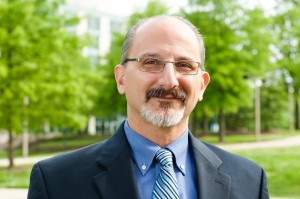
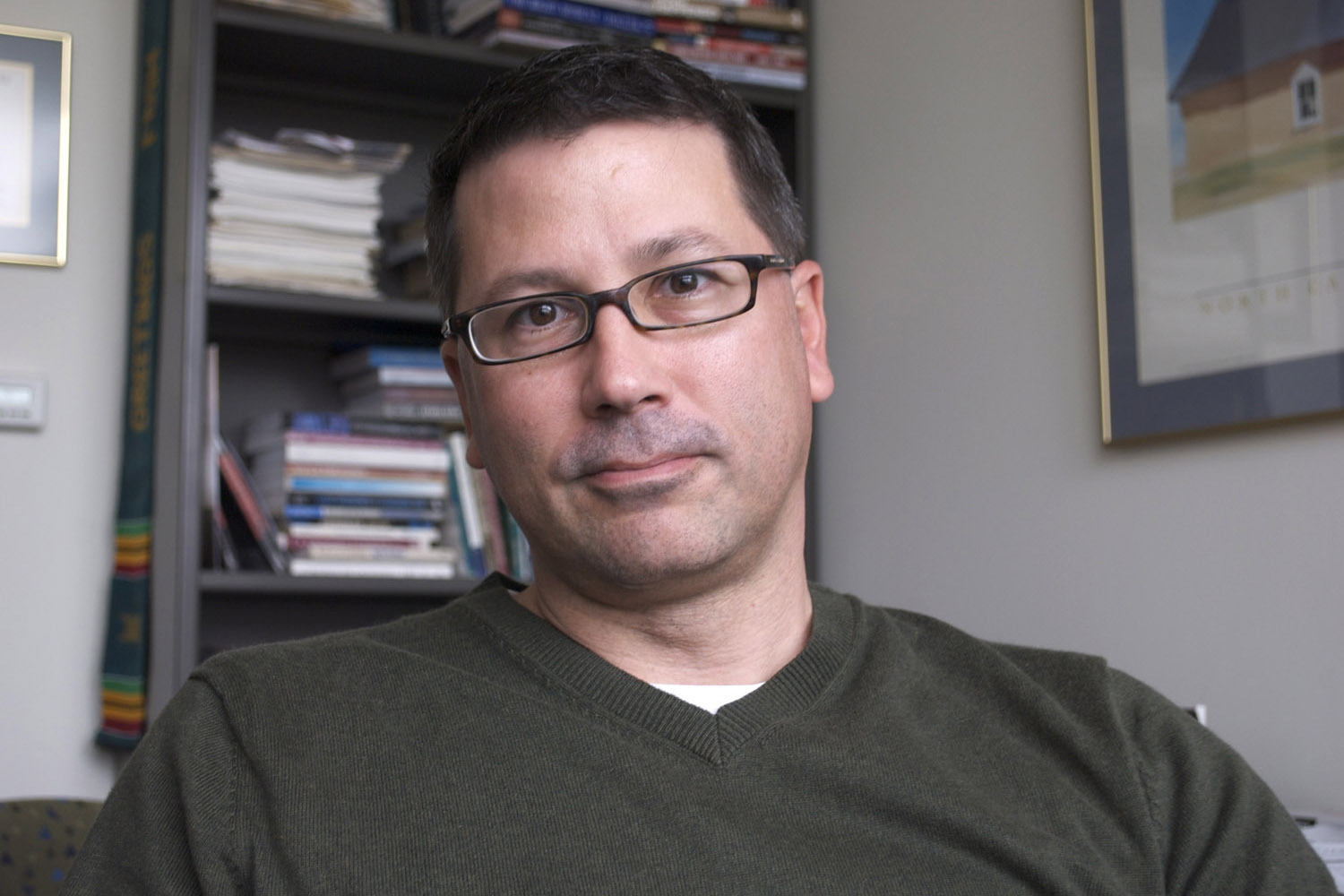
Curtis Menyuk recently received the The IEEE Photonics Society William Streifer Scientific Achievement Award. The award is given to recognize an exceptional single scientific contribution which has had a significant impact in the field of lasers and electro-optics in the past 10 years. The award is given for a relatively recent, single contribution, which has had a major impact on the Photonics Society research community. It may be given to an individual or a group for a single contribution of significant work in the field. Menyuk received the award, “For seminal advances in the fundamental understanding and mitigation of polarization effects in high-performance optical fiber communication systems.” 

Menyuk received the B.S. and M.S. degrees from MIT in 1976 and the Ph.D. from UCLA in 1981. He has worked as a research associate at the University of Maryland, College Park and at Science Applications International Corporation in McLean, VA. In 1986 he became an Associate Professor in the Department of Electrical Engineering at the University of Maryland Baltimore County, and he was the founding member of this department. In 1993, he was promoted to Professor. He was on partial leave from UMBC from Fall, 1996 until Fall, 2002. From 1996 – 2001, he worked part-time for the Department of Defense, co-directing the Optical Networking program at the DoD Laboratory for Telecommunications Sciences in Adelphi, MD from 1999 – 2001. In 2001 – 2002, he was Chief Scientist at PhotonEx Corporation. In 2008 – 2009, he was a JILA Visiting Fellow at the University of Colorado. For the last 25 years, his primary research area has been theoretical and computational studies of lasers, nonlinear optics, and fiber optic communications. He has authored or co-authored more than 230 archival journal publications as well as numerous other publications and presentations, and he is a co-inventor of 5 patents. He has also edited three books. The equations and algorithms that he and his research group at UMBC have developed to model optical fiber systems are used extensively in the telecommunications and photonics industry. He is a member of the Society for Industrial and Applied Mathematics. He is a fellow of the American Physical Society, the Optical Society of America, and the IEEE. He is a former UMBC Presidential Research Professor.

Alumni Perk: Insurance Program

M&A_LongTermCareIns_Red_1955

The Cost of Waiting: Consider Long Term Care Insurance Now

A major challenge of retirement planning is finding an affordable way to fund the potential need for extended care, whether in your own home or in a facility. Recent studies show that most Americans underestimate the cost of long term care, while 56% overestimate the cost of the insurance that would defray those very costs.² Delaying the purchase of LTC insurance can have dire consequences.

Nothing impacts policy pricing more than age and health, so the sooner you purchase coverage, the lower the base rate for the life of your policy. Life-altering events can occur at any age, leaving one with few options for LTC insurance. Delaying your decision, plus the impending disappearance of industry discounts, equate to what we call “the cost of waiting.” This means there’s never been a better time for both men and women to research their LTC options than right now.

No-risk LTC consultations are available to our graduates at no cost as part of the UMBC Alumni Insurance Program. Visit http://meyerandassoc.com/umbc/ltc to download a free “10-Point Checklist” and then schedule your risk-free consultation by phone.

Regardless of your present age and health, the longer you wait to start your planning, the more it will cost in the long run—assuming you can still qualify when you’re ready.

Editor’s note: Content provided by Meyer and Associates

image001

Learn more about our alumni perks and services.

UMBC: Striking Goldwater

Striking Goldwater

UMBC has its strongest showing ever in a prestigious scholarship program.

UMBC has a national reputation for the strength of its undergraduate research offerings. It creates a campus energy directed in pursuit of discovery that is contagious–even for freshman.

That energy attracted Michael Moubarek’s attention and inspired him to become involved in research almost three years ago, when he was a UMBC freshman. After hearing upperclassmen discuss their experiences and seeing flyers advertising research opportunities, Moubarek approached Charles Bieberich, a professor of biological sciences. He soon started working on prostate cancer research in Bieberich’s lab and continues to do so today. “There’s an atmosphere of research that just buzzes around here,” he says.

And that early start on discovering what research is about pays off. Moubarek ’15, biochemistry and molecular biology, and Akua Nimarko ’15, biological sciences and psychology, recently won prestigious 2014 Barry Goldwater Scholarships. Talmo Pereira ’15, bioinformatics and computational biology, received an honorable mention in the competition.

The Barry Goldwater Scholarship and Excellence in Education Program is the premier national scholarship for undergraduates in science, engineering and mathematics. It was established by Congress in 1986 to increase research capacity in the United States. The Goldwater Scholarship is intensely competitive. Fewer than 300 awardees are selected out of over 1,500 applicants, with a maximum of four winners allowed from each university.

All three UMBC students recognized by the Goldwater program this year credit their success to participation in hands-on research early in their college career. The lab experience they received at UMBC played a large role in their Goldwater applications.

“I’m so grateful for these opportunities at UMBC that have allowed me to apply for this scholarship,” says Nimarko.

Nimarko and Pereira were attracted to UMBC because of the Meyerhoff Scholars Program, which supports students who aspire to research careers. Nimarko has researched sensory neuroscience in the lab of Weihong Lin, an associate professor of biological sciences, while Pereira worked with Ivan Erill, an assistant professor of biological sciences, studying computational genomics.

“Every step of my college career has had many professors and mentors who were instrumental to my success, all of whom I am profoundly grateful for,” Pereira says.

The foundation in research they received at UMBC has been the springboard for all three students to pursue opportunities in renowned labs around the country.

Nimarko spent last summer at Columbia University researching proteins related to stress with Eric Kandel, a Nobel Prize winner who is also a professor of biochemistry and biophysics in Columbia’s College of Physicians and Surgeons. Pereira participated in the MIT Summer Research Program studying connectomics, a subfield of neuroscience, and he has extended his stay at MIT at the request of lead researcher Sebastian Seung, a professor of computational neuroscience. Moubarek continues to collaborate with Bieberich on work conducted at a Johns Hopkins University lab, and he has published research in the journal Cancer Cell.

Eight UMBC students have been recognized by Goldwater since 2008, and this year marks the second time that UMBC has had two winners in the same year. Previous winners include Carla Valenzuela ’10, biological sciences, who is studying to be an M.D. at Vanderbilt University; Geoffrey Clapp ’11, mathematics and computer science, who is pursuing a Ph.D. at the University of Maryland, College Park; Nathaniel Kim ’11, chemistry and political science, who is pursuing a Ph.D. at Columbia University; and Robert Wardlow II ’12, biochemistry and molecular biology, who is working on a M.D./Ph.D. at Johns Hopkins.

Simon Stacey, director of the Honors College and chair of UMBC’s Goldwater Selection Committee, hopes to increase UMBC’s participation in the scholarship program.

“We want to grow the number of people who express an interest and complete an application for the scholarship,” Stacey observes. “UMBC, with its strengths in the sciences, could easily have 15 students complete strong applications for Goldwater.”

(04/07/2014)

Thank You for Helping Our Students!

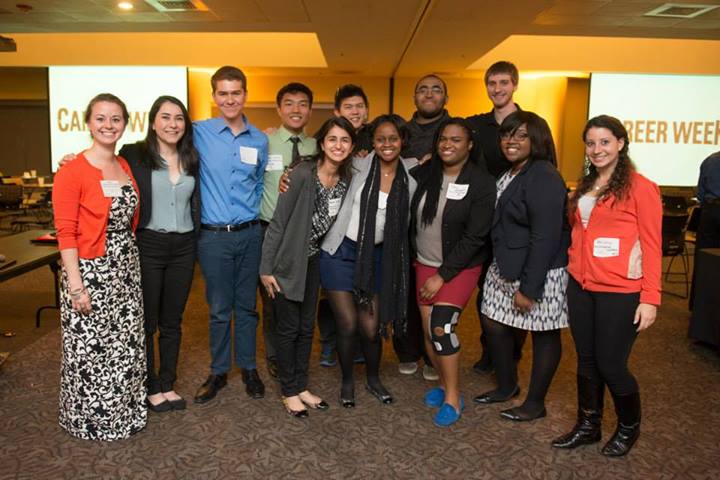
After a very successful Career Week that included the Clothing Closet and Sweeten Up Your Network events, we wanted to thank you for helping our students. Whether you volunteered your time or donated clothes, your support helps UMBC students succeed. So head on over to our other blog, Giving to UMBC, to see all the ways you help the UMBC community!

The Student Alumni Association (SAA) hosed a great networking event! (photo via SAA)

See more photos from Career Week.

Catalyst with Presenters Steve Bradley, Visual Arts, and Nicole King, AMST (4/28)

Bradley-kingCatalyst, the interdisciplinary lecture series, presented by CIRCA (UMBC’s Center for Innovation, Research and Creativity in the Arts), continues with Steve Bradley and Nicole King, Monday, April 28, beginning at 12 Noon in the Dresher Center Conference Room (PAHB 216).

UMBC associate professor Steve Bradley of Visual Arts and assistant professor Nicole King of American Studies will present their collaborative research Mapping Baybrook, an interdisciplinary exploration of place that uses digital mapping to illustrate research on the history and culture of an industrial community in Baltimore, Maryland referred to as Baybrook—a merging of the names of two neighborhoods, Brooklyn and Curtis Bay. The story of Greater Baybrook reflects the tenacity of a community striving for sustainability in the boom and bust of U. S. industrial development.

A catered lunch will be provided by CIRCA.

Learn more about this event and Mapping Baybrook at our Arts and Culture Calendar. Additional Catalyst events can be found at CIRCA’s website.

UMBC: Degree of Inspiration

Degree of Inspiration

Theatre alumni thrive in Baltimore.

With its many indie performances and off-beat exhibits, Baltimore is quickly becoming a city known for its art scene. Katie Kopajtic ’11, acting, is catching that process in real time in b.f.a. – an original web series featuring other recent UMBC graduates (many of whom were involved in the UMBC Theatre Department’s award-winning 2011 production of Las Meninas).

“We were inspired by local artists doing big things,” Kopajtic explains. “We wanted to show what’s going on in Baltimore’s art scene in a way that parallels real life.”

Indeed, shortly after the last episode of b.f.a.’s first season was released in January, cast members Katie, Dan Hileman ’12, acting, David Brasington ’12, acting, Jessie Poole ’13, acting, and Kiirstn Pagan ‘11, theatre, did their own big thing: creating a new Baltimore troupe called The Interrobang Theatre Company, which debuted its first production in March.

The video series produced by Kopajtic follows a group of friends as they try to navigate the acting world after graduation. (The friends even have their own theatre company, called “Stick People Theatre Company.”) The cast and crew filmed a pilot episode, but Kopajtic – who serves as writer, director, and also acts in the series – knew the homegrown project would need significant funding to continue to its conclusion.

“We had to think about what it would take to film an entire season,” she says. “Things like rentals and even post-production costs like editing—those add up fast.”

So the b.f.a. team launched a crowdfunding campaign on Indiegogo, eventually raising $7,000 toward a full series production budget of $10,000. Pagan, who served as the series’ marketing director, observes that the cast and crew were brought into the creative side of the project as the fundraising was ongoing.

“All of the cast members ended up being very involved in the writing process,” Pagan says. “We had multiple meetings over the summer to go over Katie’s scripts, where everyone was able to help mold the story, making it more interesting, funny, and compelling.”

After a June premiere of the pilot episode at Creative Alliance in Highlandtown, Kopajtic and her cast and crew were able to schedule the final round of filming on a reduced budget beginning in August.

“It was disappointing, but we came to terms with it,” says Kopajtic. “We learned to cut costs without cutting corners.”

The b.f.a. team found low-and-no-cost shooting locations (including Joe Squared and Ottobar) to stretch that budget, and they collaborated with Station North Arts and Entertainment and the Annex Theatre to use the set and lights at a new city arts space called The Chicken Box.

Sean McComas ‘11, acting, says the opportunity to stretch his skill set from theatre into film was an unexpected perk of his involvement in b.f.a.

“In theater, you are always following a character’s journey from start to finish,” McComas explains. “You may rehearse out of sequence, but in performance you actually go on a journey. In film, that is not the case.”

Filming wrapped in November, and the new episodes debuted online every two weeks through late fall. Kopajtic and the rest of her collaborators are planning a new season of the series, but she believes that b.f.a. is already achieving its goal: showcase Baltimore and the people who live and work there.

“b.f.a is a glimpse into the real lives of artists,” she says. “It shows people working hard, struggling to put themselves out there. That’s Baltimore. That’s what we do.”

Hileman says that the Baltimore connection was a big part of forming Interrobang. “I wanted to see more professional opportunities for young actors like myself in the Baltimore area,” she says. ‘[The series] is funny to me because when people think of moving somewhere to start their acting career, they don’t think of a city like Baltimore. But personally, I never had a desire to move anywhere else; I decided to make my own opportunities in a city that I love with talented people who deserve to be paid for their hard work.”

Pagan sees a synergy between the two projects. “I think the idea to start Interrobang came totally unrelated to b.f.a.,” she says, “but now that the two have become so intertwined, it is really interesting to see how one effects the other…. I’m on the writing team for Season Two of b.f.a. and I am constantly referring to things that happened to us at Interrobang as things that could possibly happen to Stick People on their journey to create not only a successful theatre company but dynamic, interesting art.”

– Laura Lefavor ’13 and Richard Byrne ’86

To watch b.f.a., go to bfatheseries.com.

Investigate The Interrobang Theatre Company at http://www.interrobangbaltimore.org/

(04/24/2014)

Helping Students, One Career Week at a Time

The UMBC community gives back in many ways. The Clothing Closet and Sweeten Up Your Network events were great examples of exactly that. Thanks to your donations of time, money and clothes, students were able to find outfits for future job interviews, brush up on their networking skills and make connections that could last a lifetime. Weren’t able to make it? Take a look at some of the pictures and head over to the Student Alumni Association Facebook page for more!

Some of the clothes donated by the UMBC community. (photo via SAA)

Another happy student finds an interview outfit! (photo via SAA)

UMBC SAA member Sheena was able to mix and match a few items to create a great outfit. (photo via SAA)


The Student Alumni Association hosted a great networking event! (photo via SAA)

Alumnus and UMBC staff member, Jeremiah Sawyer ’13, chats with a student about UMBC’s Career Services Center. (photo via SAA)


Ellen Handler Spitz, Honors College, Writes Essay in City Paper for National Library Week

For National Library Week, Honors College Professor Ellen Handler Spitz wrote an essay in City Paper that examines the value of borrowing books, especially children’s books, from the library.

“Feeling rebellious over our dizzying speed-mad era of e-books, e-readers, digital and virtual realities, I want to advocate for the practice of borrowing a good old-fashioned book from the library—especially now, during National Library Week. I want to remind everyone of the simple joy of settling down in a cozy nook, turning well-worn pages, and reading aloud to a child,” Spitz writes.

She discusses the value of reading children’s books of the past and maintaining links among generations, while also focusing on the importance of fostering imagination and creativity in young readers.

“With no slight intended but rather my sincere appreciation to the wonderful children’s book authors of today, I urge you to check out the classics of the past. Borrow them from your library. Share them with the children in your life.  Their quality rewards sustained attention—hushed, absorbed hours. Read alone or with an adult, they allow today’s children to slow down, to turn away from trivial distractions, and to expand inwardly in historic time, from generation to generation…”

To read the complete essay titled “Remembering Children’s Books of Yesteryear During National Library Week,” click here.

Constantine Vaporis, Asian Studies, Named Smithsonian Journeys Expert

Asian Studies Program Director Constantine Vaporis has been selected as a Smithsonian expert for tours of Japan. As a director, the Smithsonian Journeys program will periodically ask Vaporis to lead tours in Japan, with the first one set for 2015.

vaporis

Vaporis’s research focuses on the Edo period and he is interested in the entire range of Japanese history. He is author of Breaking Barriers: Travel and the State in Early Modern Japan; Tour of Duty: Samurai, Military Service in Edo and the Culture of Early Modern Japan; Nihonjin to sankin kôtai [The Japanese and Alternate Attendance]; and Voices of Early Modern Japan: Contemporary Accounts of Daily Life during the Age of the Shoguns.

You can learn more about the Smithsonian Journeys program and Vaporis’s tour expert selection by clicking here.

Laura Hussey, Political Science, on MarylandReporter.com

A Maryland Democratic gubernatorial candidate forum held at Towson University April 17 drew attention to college student participation in the upcoming election.

Laura Hussey

Laura Hussey, an assistant professor of political science, was interviewed for an article posted on MarylandReporter.com, and she noted interest groups and political parties tend to notice when candidates devote their time to appealing to younger voters – the generation that will serve as the future workforce behind their causes.

“The Obama campaign benefited from appealing to college students greatly,” Hussey said. “There are benefits beyond the actual votes.”

To read the full article  on MarylandReporter.com, click here.

Thomas Schaller, Political Science, Op-Ed in The Baltimore Sun

In an op-ed published in The Baltimore Sun on April 15, Political Science Professor Thomas Schaller writes about how the increased use of credit cards will likely lead to more consequences than fraud. In addition to loss of consumer privacy, Schaller writes relying exclusively on credit cards leads to another big cost: the burden of servicing credit debt.

Tom Schaller

“When big banks get over-leveraged, they turn to the government for bailouts. And guess what? So do individuals: Americans’ average credit card balance dropped after the financial crisis — which sounds like good news until you learn that the decrease resulted from millions of people simply defaulting on their debts,” Schaller wrote.

He added the banks holding debts have to make up for their losses, so “even if you diligently pay the full monthly balance on all your credit cards, indirectly you’re subsidizing not only Visa and MasterCard, but the banks covering their losses from credit card defaulters.”

To read the full column titled “Paper or plastic?” in The Baltimore Sun, click here.

Advancing Excellence: The Student Experience

Our UMBC: A Strategic Plan for Advancing Excellence is founded on a broadly inclusive process. With campus input, the Strategic Planning Steering Committee identified four areas widely viewed as drivers of future success for UMBC: The Student Experience, Innovative Curriculum and Pedagogy, Collective Impact in Research, Scholarship, and Creative Achievement, and Community and Extended Connection. A strategy group will explore and recommend goals for each area, and will recommend metrics to assess how well we are addressing our objectives.

This is the first in a series of interviews with the co-chairs of each focus area.

StrategicWebSeries01-9431The primary goal of The Student Experience Strategy Group is examining ways to create vibrant, exceptional and comprehensive undergraduate and graduate student experiences that integrate in- and out-of-classroom learning to prepare graduates for meaningful careers and civic and personal lives. Student Experience Strategy Group Co-Chairs Devin Hagerty, professor of political science and program director of global studies, and Kim Leisey, associate vice president of student affairs, believe that students continue to prioritize a strong sense of community and belonging, a theme that will help inform their work as co-chairs.

Both Hagerty and Leisey bring important perspectives to the Strategy Group research, which will examine the roles of safety, community and belonging; preparation in and out of the classroom; the impact of diversity; participation in global citizenship; delivery of services; and faculty and staff infrastructure.

While Hagerty’s focus is academics and Leisey’s is student affairs, the collaborative nature of the campus helps them to see the big picture and hear from all members of the community. As former chair and now program director, Hagerty’s work centers on the classroom experience, but he also has worked with students in a variety of settings, including bringing workshops into residence halls. “I’ve seen all of the student issues, both academic and personal, and the relationships I have across campus have been helpful to that experience,” he explains. On the other hand, although Leisey’s work focuses on both undergraduate and graduate students, she also works closely with faculty and staff across the campus.

As they begin their work as co-chairs, Hagerty and Leisey say they are reflecting on how the campus and the student experience have changed since they first came to UMBC 13 and 23 years ago, respectively. UMBC has grown into a nationally and internationally recognized institution, and an inclusive strategic planning process is critical to understanding the needs of its students and the role the university plays in a rapidly changing world. Both feel it is important to make sure students feel they are a part of a community, and are connected with and supported by the institution.

“I’ve worked with both undergraduate and graduate students and I get a lot of input from them,” says Leisey. “For me, co-chairing this group is an opportunity to share that input and focus on what we want UMBC to look like in the next few decades – what exists now and what’s missing. In doing that, we also have to project what’s ahead in the world and the impact that will have both in and out of the classroom.”

Hagerty agrees, sharing, “This also is a good opportunity to audit ourselves as we are proactive, creative and innovative in keeping up with the student body. There’s a lot we do well, and it’s good to take a fresh look to make sure we’re doing as well as we think. We try to excel at everything, and we want to stay on the map without losing the liberal arts teaching. We want to know how that feels for students: How do they interact with all of the different parts of the campus and what kind of experience do they have?”

UMBC is well known for its diversity. Leisey explains that one challenge is taking advantage of that diversity in helping people connect and provide experiences that help students learn about one another – and find commonalities among the differences. Hagerty adds that it is important to understand the student experience as a whole, and how it transforms and prepares students for the future. “The challenges students have now are preparing them to be global citizens and professionals.”

While the role of technology has grown exponentially, both feel that students may be missing more face-to-face connections. “I’d like to better understand the role of technology [in the student experience], but I have a hunch that, although this generation is connected technologically, they miss just being with people,” says Leisey.

Hagerty and Leisey would like to receive input on the student experience from students and colleagues across the campus, and look forward to meeting with focus groups during the strategic planning process. They also welcome questions and comments from the campus. You can contact them at dhagerty@umbc.edu and leisey@umbc.edu.