
All posts by: UMBC News Staff


The Mathematics of Being Human receives positive review in advance of production in New Delhi

Since it debuted at UMBC in November 2014, The Mathematics of Being Human has garnered strong praise and it has traveled to San Antonio, New York City, and Baltimore. Its latest review comes in advance of an independent production of the play in New Delhi in January.

Stephen Abbott, a professor of mathematics at Middlebury College, reviewed the play for the January notice of the American Mathematical Society. Praising it for building off of real life experiences to explore studying mathematics and the humanities, Abbott gave the production a positive review.

“Witty and lighthearted, The Mathematics of Being Human is at its core a heady piece that engages its audience’s minds without making any sustained attempt to engage its hearts,” Abbott wrote in the review.” He added: “So is this play an argument for or against interdisciplinary teaching? Like a good piece of art, The Mathematics of Being Human doesn’t make this obvious or absolute for its viewers.”

The play, written by Michele Osherow, an associate professor of English, and Manil Suri, a mathematics professor, is inspired by their experiences jointly teaching a freshman seminar that bridged their two areas of expertise. The production was a natural outgrowth of a popular Chronicle of Higher Education article series and it debuted at UMBC in November 2014. It was directed by Alan Kreizenbeck, an associate professor of theatre, and Savannah Jo Chamberlain ’16, theatre, and Chaz Atkinson ’16, theatre, portrayed students in the seminar.

The Mathematics of Being Human is scheduled to be performed as an independent production with a new cast at the American Center in New Delhi on January 14 and 15, 2016. A future production will take place at the University of Pittsburgh.

Read Stephen Abbott’s full review in the January American Mathematical Society notice.

Image: Mathematics of Being Human debuts at UMBC. Photo by Marlayna Demond ’11 for UMBC. 
Alternative Spring Break: The ARC of Carroll County

As we wrap up our spotlight on Alternative Spring Break, we’d like to talk about another trip that impacts our Maryland community. The ARC of Carroll County serves people with intellectual and developmental disabilities throughout their local area, providing resources for employment, education, transportation, and community living.
On this ASB trip, students will have the chance to work directly with the people the ARC supports, building bonds and breaking down stereotypes about disability. Your gift will  go towards supplies, food, lodging, and transportation for 12 students who are bound to remember this trip for the rest of their lives.
To donate to the ARC ASB trip, click here. To hear from the student leaders themselves, click the video below:

Alternative Spring Break: Public Health

This week, we’ve been focusing on UMBC’s Alternative Spring Break trips, which give students the chance to go out into the world, make a difference, and learn more about issues affecting society on their week off in March. Today, we’re shining a light on the Public Health trip.

Through this service-learning opportunity, students will learn about the Maryland through hands-on service projects in free clinics and health-focused nonprofit organizations throughout the city of Baltimore. This year’s trip, in particular, will focus on the issues of childhood obesity and food deserts in Baltimore.

As with the other trips we’ve featured this week, any financial contribution you might make is much appreciated, and will help cover the cost of supplies, lodging, food and transportation for 12 students. To give, head here. To hear straight from this year’s trip leaders about the positive impact of the Public Health trip, give this video a watch:

Alternative Spring Break: Homelessness in Baltimore

Here on the giving blog, we’ve been giving you an look at UMBC’s Alternative Spring Break programs, which give students a chance to participate in a service learning project over the March holiday. This next trip takes students right into the city of Baltimore, where, over the course of one year, at least 30,000 people will experience homelessness at one point.

Over their spring break, students will work on various projects throughout the city, and learn about how its homelessness problem intersects with poverty, crime, and other issues facing Baltimore. Your gift will go towards supplies, lodging, food, and transportation for 12 UMBC students.

To give to the Homelessness ASB trip, head to GiveCorps. To learn more about the trip from this year’s student co-leaders, take a look at this video:

The Hilltop Institute Senior Research Analyst Michael Abrams presents 2015 Shinogle Fellowship Lecture

On Friday, December 4, Hilltop Senior Research Analyst and UMBC Public Policy PhD candidate Michael T. Abrams, MPH, gave the 2015 Judith A. Shinogle Memorial Fellowship lecture at UMBC. Abrams discussed the research projects—spearheaded by Shinogle before her tragic death in 2012—that he and UMBC researchers are conducting to inform policy decisions about health care and treatment for adults with serious mental illness, and children with asthma. He also discussed his dissertation research, which focuses on the impact of news coverage on the dissemination of prescription drug warnings issued by the U.S. Food and Drug Administration.

Colleagues from Hilltop and UMBC’s School of Public Policy, faculty mentors, research partners, friends, and family members joined Abrams to celebrate his achievement. Abrams was selected by a faculty committee in recognition of his outstanding scholarship and research in health policy. At Hilltop, Abrams conducts quantitative and qualitative policy and health services research related to the brain and the behavioral health of Medicaid and other low-income populations.

The family of Dr. Judith Shinogle established the award in her memory to provide support for outstanding doctoral students committed to health policy research. Dr. Shinogle had a distinguished and productive career as a health policy analyst and researcher. At the time of her death, she was a senior research scientist with the UMBC Maryland Institute for Policy Analysis and Research and an adjunct faculty member of the School of Public Policy.

The complete 2015 Shinogle Fellowship Lecture can be viewed below.

Note: This article originally appeared on The Hilltop Institute website, written by Marsha Willis, senior policy analyst, The Hilltop Institute. 

Image: School of Public Policy Professor David Salkever, Michael Abrams, and School of Public Policy Professor and Director Donald Norris. Photo by Marsha Willis. 

Data from learning management systems help improve teaching, say UMBC experts

Systems that store and analyze data about how students are progressing through their coursework can be a powerful source of better decision-making in higher education. That’s the theme of a CampusTechnology.com article featuring a lengthy section on UMBC’s use of the Blackboard learning management and data-analysis system to promote student success.

At UMBC, Blackboard data about student performance are now “across all the colleges and all the key functional offices that are responsible for student success, so they’re all able to get the data they want,”  says Jack Suess, chief information officer and vice president of information technology. Among the findings on teaching and learning that have emerged from Blackboard data-crunching at UMBC are these:

  • students who get a D or an F use Blackboard almost 40 percent less than those who get higher grades
  • heavy Blackboard use among students helps flag innovative teaching
  • one way to improve student performance is through use of a Blackboard feature that lets instructors set preconditions for accessing course materials–passing a quiz, for example
  • differences in the way students perform in courses subsequent to a “gateway” course can help pinpoint teaching practices that are especially effective in that course.

John Fritz, UMBC’s assistant vice president of instructional technology and new media, is a fan of the third tier of learning management systems–the area that includes electronic portfolios and the preconditions for release of new material. That part of the system “sets up a structure for student responsibility and self-awareness” that puts the focus on what students are doing for themselves, a necessary complement to what institutions are doing for students, Fritz believes.

Experts from three universities, including Suess and Fritz, named several best practices for using data from a learning management system. One piece of advise is to drop the term “analytics” in favor of, for instance, the more accessible “intelligence.”

Another best practice, according to Fritz,  is to make initial research projects simple but rigorous.”Start small, where you’re following an unsure hypothesis,” advises Fritz. “Refine your method and bring rigor … then help disseminate those findings.”

Read the full article, “How Data From Your LMS Can Impact Student Success,” at CampusTechnology.com.

Image: Student in a UMBC cybersecurity course. Photo by Marlayna Demond ’11 for UMBC.

UMBC and U.S. Navy celebrate partnership establishing Maryland’s first NROTC unit

On Monday, November 30, 2015, Assistant Secretary of the U.S. Navy Dennis McGinn and U.S. Senator Barbara Mikulski joined President Freeman Hrabowski for a ceremony to formally celebrate the establishment at UMBC of Maryland’s first Naval Reserve Officers Training Corps (NROTC) program.

The program, which is part of the new Maryland NROTC consortium that includes the University of Maryland, College Park, provides an opportunity for students to earn a commission in the U.S. Navy or Marine Corps while completing their undergraduate degrees.

During the event, McGinn spoke highly of UMBC as an institution with exceptional leadership and innovative approaches to teaching and learning. Through this collaboration, the U.S. Navy will attract individuals from diverse backgrounds and talents to become the leaders of the future, he said.

Hrabowski commended the longstanding relationship between UMBC and the Navy, which began two decades ago through initial conversations about the potential for partnership. Many UMBC graduates already work for the Navy, and many more will do so through this program, said Hrabowski.

The NROTC program is currently accepting applications and naval science courses are expected to begin in fall 2016.

Hrabowski attributed the university’s strong partnership with the Navy to Sen. Mikulski, whose support has been instrumental in the growth of UMBC and its impact on the community, the state and the nation.

“We quite simply would not be here today without the leadership and support of Sen. Mikulski. She has been an amazing champion for the country, for Maryland, and for the work we are doing at UMBC,” said Hrabowski.

Sen. Mikulski receives Distinguished Public Service Award

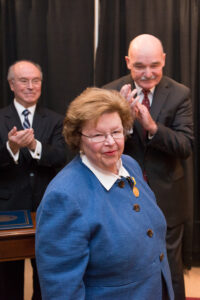
A highlight of the event came when the Secretary of the Navy recognized Sen. Mikulski with the Distinguished Public Service Award for her exceptional leadership in service to Maryland and the United States. The award came just days after Sen. Mikulski accepted the Presidential Medal of Freedom at the White House for accomplishments during her career as the longest serving woman in U.S. Congress.

Sen. Mikulski expressed her pride in witnessing the establishment of the NROTC at UMBC. By bringing the program to campus, she said, we open many new pathways for talented graduates from science, technology, and the arts to become the next leaders of our country.

“We are investing in the people of the future that will lead our Navy and our Marine Corps, and they will lead it with a tremendous background that starts right here [at UMBC],” said McGinn.

“There could be no better campus in the entire country to do this.”

Image: Senator Mikulski, Assistant Secretary of the U.S. Navy Dennis McGinn, and President Freeman Hrabowski sign the ceremonial proclamation. Photo by Marlayna Demond’ 11 for UMBC.

Donald Norris says metropolitan governance is unlikely for Baltimore region

Is metropolitan governance, or the sharing of power and authority by jurisdictions, a good idea for Baltimore City and its surrounding counties? It’s been a topic that has been proposed many times dating back to the 1930s, and it was most recently in the news following the unrest in Baltimore earlier this spring.

9781409421924.PPC_PPC TemplateDonald Norris, professor and director of the School of Public Policy, is author of the new book Metropolitan Governance in America, which examines the possibility of regional governance in the United States, attempts to establish metropolitan governance in the past, and the problems that have arisen due to the lack of adequate metropolitan governance. Norris, who has extensively researched public management issues, recently discussed his book and the prospects for regional government in Baltimore on the Baltimore Sun podcast Roughly Speaking with Dan Rodricks.

In a wide-ranging discussion, Norris discussed the history of the metropolitan governance debate and how metro government likely won’t happen in the Baltimore region, among other topics.

“It makes great sense theoretically. It doesn’t make any sense whatsoever when you look at the impediments to metropolitan government,” explained Norris. “Whether it’s Harford County or Howard County or Baltimore City…if we don’t live in the region, we don’t identify with the region. We identify with our neighborhoods and the jurisdiction that we pay our taxes to. We expect that jurisdiction and the officials that we elect in it will use those taxes wisely within the jurisdiction to provide services for us, not to spend that money on somebody somewhere else.”

Norris discussed how many people favor local governments, and those who oppose regional governments argue they are too far removed from the daily lives of citizens.

“It gets too big, it’s too remote, and it’s too bureaucratic,” said Norris. “You can’t achieve the kind of economies of scale that you thought you could achieve to begin with.”

Listen to the full podcast (interview begins at 23:00) on the Baltimore Sun website.

Image: Donald Norris speaks at UMBC’s 40th anniversary event for public policy. Photo by Marlayna Demond ’11 for UMBC.

UMBC expert describes the advantages of home-based care for chronically ill patients

A recent Journal of the American Geriatrics Society study found that home-based primary care increased patients’ satisfaction with care and lowered costs, hospitalization rates, and emergency room visits. Following up on the study, The Washington Post published an article that explored how many doctors are now pushing for house calls to bring care to chronically ill patients.

Judah Ronch, dean of the Erickson School, was quoted in the article and outlined the various advantages of home-based care. “If they’re at home, they’re in an environment that can expedite healing, for example, more natural light,” said Ronch, a nationally renowned expert on improving the treatment and mental well-being of elders. Being at home also helps patients see themselves as “not a sick person,” he said.

Not all primary care facilities would qualify for home-based care due to specialized skills and the need to employ and partner with nurse practitioners and social workers. But Ronch also described how health care can be effective, even in the absence of a facility such as a hospital or nursing home.

“Many old people in hospitals don’t need to be there,” he said. “It’s not about serving the needs of the institution, but serving the needs of the people. It’s the idea that we can deconstruct the health-care system and reconstruct it to serve the patient in a way that’s fiscally and medically better.”

Read “Doctors prescribe old-fashioned house calls when treating the old and frail” in the Washington Post. Read more about Ronch’s research on the Erickson School website.

Image: Erickson School Dean Judah Ronch speaks at an event at UMBC. Photo by Marlayna Demond’ 11 for UMBC.

UMBC named a top Baltimore workplace for 2015

For the third consecutive year, the Baltimore Sun has named UMBC as one of the region’s top places to work. UMBC was the only government agency and the only university to rank among the top 100 workplaces in three size bands. With about 1900 employees, UMBC is considered a large employer.

Baltimore Sun Top Workplaces Logo

Organizations were ranked within bands by their scores on a confidential employee survey that measured job satisfaction, organizational health, and engagement. Organizations were invited to participate in part based the nomination of an employee. In all, 172 companies participated, and approximately 22,500 employees out of about 37,300 employees in those organizations responded.

UMBC has also appeared six years in a row on the Chronicle of Higher Education‘s top academic workplace list, including this summer.

Image: True Grit statue near the UMBC Administration Building. Photo by Marlayna Demond ’11 for UMBC.

Alternative Spring Break 2016: Gesundheit! Institute

ASB2016

As we near the end of the calendar year, we’d like to remind our community of the many places their gifts might go this holiday season. This week, we’ll be focusing on next year’s Alternative Spring Break trips. These provide a wonderful opportunity for students to spend their week off doing good for the communities and gaining a new understanding of the world.

One of these trips will take students to Patch Adams’ Gesundheit! Institute. They’ll interact with patients, help maintain the grounds, and learn about Adams’ humanistic model of health care and the Institute’s approach to social justice. In past years on this trip, students have visited veterans’ hospitals and retirement homes in the area, tended to organic gardens, and kept the Institute’s rural West Virginia campus clean and bright.

Your donation will go towards the cost of supplies, lodging, food, and transportation for 12 students over the upcoming spring break. To give to the Gesundheit! trip, head to the GiveCorps site. For more from the students themselves, take a look at this video!


Roundup: UMBC in the News

One of the things that makes UMBC great is how wonderful our alumni, students, faculty, and staff are. Because of these amazing people, UMBC often finds itself “in the news,” so each week, we’ll be sharing with you a round-up of the most newsworthy achievements from our community.

  • Kimberly Moffitt, American studies, appeared on WEAA-FM’s The Marc Steiner Show on Monday to discuss the Freddie Gray case, Maryland political happenings, and the recent shooting at a Planned Parenthood location in Colorado.
  • Ellen Hemmerly, bwtech@UMBC, penned an op-ed for the Baltimore Sun on the city’s future as a cybersecurity hub, citing its proximity to the federal government and to defense and intelligence contractors, its preponderance of cybersecurity firms, and its potential to attract even more startups in the coming years.
  • Christopher Shuman, Joint Center for Earth Systems Technology, confirmed findings from NASA’s Operation IceBridge that both the north and south polar ice caps have decreased dramatically in height, saying this is “not at all surprising given what we have observed with other sensors.”
  • Jason Loviglio, media & communication studies, called for more diversity in the podcasting world after attending the 2015 Podcast Movement in Texas earlier this year.

For more on these stories, and for even more UMBC updates, head to our brand-new news website!