All posts by: Magazine Editor


Career Q&A: Chris Adams ’15, economics

Every so often, we chat with an alum about what they do and how they got there. Today’s guest, investment banker Chris Adams ‘15, economics, is putting his interests in business and sports to work with his new venture, SharpRank. We caught up with Adams, who recently appeared on an “Inside Scoop Panel” offered by the UMBC Career Center, to learn more about the world of cross-sport performance ranking.

NAME: Chris Adams
MAJOR: Economics
GRAD YEAR: 2015

Q: Tell us a little about SharpRank. How did you get interested in this type of work?

A:  There is always opportunity that comes out of difficult times.  My business partners and I saw such opportunity in the emerging, ever-evolving landscape of sports betting. While listening to sports radio and podcasts, we would hear experts (or “Sharps”) claim to have incredible records at picking games successfully.  We started thinking the general public is largely held in the dark with respect to this industry (sports betting); experts are self-proclaimed.  Attributes of efficient markets are transparency and “full information,” and this particular industry was seemingly lacking both.  While the sports world was completely shut down for six months we went to work creating an algorithm that incorporates metrics like accuracy, consistency, longevity, etc., to produce a “Madden” type ratings system to rate these “Sharps” that is both easy to understand and effective at performance ranking, The scores are normalized so the public can compare “Sharps” who focus on different sports on a level playing field; much like Morningstar does for funds and other securities.  SharpRank was created to provide transparency for the general public in a traditional murky market.  The sports gambling industry is booming and our team operates under the premise that “when there is a gold rush, don’t go digging, sell shovels.”  Because of this we are now a part of the ecosystem and constantly growing/evolving.  

Q:  Were there any classes or professors at UMBC who really helped you or inspired you along the way? 

A:  I came to UMBC somewhat non-traditionally. I had helped start a business after high school and so upon entering UMBC, I knew exactly what I wanted to learn and study and where to focus my attention: statistics, game theory, economic theory, etc.  Having said that, I was fortunate enough to expand my horizons and take the “What is an American” class with Professor [Kimberly] Moffitt, who challenged my views and stances.  She has proven to be an incredible friend and sounding board to this day – despite still not agreeing on Disney’s values. Additionally, my independent project with Professor [R. Scott] Farrow on two-sided markets helped build the framework for the platform we use at SharpRank.  Dr. [Freeman] Hrabowski has been and continues to be one of the most influential leaders I have had the privilege of interacting with. He took the time to meet with me in person multiple times during my time at UMBC and remains a strong support and influencer.    

Q: What’s the toughest lesson you’ve learned along the way as a new entrepreneur? 

A:  Time management and delegation.  Over the past two years I have gotten engaged and married.  Last year, my wife and I bought our first home and this January we are expecting our first child! Academically I completed my MBA at UVA Darden School of Business and professionally, I work with an incredible team in investment banking full time, at Evergreen Advisors Capital.  In the off hours (between 11 p.m. and 3 a.m.) we founded SharpRank.  Needless to say, time management is a skill that I have sharpened over the past few years so that I am able to participate in all the activities that I am passionate about.  Additionally, I cannot be good at everything, and that is okay.  Delegation is difficult but necessary when time is the constraint.  At SharpRank we have built a team that allows each of us to focus on our strengths and delegate our weaknesses.  The team is incredibly diverse in background and skill set – ranging from Top Gun instructor to financial planner and everything in between.  Our advisory board consists of 7 team members with experience in legal, start-ups, funding, etc. We lean on them for guidance in areas our team is not as familiar.  What we have found is, time management and delegation are functions of effective communication, efficiency, and trust. 

Q: What advice would you give a current UMBC student interested in starting their own business? 

A:  Just do it! Find a passion and chase it down.  Belief in the mission and passion are critical.  Seventy percent of businesses fail within the first year, but the devil is in the details with statistics and in this case, be the minority.  Be the example for the next generation of entrepreneurs to turn to and when that time comes openly accept that invitation to help.  Harbor an environment of supporters/team members who have aligned values and will ask the tough questions. If it does not work, the photo negative is as important as the end photo; SharpRank is not the first idea my partners and I have attempted.  View challenges as opportunities and do not let perfection get in the way of progress.  Action, action, action. If you are interested in learning more or are interested in joining the team please reach out, info@sharprank.com. We are always looking for talent. 

Header photo courtesy of Adams.

Learn more about other entrepreneurial alumni by using the UMBC Alumni Business Directory.
Read more Career Q&A stories here.

Proposed Student Visa Policy Could Hinder US Competitiveness

By David L. Di Maria, associate vice provost, International Education, UMBC

In an effort to crack down on international students and scholars who overstay their visas, the Trump administration is seeking to implement a new set of rules that would make it more difficult for them to remain in the U.S.

Among other things, the proposed rules would require students and scholars from certain countries to leave within either two or four years. This would be irrespective of whether or not they’ve completed their degrees and research. Only those who could prove a “compelling” reason to stay longer would be allowed to do so.

But the rule, which has already drawn more than 20,000 comments from the public, comes with a steep price tag. It would also undermine America’s interest in attracting talent from abroad and, ironically, it would do little to actually curtail the problem of visa overstays that it purports to solve. That is my analysis as a higher education administrator who specializes in international education.

Time limits

The Department of Homeland Security’s proposed tighter restrictions are outlined in a 256-page document.

Which of the two new proposed maximum time limits – two or four years – would apply would depend on various criteria. Currently, these students and scholars are admitted for “duration of status,” which means they may stay for as long as their academic endeavors require, as long as they follow the terms of their visa.

Things that would subject a student or scholar to a two-year cap include being from certain countries, pursuing particular courses of study and whether or not their university fully participates in E-Verify, a web-based federal document verification system.

There are other changes as well.

For instance, students will have 30 days – half the time currently allotted – to leave the country after completing their academic program. Any petitions for extensions of stay would need to be approved by U.S. Citizenship and Immigration Services. Certain activities, such as participating in off-campus internships, would be prohibited while this paperwork was pending.

This new process also would require students and scholars to pay US$455 in new filing fees.

Enough time?

Federal data show it takes four years and four months, on average, to complete a bachelor’s degree. In fact, only 44% of first-time, full-time students attending a four-year institution in 2012 completed a bachelor’s degree within four years. For international students, 52% graduate within four years. That means nearly half of all international students take more than four years to finish college.

There are many reasons students often require more than four years to graduate. Those reasons could range from pursuing more than one major to being involved in extracurricular activities or having family obligations.

For graduate students, it could be that the research they are doing has been delayed for some reason. In fact, the National Science Foundation reports that it takes an average of five years and 10 months to complete a doctorate.

The uncertainty over whether or not a degree could be completed within the time limits set by the proposed rule would further weaken the ability of the U.S. to attract global academic talent.

Visa overstays by the numbers

The proposed rule builds upon the Trump administration’s more than 400 attempts to reshape the U.S. immigration system through executive actions.

While a key argument used to justify the proposed changes is that people who overstay visas may endanger national security, the government estimates that just 1.52% of all international students and exchange visitors overstay. The actual rate may be even lower given that the government overestimates overstays because of a lack of capacity to properly record departures.

Close tabs

International students and scholars are very closely tracked by their colleges and universities. While the proposed rule would add additional caseloads to an already overwhelmed government agency and a paper-based immigration system that the Department of Homeland Security itself describes as “outdated,” it may do little to prevent overstays. On the contrary, I believe the new rule may force some students to make the impossible choice between committing an overstay and abandoning their educational dream.

In June, U.S. Citizenship and Immigration Services announced that it faced a $1.2 billion shortfall. Over the next decade, DHS estimates the cost to implement the new rule will be as high as $2 billion. While filing fees for extension requests will help USCIS increase revenue, research shows that estimates for costs of compliance with a new regulation are often incomplete.

DHS predicts the higher education sector will lose $93 million during the first year of the rule and roughly $30 million each year thereafter because of staff time spent on training, implementation and supporting petitions for longer stays.

Other federal and state agencies, such as divisions of motor vehicles, as well as employers needing to reverify employment eligibility on a more regular basis, will face similar burdens.

In the end, I believe the economy will lose billions should the new restrictions further accelerate the decline in international enrollment.

Implications for U.S. competitiveness

Global competition in science and technology is increasing.

Consider the rise of other nations in critical areas such as artificial intelligence, quantum computing and synthetic biology.

This has serious implications for economic and national security. Specifically, the most scientifically and technologically advanced nations tend to dominate global market share in innovative industries, as measured by leading companies, exports and foreign direct investments. They also have the most advanced military capabilities, ranging from autonomous unmanned vehicles to hypersonic and directed-energy weapons.

Additionally, some nations are using the current political climate to lure foreign talent away from the U.S.

The role of international students

International students play a critical role in helping the nation excel in science and technology.

Their enrollment helps universities continue to offer STEM majors and graduate programs. These majors and programs benefit U.S. students and employers.

Consider that 1 in 3 people with science and engineering jobs in the U.S. were born in another country. This includes more than half of all biomedical researchers and nearly a quarter of pharmaceutical manufacturing industry employees.

While many international students leave the country after earning their degree, those who choose to stay provide a source of high-skilled talent that ensures our country remains globally competitive in science and technology.

*****

David L. Di Maria, Associate Vice Provost for International Education, University of Maryland, Baltimore County

Header image: The proposed policy mainly targets students from the Middle East and African nations. Brothers91/E+ via Getty Images Plus

[Deep knowledge, daily.Sign up for The Conversation’s newsletter.]

This article is republished from The Conversation under a Creative Commons license. Read the original article.

Amy Coney Barrett May Be the Next Woman on the Supreme Court – but Does a Nominee’s Gender Matter?

By Susan M. Sterett, professor, Public Policy UMBC

President Donald Trump has so far appointed fewer women as federal judges than any president since Ronald Reagan. In the Senate confirmation hearings now underway for Amy Coney Barrett, Republic senators have repeatedly pointed out that the president is appointing a woman to the Supreme Court.

I am a scholar of the politics of courts who has studied the demand for greater gender and ethnic diversity on courts around the world. Research shows gender diversity in the judiciary matters – but not because women and men necessarily judge differently.

Women on the bench

Jimmy Carter was the first president to take gender diversity in the courts seriously. The federal bench was “almost entirely male and white” when Carter entered office in 1977, according to professors Rorie Solberg and Eric N. Waltenberg. In his four years as president, Carter appointed women to more than 15% of the available federal district court positions.

Reagan appointed far fewer women by percentage to the federal courts than Carter – just 10% of his nominees between 1981 and 1989 were women – but answered concerns about that by putting the first woman on the United States Supreme Court, appointing Sandra Day O’Connor in 1981.

Later presidents went on to appoint more women to the judiciary, including the Supreme Court. Presidents Clinton and Obama appointed a greater percentage of women to federal courts than either President George H.W. Bush or George W. Bush.

https://datawrapper.dwcdn.net/Rkyj6/2/

For years now, political scientists have looked at judges’ rulings to see if they can identify differences in outcomes based on their gender, particularly in the lower courts, which hear more cases than the Supreme Court.

But women do not all agree on legal issues any more than men do. What differences researchers have found – for example in how judges handle immigration cases – can be explained by work experience. If women more often entered immigration courts after first working as immigration lawyers while men more often started as prosecutors, that could account for what appear to be gender-based differences.

Both men and women both learn from their lives, including in ways that will affect how they judge. When people ask about gender and judges, many have women in mind. But men also have life experiences that contribute to how they judge. Untangling gender or race from work, life and education experience – and from the political party of the president who appointed them – is messy.

Antonin Scalia served both President Richard Nixon and President Gerald Ford before he became a Supreme Court justice, an experience most analysts argue shaped his legal interpretations about executive power. But Scalia wouldn’t have had that experience if he weren’t a man. So did his judgment reflect his experience or his gender?

The case for diversity

No matter how you answer that question, diversity of life experience is one reason gender representation on the bench matters.

Here’s another: Not seeing women in leadership roles feeds beliefs that women do not belong in leadership roles. And exemplars – such as the only woman in a high-level position – are vulnerable to harsh judgments that arise from discriminatory beliefs based on their gender.

These biased expectations are very difficult to change.

As more women hold positions in fields dominated by men, like the law, however, it becomes more difficult to believe that all women are essentially the same and easier to assess them based on their work. Furthermore, research shows teams of people with more diverse life experiences often come up with more ways to address a problem.

Employing women equally in political positions, including on courts, is also a critical aspect of women’s hard-won equality. Gender diversity is one result of increasing expectations that politics and law not discriminate based on sex – an achievement Ruth Bader Ginsburg helped secure.

That right, explicitly, does not hinge on gender-based differences in behavior. Women can and do vote however they choose because they are equal citizens. They can and do serve on juries, just as men do, without giving a reason for why they should.

Four women – Justices Sandra Day O’Connor, Ruth Bader Ginsburg, Sonia Sotomayor and Elena Kagan – have now served on the small, slow-to-change Supreme Court, each with their different way of interpreting the law. So Americans are free to assess, and even disagree with, the legal interpretation of a Supreme Court nominee like Judge Barrett without feeling they’re simultaneously judging all women.

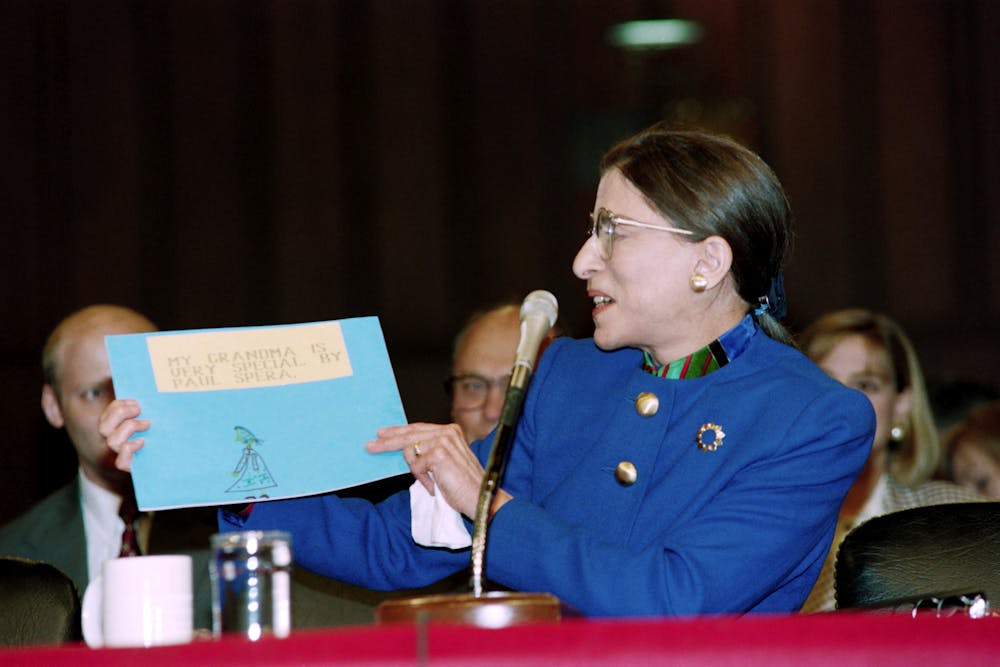
Ginsburg holds up a blue piece of paper with a child's drawing reading, 'My grandma is very special' written on it
Ginsburg shows off a drawing made by her grandson at her Senate confirmation hearing in 1993. Jennifer Law/AFP via Getty Images

Justice Ginsburg and Judge Barrett

Barrett and Ginsburg could not be more different.

Justice Ginsburg began her career advocating for gender equality with the American Civil Liberties Union’s Women’s Rights Project, a project she organized. Over her many decades on the bench she became a feminist icon, inspiring movies and a children’s book.

Judge Barrett, in contrast, has been a judge since only 2017, making it difficult to assess her legal interpretation. But she is backed by the leading conservative advocacy group, the Federalist Society, which the Trump administration relies upon to identify judicial nominees. The Federalist Society is pro-guns, anti-abortion and anti-business regulation.

As a law professor, Barrett wrote articles that give clues to how she might judge. She has criticized the Supreme Court’s decision upholding part of the Affordable Care Act, for example. And some abortion advocates cite her writing on how to weigh legal precedent to argue she would be willing to overturn earlier court decisions that protect reproductive rights.

These big differences between Justice Ginsburg and Judge Barrett – not simply their shared gender – would characterize Barrett’s work on the Supreme Court.

*****

Susan M. Sterett, Professor of Public Policy, University of Maryland, Baltimore County

Header image: Trump with 7th U.S. Circuit Judge Amy Coney Barrett and her family Sept. 26 at the White House. Chip Somodevilla/Getty Images

This article is republished from The Conversation under a Creative Commons license. Read the original article.

[Like what you’ve read? Want more?Sign up for The Conversation’s daily newsletter.]

Repatriating the archives: Lumbee scholars find their people and bring them home

By Ashley Minner, professor of the practice, American studies, UMBC, and Jessica R. Locklear, University of North Carolina at Chapel Hill

Following World War II, thousands of Lumbee Indians migrated from their tribal homeland in rural North Carolina to industrialized cities, including Baltimore and Philadelphia.

Seeking work and a better quality of life, they formed distinct Lumbee communities. They brought their foods – cornbread, collards, pastry. They brought their singing and strong work ethic. They became business owners. They founded churches and urban Indian Centers.

Their lives and contributions became part of the historical record and cultural landscapes of these places, but over time, a complex set of factors have resulted in the movement and displacement of the people themselves.

We are Lumbee scholars Ashley Minner from Baltimore and Jessica Locklear from Philadelphia. We have mined local archives in search of our forebears. We’ve found news articles, photographs, maps and even video footage documenting relatives and friends who often have no idea they are represented in collections.

As safeguarders of history, institutional archives necessarily have rules in place to govern access to their collections. Many of the materials are also subject to copyright, and the rights are owned by the creators of the materials or their employers. In other words, a photographer or the company the photographer was working for would own the rights to a specific photograph.

Faced with restrictions as to how the memories we found can be accessed and shared, we ask: Who has the right to the archives? What are our obligations both as tribal citizens and public-facing researchers when we find “our people” in them?

Ashley Minner, Baltimore

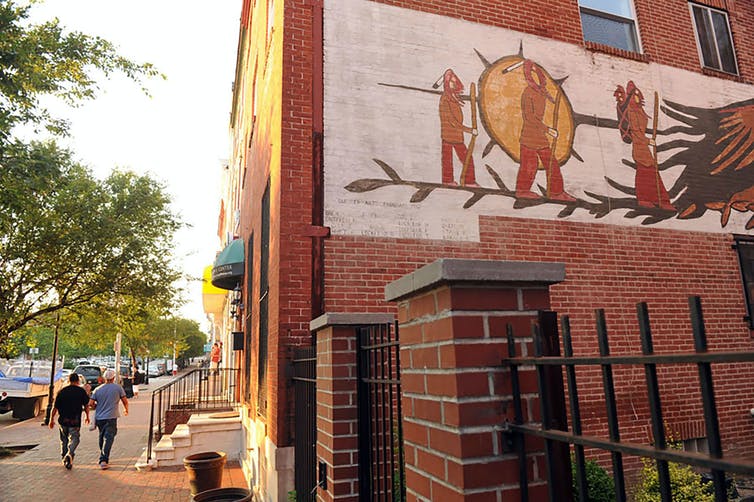
When Lumbee Indians moved to Baltimore, they settled in an area on the east side of town bridging the neighborhoods of Washington Hill and Upper Fells Point. The blocks of brick row houses with marble steps looked nothing like the rural home they left behind, but as other ethnic communities had done before them, they made this place their own.

In 2018, I hit the archives in earnest, anxious to corroborate stories shared by my elders about “the reservation” they had formed there in their youth.

They described a landscape intimately familiar to me, where places I grew up – the Baltimore American Indian Center and South Broadway Baptist Church – are still open and operating. But their stories were filled with names of businesses and people I didn’t know because this area has been continually transformed since then.

View of South Broadway from the Baltimore American Indian Center. Photo by Colby Ware for OSI Baltimore, 2014

One of the first and richest sources of documentation I found was the Baltimore News American newspaper photo archive. There were forgotten images of community leaders, legends and even relatives.

My immediate impulse was to share the photos via social media so our people could enjoy them as well. To share them legally, I needed permission from the Hearst Corporation, which owns the copyright, which I eventually got, months later.

In the meantime, I ran into Hannah Locklear, another Lumbee woman from Baltimore. She cried happy tears when I showed her one of the archival images I had saved on my phone. There was her great-grandma, Margie Chavis, young, standing on the stoop of the Baltimore American Indian Center. Along with our memories, images from archives like these are sometimes all that remain.

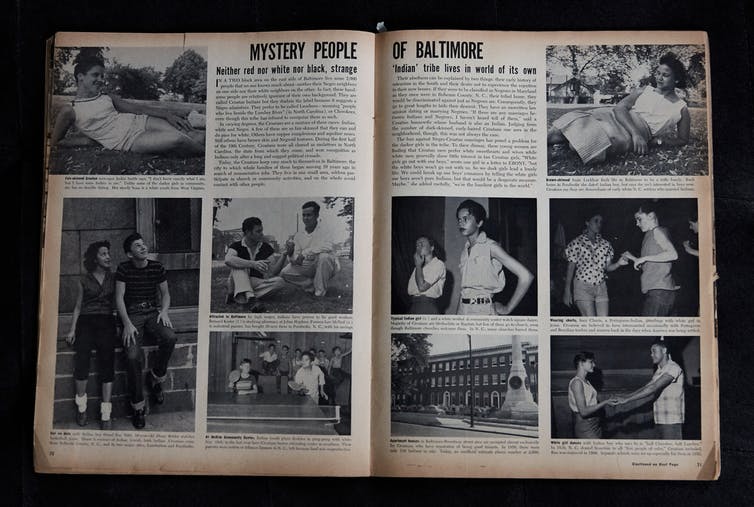
A fellow researcher alerted me to a September 1957 Ebony magazine article – “Mystery People of Baltimore: Neither red, nor black, nor white. Strange ‘Indian’ tribe lives in world of its own.”

A grainy print copy is available at Baltimore’s Enoch Pratt Free Library. I noticed right away that one of the featured photos – taken at a youth social dance and captioned “Typical Indian girl” – was my Aunt Jeanette. Just 14 years old, she was neither interviewed nor told how her photo would be used.

With great celebration, the Ebony and Jet Magazine photo archives were recently donated to the National Museum of African American History and Culture and the Getty Research Institute so they would be “widely accessible to researchers, scholars and the public.” But those archives aren’t publicly available yet.

Incredibly, a copy of the magazine itself was listed in the collections of a London prop shop. I bought it and brought it home to Aunt Jeanette.

She carefully opened the yellowed, oversized magazine and delightedly found a teenage version of herself inside, along with photos of other Lumbee young people, new on the Baltimore scene, playing at youth centers, sitting on stoops, lounging in Patterson Park.

‘Mystery People of Baltimore’ spread, Ebony, 1957. Photo by Sean Scheidt ’05, visual arts

Despite the hurtful context of the article, Ebony managed to capture a special time for our community. These are some of the only images we have of “the reservation” in its heyday.

Unfortunately, they are available only to those who can wait an indeterminate period of time until they’re made publicly available, and then navigate the bureaucracy of the institution where they’re housed.

Jessica Locklear, Philadelphia

Unlike Baltimore, there was no “reservation” in Philadelphia. Here, Lumbees settled in pockets across the city, yet found ways to forge a sense of community. When I started my research, I doubted there would be evidence of Philadelphia’s Lumbee community in any archives. I was wrong.

While searching the archives of the Philadelphia Inquirer newspaper, I found a story about a Lumbee man named Thessely Campbell who was set to star in a 1984 PBS documentary. Campbell moved from Fairmont, North Carolina, to Philadelphia in 1952 and found employment as a welder at the Budd Company.

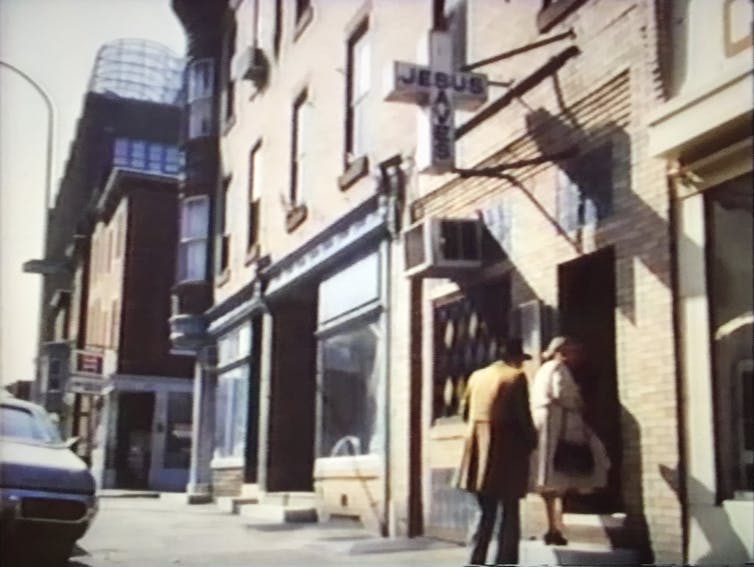
Obtaining a copy of this documentary was a lengthy process. The closest available copy was at a university library over 320 miles away. “The Work I’ve Done” focuses on Campbell’s retirement, but also documents Philadelphia’s Lumbee community, including footage shot inside the Native American Freewill Baptist Church, where Campbell was a minister.

Screenshot showing the Native American Freewill Baptist Church, where Campbell was a minister. ‘The Work I’ve Done.’ Blue Ridge Mountain Films, Directed by Kenneth Fink, 1984.

In 2019, I conducted an oral history interview with Campbell’s wife, Helen. She wanted a DVD copy of the film to keep and share with family. It was at this moment I asked: What is my obligation to pass along material that is available to me, as a scholar, to those who may not be able to access it otherwise?

I felt strongly a copy of this film belonged in the hands of the family represented in it. Asserting a claim of fair use, I made Ms. Helen a copy, and I’m glad I did – she passed away a few months later.

More recently, I stumbled upon a digital copy of the documentary made available by the Internet Archive, a nonprofit dedicated to universal access of archival materials. However, “accessible” does not always mean findable.

In sifting through various archival records, I occasionally find photos of familiar faces, which I try to share with those individuals or families. Most people are tickled to find they are in the archives, and most enjoy being able to view and share images they would not have found themselves.

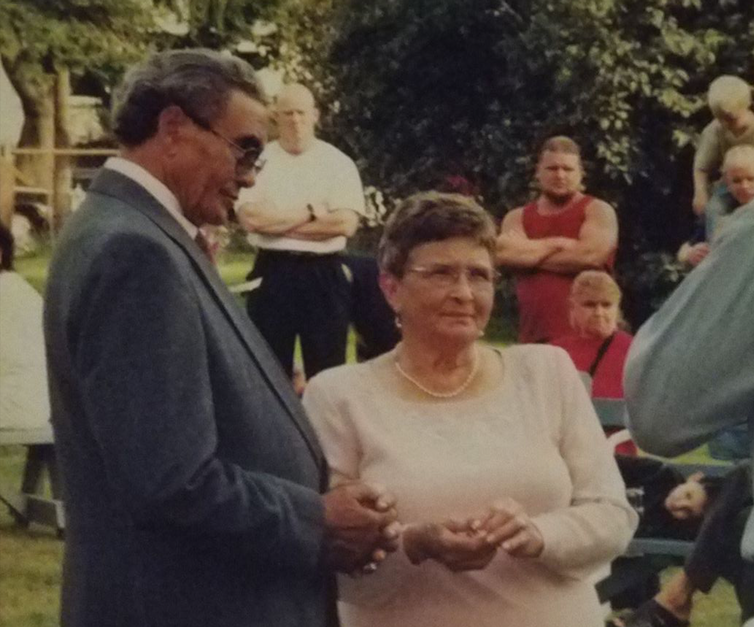
Rev. Thessely Campbell and Helen Campbell. Photo courtesy of Maria Luisa Rios.

Accountability in two directions

The renowned Lumbee scholar Malinda Maynor Lowery writes of being “bound by two sets of ethics that overlap heavily: A Lumbee’s obligation demands accountability to the people who have lived history, and a historian’s responsibility demands accountability to the widest possible sources.”

As tribal citizens and scholars doing public-facing work, we consider ourselves similarly bound. We search for “our people” far and wide. When we find them in archives, we feel obligated to bring them home to their families.

Knowing our people will not access archives as we do, through libraries, universities and museum collections, we meet them where they are – in their homes, out in the world, and on social media.

Repatriating the archives isn’t always about removing materials from institutional care. It’s making sure the people whose lives and cultures are represented in collections know they are there, and ensuring they have the ability to view and share these materials as they see fit. When materials are returned to their communities of origin, they become reactivated.

If we have the ability to give a woman – or a whole community – the opportunity to disarm a hurtful encounter of their youth, and to allow public affirmation of their beauty and true history, we will. If we can return a walking, talking, preaching, singing father, husband and minister to his people, we will.

We are dedicated to sharing the rich histories of former Lumbee neighborhoods with present generations. Bringing archival materials directly to our people presents opportunities to interact with our shared past – and that informs our future.

Ashley Minner, Professor of the Practice, Department of American Studies, University of Maryland, Baltimore County and Jessica R. Locklear, Ph.D. Student in History, University of North Carolina at Chapel Hill

This article is republished from The Conversation under a Creative Commons license. Read the original article.

Header Image: Jeanette W. Jones holds the September 1957 issue of Ebony magazine, which features the article ‘Mystery People of Baltimore: Neither red, nor black, nor white. Strange ‘Indian’ tribe lives in world of its own.’ She is pictured at center, with her hand on her hip. Photo by Sean Scheidt ’05, visual arts

Teaching Kids to Read During the Coronavirus Pandemic: 5 Questions Answered

By Keisha McIntosh Allen, assistant professor, Education, UMBC, and Kindel Turner Nash, associate professor, Early Childhood Education, UMBC

Keisha Allen and Kindel Nash research how kids learn to read and prepare future teachers at the University of Maryland Baltimore County. They are also raising children of their own. Here, they answer five questions many families and teachers may have about what they are seeing with virtual learning for early childhood education.

1. How do most kids learn to read?

Nash: Long before they enter kindergarten, most kids can “read” the words they encounter in their favorite books or around their home, on street signs and anywhere else they go.

Allen: Establishing routines that involve reading can help, such as reading them books – whether they are printed on paper or accessed through digital devices – and letting them watching others read. For example, my 1-year-old pretends that she can read because she often sees her 6-year-old brother reading.

Kids typically learn to read books through a series of phases, which often overlap. Initially, they “read” pictures in their storybooks, rather than the words, often in books others have read to them before. Then, they pretend to read words they’ve memorized.

Nash: Making reading fun can also develop a love of reading. Before my four kids, who are now teenagers, went to school, for example, they loved to hear their dad read aloud stories like Virginia Hamilton’s “Taily-po” in a scary, mysterious voice. “Taily-po,” part of Hamilton’s “The People Could Fly” collection, is a folk tale about a “peculiar” creature that has lost its tail. All four love reading and are avid readers now.

Allen: Eventually, usually in kindergarten and first grade, kids begin to read the words, but only the most basic and simple ones. Finally, ideally by third grade, they start to read fluently – the technical term for being able to read quickly while comprehending the text.

2. Does social distancing make it harder to teach reading?

Allen: Social distancing could pose real challenges. This is because learning to read is an inherently social activity. Also, when children attend school in person, most reading instruction happens between teachers and other students.

Nash: Social distancing can be overcome if families and educators work together during this time. If educators do a better job of involving families, some children will probably learn to read more quickly learning to read more quickly than before.

Allen: It’s also important for teachers to consider and build upon the reading routines that families already have at home like those mentioned above. My local library has a subscription to Ready Rosie. This research-based parenting curriculum is intended to help families get children ready to enter elementary school.

3. What’s potentially at stake?

Nash: Many families and teachers are worried that children will fall behind during the coronavirus pandemic. In terms of reading, this concern is quite reasonable, given that only 35% of fourth graders could read at or above their grade level before the pandemic, according to a federal standardized test.

Allen: As an educator and a Black mother, however, my greatest fear is that remote learning will turn my 6-year-old son away from learning altogether. Children of color are disproportionately negatively impacted by schooling. I fear that instruction that is not engaging in an online context will manifest in my son’s teacher not recognizing his brilliance through the computer screen, especially if it is not legible in the ways some teachers view kids or have been taught to evaluate student knowledge.

Nash: Similarly, I fear that the way teachers either do or don’t engage my Black multiracial teens could have a lasting academic impact on their attitudes and feelings about school. I am concerned that this might one day affect their ability to get into the college they want or to access honors or AP courses in the future.

4. What role do teachers usually play?

Allen: Teachers ideally get to know their students well, which enables them to become familiar with each child’s strengths and interests. That makes it easier to select books and other texts that students will enjoy reading themselves or having someone else read to them over and over. Reading books and passages again and again is a great way to develop students’ fluency and comprehension.

Nash: It works best when teachers sometimes pause while reading books aloud. It is also helpful when teachers have students discuss what’s happening in small groups, schedule time daily for students to practice reading on their own and let kids choose what they read. Other good strategies include teaching students letters and sounds, making children familiar with what the most common English words, such as “the,” “was” and “you,” look like when they are written out, and sharing strategies for figuring out how to comprehend words that are spelled in tricky ways.

Some of these teaching techniques are, of course, easier to do with remote learning than others.

Allen: It’s also important for teachers of young children to check in on their students, use practices that are humanizing and caring, and do what they can to meet any immediate needs. One good example of meeting immediate needs is Alicia Arce-Boardman, an author of books for teachers and a bilingual teacher of third graders at Northern Parkway School in Long Island. She considered it so important for her students to have books in hand so that they were not just reading words on a screen that she personally delivered two books to each of her 16 students before the school year started.

One way that young children learn to read and write is by emphasizing the sounds at the beginning and the end of words.

5. How can family members and other guardians help?

Nash: It will help a great deal if families see themselves as partners with their child’s teachers and appreciate how everyday activities can support the process of learning how to read. For example, families can seek out books that feature characters from their children’s favorite television shows and read them with their kids. Further, Netflix, PBS Kids and Amazon Prime Video have an extensive library of shows that teach reading skills. For families with young children who allow recreational screen time, these programs can strengthen reading skills.

Allen: Being mindful of a child’s personality and interests also helps. I was blown away listening to my son read an “Elephant and Piggy” book by children’s author Mo Willems. He read with fluency and excitement that was not visible when they just practiced sight words – words like “does” and “know” that can’t be sounded out. I have followed up by getting him an age-appropriate graphic novel and other books that cater to his sense of humor.

Families can can also use digital tools to provide opportunities for kids to create and write their own stories. I have downloaded blank comic books and other materials from the internet to make reading and writing fun for my son.

Nash: With virtual learning, it’s so important to provide space and time for children to share stories, books and writing creations with friends, neighbors and loved ones in person or even via video.

If families try harder to make reading at home a fun and routine activity, and teachers can partner and engage with families more than before, we don’t believe that virtual learning has to be an obstacle to learning how to read. Done right, it might actually do the job better.

*****

Keisha McIntosh Allen, Assistant Professor of Education, University of Maryland, Baltimore County and Kindel Turner Nash, Associate Professor of Early Childhood Education, University of Maryland, Baltimore County

This article is republished from The Conversation under a Creative Commons license. Read the original article.

Header image: Siblings, as well as parents, can help young learners become avid readers. Klaus Vedfelt/DigitalVision via Getty Images

[Deep knowledge, daily. Sign up for The Conversation’s newsletter.]

How Can Smoke from West Coast Fires Cause Red Sunsets in New York?

By Jeffrey B. Halverson, professor, Geography and Environmental Systems, associate dean, Graduate School, UMBC

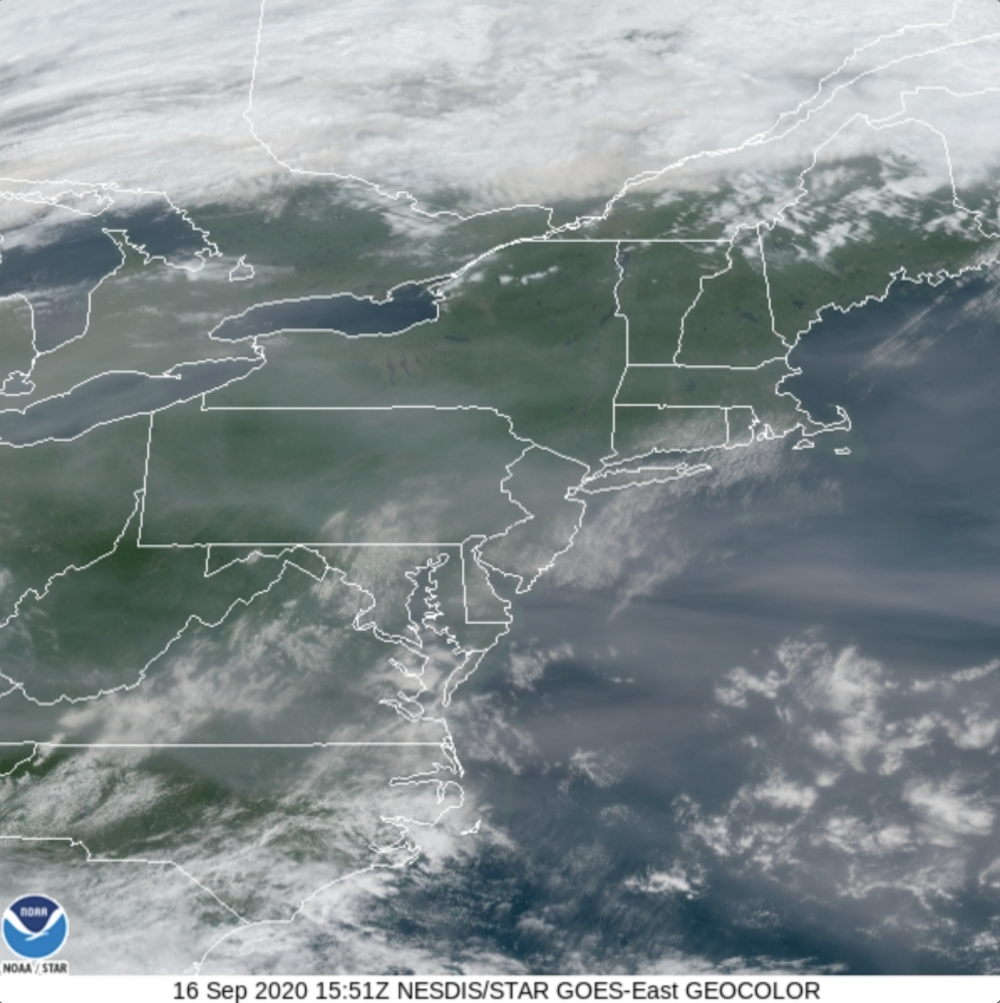
If you are one of the millions of people in the Midwest and Eastern U.S. who turned your gaze toward the sky recently, you may have noticed the sun shining through an odd, milky haze. This widespread opaque veil was caused not by clouds, but rather by smoke from wildfires in the Western U.S.

The smoke was cruising by in the middle levels of the atmosphere many thousands of feet above the ground. While far too high to smell, it caused spectacularly hued sunsets from New York to D.C. to Missouri.

A satellite photo of the Eastern U.S. with a haze of smoke visible.
The thin haze, easily visible in this satellite photo over Pennsylvania and New York, is smoke that traveled over a thousand miles on air currents from the fires on the West Coast. NOAA

Red sky at night

Lasting for about a week from Sept. 12 to Sept. 19, the smoke could be seen in satellite images as wisps and patches of light gray and was especially apparent over the darkly contrasting water of the Atlantic.

Soot particles are much larger than air molecules and are more adept at scattering the yellow, orange and red wavelengths of sunlight. The enhanced oranges, pinks and reds during sunset occur when the Sun’s rays have to travel through more smoke. That happens when the Sun is very low near the horizon rather than when it is directly overhead, hence the fiery sunsets.

Riding the jet stream

The smoke on the East Coast is coming from the horrifically large and persistent wildfires in the Western states. Smoke from those fires is showing up not only on the Eastern Seaboard, but even across the Atlantic in Europe.

How has all that smoke migrated so far? Blame this on the vagaries of the jet stream.

The jet stream is a high-altitude belt of fast wind that sails from west to east around the hemisphere in the middle latitudes. The jet stream is always present, but its wind speeds and exact path around the globe vary daily.

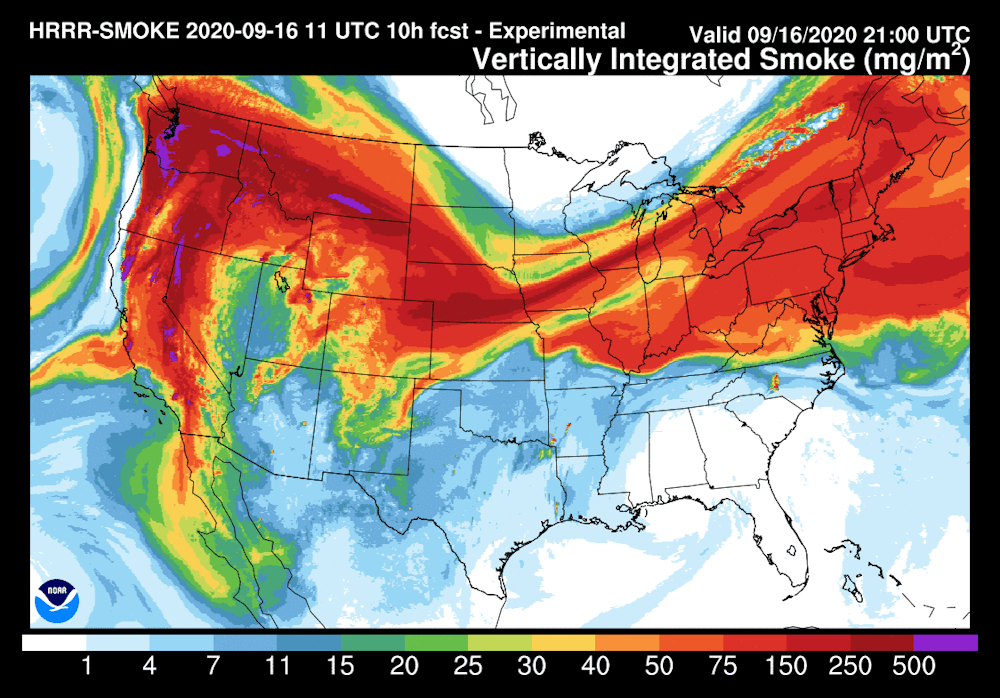
A map of the U.S. showing concentrations of smoke traveling across the Northern U.S. from the West to the East Coast.
Smoke, highlighted by the darker colors, follows the course of the jet stream once it gets high enough into the atmosphere. NOAA

In early September, the jet stream’s path abruptly dipped south, draping it through the Western states. When this happened, the air current picked up the rising plumes of smoke and transported them across the U.S. in a layer of air between 10,000 and 20,000 feet above sea level. As the smoke layer raced eastward at up to 100 mph, it spread over cities along the way – dimming the Sun and creating red sunsets.

A connected world

Smoke isn’t the only aerosol that can sail around the Earth on wind currents. Pollution from China regularly travels to the U.S., where it’s been detected along the East Coast. Fine dusts lofted from the Sahara Desert in Africa can be swept westward to the Southeastern U.S., as happened just a few months ago.

After a week of hazy skies, a large air mass from Canada blew into the East Coast bringing in smoke-free air. But the Western U.S. fire season continues, and if the jet stream dips south again, the East could experience additional blasts of smoke-laden air. The globe may be vast, but wind currents connect us all.

*****

Jeffrey B. Halverson, Professor of Geography & Environmental Systems, Associate Dean of the Graduate School, University of Maryland, Baltimore County

This article is republished from The Conversation under a Creative Commons license. Read the original article.

Header image: A red hazy sunset over Indiana caused by wildfire smoke from the Western U.S. SOPA Images/LightRocket va Getty Images

[Deep knowledge, daily. Sign up for The Conversation’s newsletter.]

Women Have Disrupted Research on Bird Song, and Their Findings Show How Diversity Can Improve All Fields of Science

By Kevin Omland, professor, Biological Sciences, UMBC; Evangeline Rose, Ph.D. ’20, biological sciences, UMBC, and Karan Odom, Ph.D. ’16, biological sciences, Cornell University

Americans often idealize scientists as unbiased, objective observers. But scientists are affected by conscious and unconscious biases, just as people in other fields are. Studies of birds’ vocal behavior clearly show how research approaches can be affected by the people who do the work.

For more than 150 years, dating back at least to Charles Darwin’s writings on sexual selection, scientists have generally considered bird song to be a male trait. The widely accepted view was that bird songs are long complex vocalizations produced by males during the breeding season, whereas such vocalizations in females are generally rare or abnormal.

But over the past 20 years, research has shown that both males and females in many bird species sing, especially in the tropics. For example, our group has studied female song and male-female duets in Venezuelan troupials, a tropical species that sings year-round to defend territories. And we have studied female song in eastern bluebirds, a temperate species in which females sing to communicate with their mates during the breeding season.

Recent findings have shown that female song is widespread, and it is likely that the ancestor of all songbirds had female song. Now, rather than asking why males originally evolved song, the question has become why both sexes originally evolved song, and why females have lost song in some species.

In a recently published study, we reviewed 20 years of research on female bird song and found that the key people driving this recent paradigm shift were women. If fewer women had entered this field, we believe that it likely would have taken much longer to reach this new understanding of how bird song originally evolved. We see this example as a powerful demonstration of why it’s important to increase diversity in all fields of science.

Male and female troupials duetting in Puerto Rico. Karan Odom, CC BY-ND

New voices lead to new perspectives

Traditionally, white men working in countries of the Northern Hemisphere have conducted much of the research on bird song. Researchers in countries such as the U.S., Canada, England and Germany have focused much of their work on migratory birds that breed in the north temperate zone.

But starting in the 1990s, new research began to contradict this view. Studies pointed out the bias toward temperate zones in previous work, and indicated that in the tropics, females of many species are prolific singers. Researchers began to study how female birds use their songs, how females learn songs and why females in some species join their mates to sing precisely coordinated duets.

We noticed that women had written many of the key papers on female song published in recent years and wondered whether this was a general trend. To see whether women were significantly more likely to publish about female bird song than men, we identified all papers with “female song” in the title or abstract that had been published in the last 20 years. Next we assembled a set of papers generally published in the same journals in the same years, but focused on “bird song” more broadly.

Pair of Venezuelan troupials
Male and female troupials. Both sexes are elaborately colored, and both sexes sing. Karan Odom, CC BY-ND

For each of these papers we determined the genders of all authors, including the first author, middle authors and final author. Final authors frequently are the senior authors – for example, research group leaders.

Focusing on first authors, we found that 68% of female song papers were written by women, whereas only 44% of the bird song papers were written by women. Therefore, men were 24% less likely to study female song than bird song. Conversely, women were 24% more likely to study female song.

Middle authors on female song papers were also slightly skewed toward women. However, last authors were much more commonly men for both female song and bird song papers. In other words, the team leaders on these projects were still more likely to be men.

For female song studies, 58% of last authors were men. In our view, although ornithology is now a relatively gender-balanced field, more women need to be promoted into senior leadership positions, so that they can lead key decisions on research directions, funding and student projects.

Female northern cardinals sing along with males and have many different calls.

Diverse perspectives help drive scientific progress

A major goal of our study was to recognize and promote the diverse perspectives of researchers with different backgrounds and identities. However, we felt it was crucial for our study to look back at least 20 years, since that was the time frame over which this key paradigm shift occurred. Many authors from that far back would be difficult to contact directly for a variety of reasons.

In the future, allowing authors to self-identify for studies of gender and authorship in a range of fields would likely produce more correct gender data and allow researchers to identify as nonbinary or non-gender-conforming.

Our case study on bird song provides dramatic evidence that who researchers are, where they are from and what experiences they have had influence the science that they do. More diverse groups of researchers may ask a broader range of questions, utilize more varied methods and tackle problems from a wider range of perspectives.

Gender is just one aspect of identity that could influence topics, conceptual approaches and specific methodologies used in a wide range of scientific disciplines. Many other factors, such as race, ethnicity, geographic location and socioeconomic standing, could also have important impacts on scientific research.

Recent events have vividly illustrated the effects of racial biases in areas ranging from criminal justice to outdoor recreation. Our study shows why it is important to address racial, gender and other biases to improve the outcomes of research, teaching and outreach at colleges and universities around the world.

*****

Casey Haines ’19, biological sciences, a recent undergraduate student at the UMBC, was lead author of the study on which this article is based. Michelle Moyer, a PhD student at UMBC, helped with this work.

Kevin Omland, Professor of Biological Sciences, University of Maryland, Baltimore County; Evangeline Rose, Postdoctoral Research Associate, University of Maryland, and Karan Odom, Postdoctoral Fellow, Cornell University

Header image: Female song is common among fairywrens, like this red-backed fairywren. Paul Balfe/Flickr, CC BY

This article is republished from The Conversation under a Creative Commons license. Read the original article.

[Deep knowledge, daily. Sign up for The Conversation’s newsletter.]

Will the New 15-Minute COVID-19 Test Solve US Testing Problems?

By Zoë McLaren, associate professor, Public Policy, UMBC

On Aug. 26, the Food and Drug Administration granted an Emergency Use Authorization to a new rapid antigen test for COVID-19 called the BinaxNOW test.

I study public health policy to combat infectious disease epidemics. Testing is one of the most powerful tools available to fight the spread of COVID-19. The new test is inexpensive, rapid and easy to use. It will massively scale up access to testing, but hurdles remain in achieving widespread, frequent COVID-19 testing.

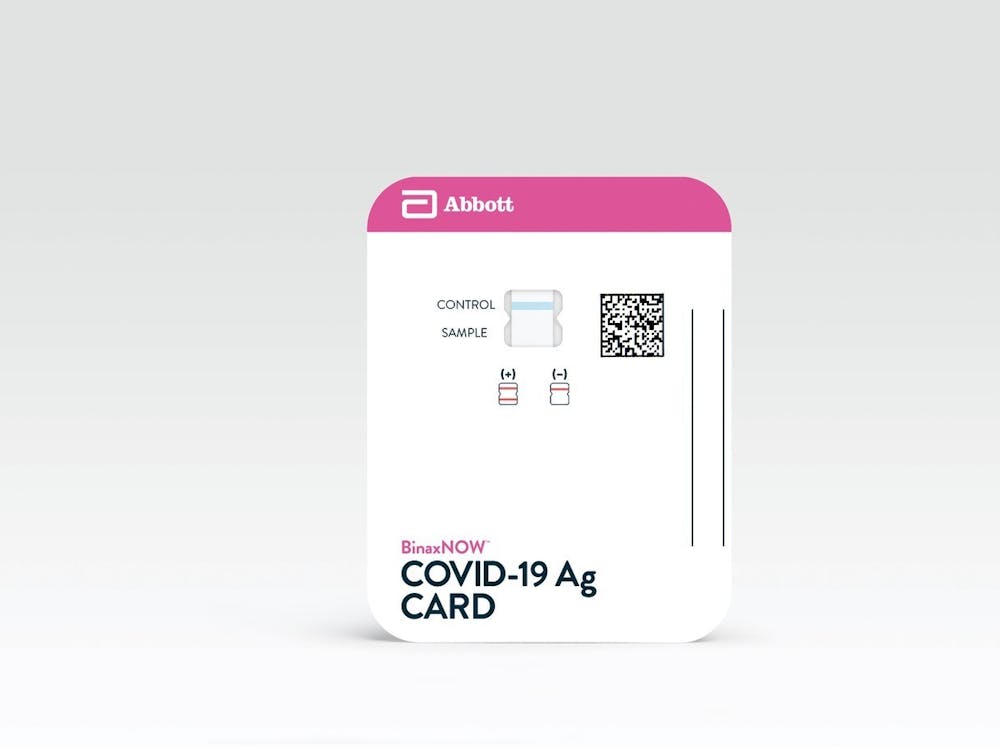
A digital results page for the BinaxNOW test.
The Abbott BinaxNOW rapid antigen test claims to give results in 15 minutes. Abbott

What type of test is BinaxNOW?

The credit-card-sized test is an antigen test that detects a specific viral protein from SARS-CoV-2. It costs US$5 and doesn’t require a lab or a machine for processing.

Performing the test is simple. A health care worker or technician would use a swab to collect a sample from less than 1 inch inside the nostril. They would then combine the sample with a few drops of chemicals inside the test card. Within 15 minutes, the test strip would show a positive or negative result. The test is also paired with an app that produces a digital code that can be scanned to show proof of a recent negative COVID-19 test.

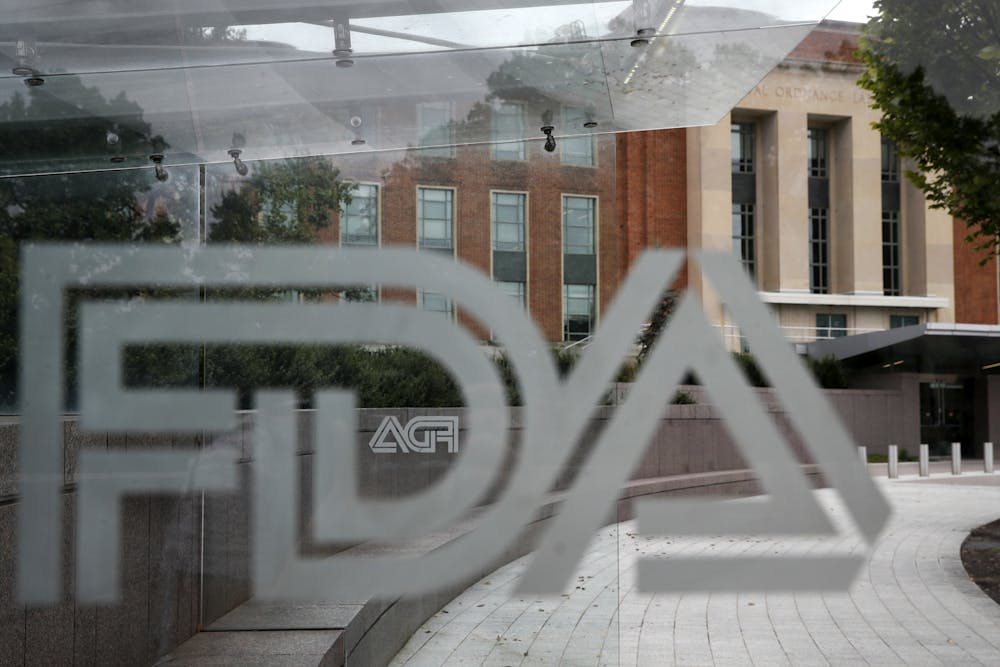
A sign showing the FDA logo with the FDA headquarters in the background.
The FDA granted emergency use authorization for the test, but only for use on patients with symptoms of COVID-19. AP Photo/Andrew Harnik, File

What does the Emergency Use Authorization allow for?

The BinaxNOW test is currently only authorized for patients who have had COVID-19 symptoms for seven days or less, which is when virus levels in the body are likely to be high. It must be prescribed by a physician and performed by a trained technician or other health care worker.

The PCR test for COVID-19 is currently widely used and considered the gold standard, but requires patient samples to be sent to a lab and can take days to provide results. The new antigen test is designed to be a cheap and quick alternative to PCR testing for diagnostic purposes in a medical setting. It would add critical capacity to an overstretched testing system.

The emergency use authorization provides preliminary authorization for doctors to prescribe the antigen test while the full FDA approval process is ongoing. The authorization could be revoked if the test is not as accurate or reliable as expected.

How accurate is this test?

Abbott, the health technology company that produces the test, reports that when patients had symptoms the test was in agreement with PCR testing for 97.1% for COVID-19 positive cases and 98.5% for COVID-19 negative cases. This is high enough for diagnostic settings where accuracy is critical.

However, the true accuracy could be lower because the performance testing group was only 102 people and the accuracy hasn’t been validated by the FDA as part of the full approval process. There will inevitably be some false negatives and false positives with the BinaxNOW test since accuracy isn’t 100%, but the FDA will monitor the data to make sure the test meets the reported accuracy.

People waiting in a line of cars with health care workers standing under pop-up shade structures.
Long lines and slow turnaround times have limited access to testing, but the new Abbott test should be far easier and faster. AP Photo/Nati Harnik

Can this test be used for widespread screening?

The BinaxNOW test is cheap, rapid, able to be mass-produced and easy to use outside a lab. This makes it a promising candidate for widespread screening. However, the test is currently only authorized for people with COVID-19 symptoms.

This is an obstacle because an estimated 40% of all COVID-19 cases are asymptomatic and these people likely don’t know that they’re contagious. To maximize the effectiveness of any COVID-19 screening program, it is important to test people whether they have symptoms or not.

Health care providers are able to prescribe the BinaxNOW test for asymptomatic patients for off-label use, but health officials don’t yet know how accurate the test is when performed on asymptomatic people.

Is this test a game-changer?

The massive expansion of testing access made possible by the BinaxNOW test will almost surely outweigh the downsides of a small number of inaccurate results. Abbott plans to manufacture 50 million tests per month starting in October. This will quickly exceed the 76 million COVID-19 tests the U.S. has performed over the last six months.

Widespread, frequent testing is effective at slowing the spread of the coronavirus. The new testing capacity made possible by the authorization of this rapid antigen test represents a major advance in bringing the pandemic under control.

*****

Zoë McLaren, Associate Professor of Public Policy, University of Maryland, Baltimore County

This article is republished from The Conversation under a Creative Commons license. Read the original article.

[Get the best of The Conversation, every weekend. Sign up for our weekly newsletter.]

Header image: AP Photo/Elaine Thompson

1 in 10 US Students Are English Learners

By Jennifer Mata-McMahon, associate professor, Education, UMBC

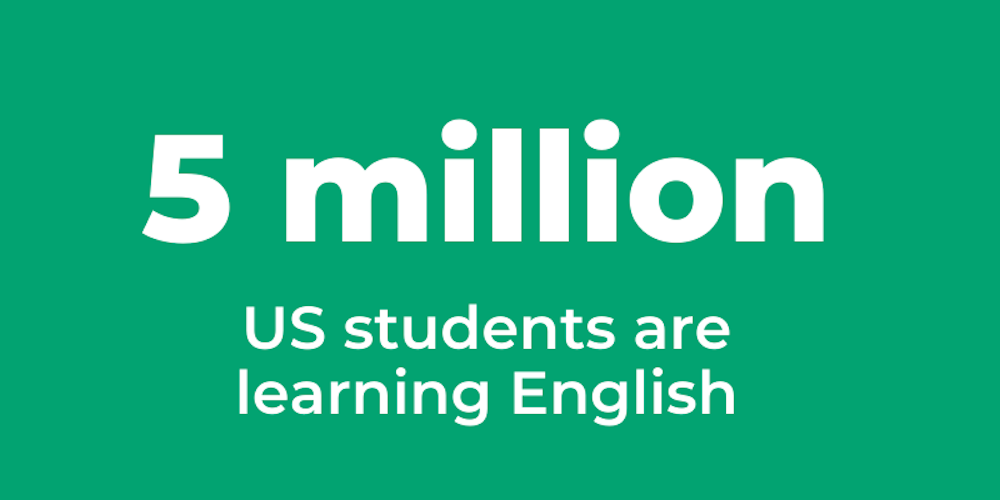
1 in 10 US students are learning English

More than 1 in 10 of the nation’s approximately 50 million public school students speak a native language other than English, according to the latest federal data. Roughly 3 in 4 of these English learners speak Spanish.

The percentage of U.S. students who are learning how to speak English has grown significantly in recent years, rising from 8% in fall of 2000 to 10% by 2017, the data indicate.

The prevalence of these students varies greatly across the country, ranging from 0.8% in West Virginia to 19.2% in California. The share of English learners is highest among young children, hovering around 16% between kindergarten and second grade. Typically, younger children have less exposure than older students to English because they are primarily communicating with relatives in their native languages. By the time students are nearing high school graduation, the percentage of English learners drops to 4.6%.

Students who remain fluent in their native language while learning to speak English become bilingual, which has many advantages. Bilingual people tend to be better at connecting with others from different ethnic backgrounds and cultures. They are also better at solving problems.

Once they grow up, bilingual adults often have better job opportunities and may earn higher salaries than those who no longer speak their native language. Also, research indicates that being bilingual can increase creativity and heighten cognitive ability.

Researchers have found that attending dual-language programs, where instructional time is split between English and another language (oftentimes Spanish), attended by both native and non-native English speakers, help children become bilingual. But only 35 states offered these programs, according to the Department of Education’s latest data.

Without those opportunities, English learners tend to stop being fluent in their first language when they reach high school and miss out on all the benefits of becoming bilingual students.

*****

Jennifer Mata-McMahon, Associate Professor of Education, University of Maryland, Baltimore County

This article is republished from The Conversation under a Creative Commons license. Read the original article.

Header image: Dual-language instruction can help children grow up to be bilingual. Robyn Beck/AFP via Getty Images

[Get facts about coronavirus and the latest research. Sign up for The Conversation’s newsletter.]

In the Work-From-Home Battle for Space, Women Are the Reluctant Nomads

By Elizabeth Patton, assistant professor, Media and Communication Studies, UMBC

It’s just past 10 a.m. and my partner, on his third virtual meeting today, is working non-stop in our home office. My son has taken over the family room to attend a virtual science camp and video-editing classes and to play video games. I now realize that this will be his work space to attend distance learning classes in the fall.

For this reason, each morning, I find myself carrying my laptop and tea around my house trying to find a quiet place to work. Before the pandemic, I never needed a dedicated space at home for work. But now I’m faced with teaching online this fall and won’t have access to my campus office, which closed in March.

With Google announcing that its 200,000 employees can work from home until June 2021 – and Twitter, Square and Slack announcing that employees could still continue working remotely after the pandemic ends – I’m sure others find themselves in the same boat of not having their own dedicated professional workspace.

And as I explain in my recent book on the social history of the home office, historically, it’s been women who have been the ones left searching for space.

The emergence of the ‘chamber room’

To better understand the makeshift nature of workspaces in the home – and why the spaces are often gendered – it’s important to look at how the home office first emerged as a distinct space.

In the 18th century, three separate spheres of domestic activity started to appear in middle-class and wealthy single-family homes. There was a social area for hosting guests, such as dining and living rooms; a service zone, which included the kitchen, cellar and laundry areas; and a sleeping area, which was the most private part of the house.

What we now call the home office emerged from generically named “chamber” rooms used by both men and women prior to the 19th century. The majority of the chamber rooms were later simply labeled “bedrooms” on builders’ floor plans. However, beginning in the 19th century, some of these spaces depicted on floor plans were interchangeably referred to as the library, den or study.

By the late 19th century, the study became primarily a space reserved for male professionals to conduct business at home, indulge in scholarly pursuits and entertain friends. For example, clergy, merchants and doctors needed a study or “interview room” because their work was more likely to be conducted at home.

The study was often separated from the private zones of the house and placed as close to the front door as possible – in the home’s social zone – to maintain family privacy.

But then, in the early 20th century, the study largely disappeared from standard, middle-class homes, which were getting smaller, remaining only in houses built for upper-middle-class professionals, creative professionals and the wealthy.

Selling the idea of working from home

Even though the study was a male space for leisure and occasional work, the home was largely seen – and championed – as a place that fostered family life.

Yet companies that sold office supplies saw the home as an untapped market. All they needed to do was convince Americans that being able to work from home was a form of convenience. Through advertisements, these companies encouraged Americans to create distinct spaces for work that needed to be properly outfitted with office equipment.

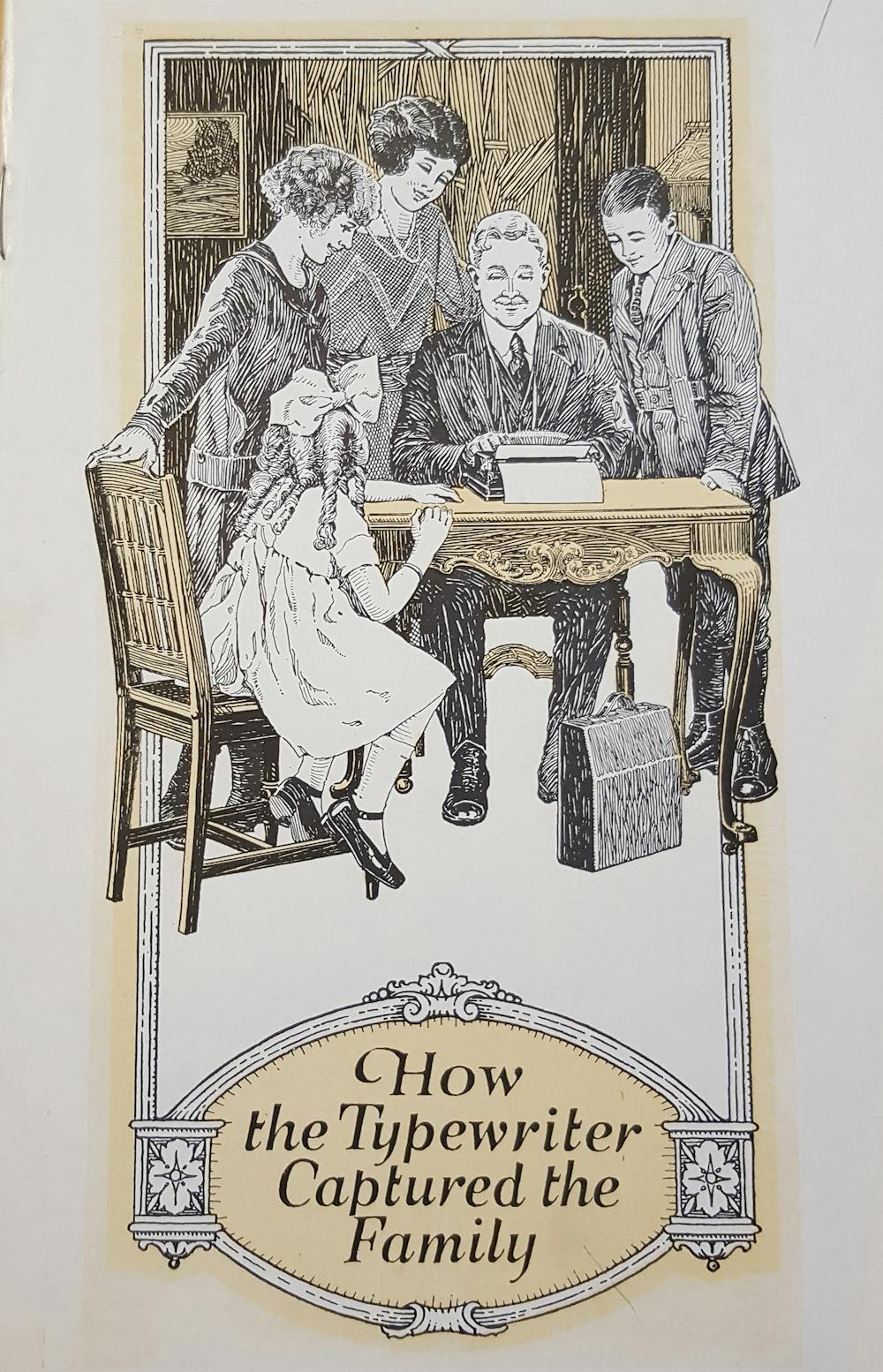
An advertisement for a portable typerwriter depicts women huddling around a man typing.
An early ad for the portable typewriter. Remington Rand Papers: Advertising and Sales Promotion Department—Typewriter Division; Hagley Museum, Wilmington, Del., Author provided

For example, in 1921, Remington Rand began marketing portable typewriters, with advertisements that tried to sell consumers on the idea of flexibility and the ability to work in the comfort of one’s home. And in the 1950s, Bell Telephone teamed up with the builders of middle-class homes to market the installation of additional telephone lines as a way to combine work and leisure under one roof.

When PCs replaced typewriters, computer companies such as Apple and IBM geared their ads towards professionals, depicting their products as tools that would allow them to telecommute, run a business out of the home or make it easier for their kids to complete homework.

Separate but unequal spaces

As these technologies started appearing in more and more homes, families started to wonder where to put them.

Popular culture offered some models. In the sitcom “Leave It to Beaver,” the study of the father, Ward Cleaver, is equipped with bookshelves, a globe, two leather chairs, a desk and a telephone. It’s a place where Ward occasionally works from home in the evening and relaxes during the weekend.

By then, however, most middle-class homes lacked studies.

Furthermore, during the postwar period, typewriter and telephone companies didn’t just advertise their products to men. They also sought to entice middle-class women into using their products to better manage tasks like corresponding with schools, insurance brokers and doctors, as well as keeping family records and paying bills. However, unlike men, women’s workspaces in advertisements, newspapers and on television were often depicted as a planning desk in the kitchen or as a little desk in the master bedroom. Rarely, if ever, did they have their own space.

Where to put office equipment was another issue. Placing it in the master bedroom interfered with the perceived functions of the bedroom: intimacy and relaxation. A PC in the living room competed with the television, while office equipment in the kitchen or dining room impeded the ability to work uninterrupted by other family members. For these reasons, advertisements and computing magazines in the 1980s began to recommend new spaces dedicated exclusively to PCs, such as the home office or a “hobby room.”

The home office works well as a quiet room to concentrate and work, but in homes that do have one – and when both partners are at home, as is increasingly the case – that space often defaults to the man.

In the end, all those companies’ advertising dollars paid off. We were working from home in greater numbers before the pandemic, and the number has since risen as offices around the country shuttered. But we’re still stuck with the same issues of too much work and not enough space to do it – with women often getting the short end of the stick.

*****

Elizabeth Patton, Assistant Professor of Media and Communication Studies, University of Maryland, Baltimore County

This article is republished from The Conversation under a Creative Commons license. Read the original article.

[Deep knowledge, daily. Sign up for The Conversation’s newsletter.]

Header image: Ward Cleaver of the popular sitcom ‘Leave It to Beaver’ in his study. Universal Pictures

Rapid Screening Tests That Prioritize Speed Over Accuracy Could Be Key to Ending the Coronavirus Pandemic

By Zoë McLaren, associate professor, Public Policy, University of Maryland, Baltimore County

Broad access to testing is one of the most powerful tools to keep the COVID-19 pandemic under control until there’s an effective vaccine in use. Diagnostic testing, which is used in medical settings to determine whether someone is infected with the coronavirus, is costly, slow and overstretched in the U.S. But that’s not the only type of test that can be used.

I study public health policy to combat infectious disease epidemics. To slow the spread of the virus, public health programs need to catch more COVID-19 cases and catch them before they spread. Innovative screening tests offer promise because they are inexpensive, rapid, easily mass produced and don’t require laboratory processing. They can be implemented at large scale for frequent testing in schools, workplaces, airports and even at home. With screening tests, huge numbers of people could be tested regularly and contagious people would be identified before they could spread the virus far and wide.

What is screening testing?

Ideally, the U.S. could provide frequent, accurate diagnostic testing to the whole population, but diagnostic capacity is struggling to keep up with demand. Screening tests make it possible to test large groups of people frequently, including those without any symptoms.

Screening tests are designed to work in a similar way to the X-ray screening of carry-on baggage at airports. X-ray screening is imperfect – some harmless items may prompt a more thorough search and some dangerous items might slip through – but it is fast enough to screen every bag and good enough to catch the majority of potential weapons.

The key, for any screening test, is that it must have a consistent rate of false positives and false negatives. If the user knows exactly how accurate it is, then they can correctly interpret their likelihood of having COVID-19. The Food and Drug Administration generally verifies the test accuracy during the approval process, but it could also be done by another government agency.

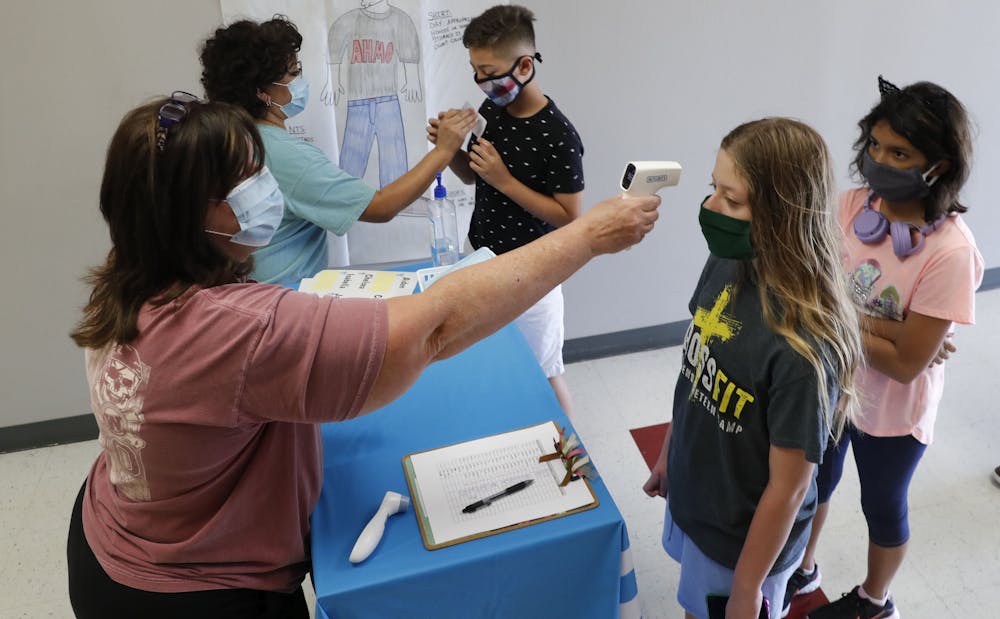
Two teachers standing with masks on checking students for fever with temperatures guns
Temperature checks are one form of screening, but miss many COVID-19 cases since 40% of infected people are asymptomatic. AP Photo/LM Otero, File

Many fields of public health employ screening test strategies. For example, thermometer-based screening was used during the SARS and Ebola epidemics. Unfortunately, temperature checks miss a lot of COVID-19 cases because an estimated 40% of people with COVID-19 show no symptoms at all. Many COVID-19 reopening plans incorporate temperature checks since they will catch some cases, but a better screening method is needed.

Which tests work for COVID-19 screening?

Several COVID-19 screening tests that cost $1 to $5 each and give a result in around 15 minutes have been developed, and many more are in the pipeline. These tests don’t require a laboratory and can be processed on-site. Many use antigen-based testing, which detects specific proteins on the surface of the virus.

Screening tests come in many different forms. The FDA recently granted Emergency Use Authorization (EUA) to Quidel and BD for antigen tests that use a small portable point-of-care machine to process samples. Though Quidel reports accuracy rates above 95%, the FDA cautions that the rate could be lower because the test hasn’t undergone the full FDA approval process.

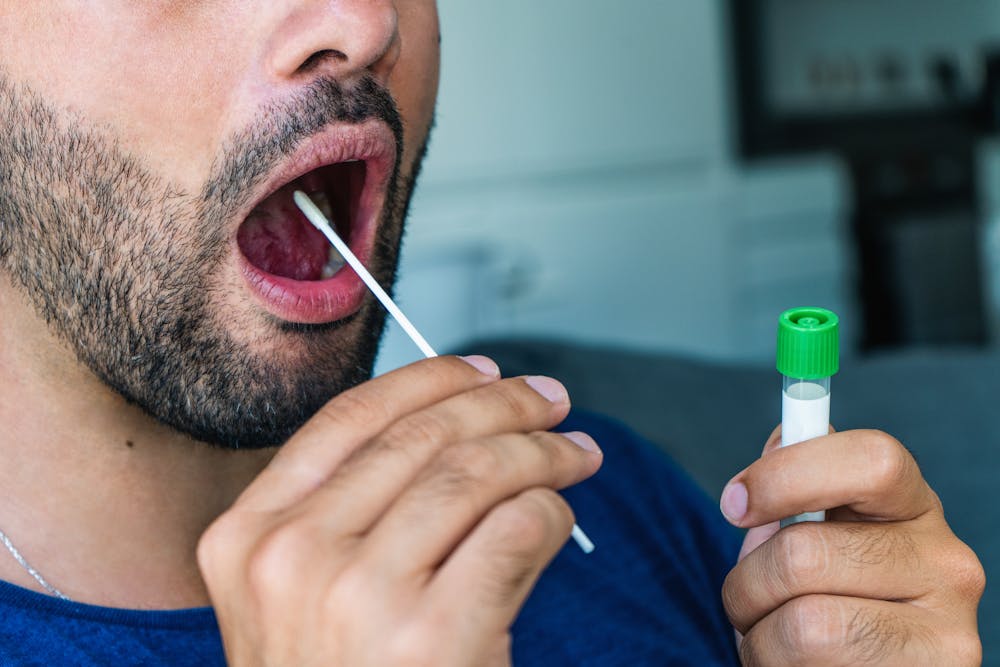
One of the most versatile options for testing is the saliva-based paper-strip test, which only requires a paper strip and a test tube. It could easily be used at home.

A man inserting a swab into his mouth while holding tube to contain the sample.
A good screening test could be done at home and give results within minutes. Circle Creative Studio/E+ via Getty Images

Moderately accurate screening tests still reduce transmission

Many inexpensive COVID-19 screening tests may not be as accurate as diagnostic tests. But screening tests with even moderate levels of accuracy can actually still effectively slow the spread of the virus, as long as the results are interpreted correctly.

Here’s how this works.

First, frequent testing catches the vast majority of cases. Someone who is infected but gets a false-negative and slips through the cracks is likely to be caught the next time they’re tested. For a test that misses 20% of positive cases, the chance of an infected person getting two false negatives in a row may be as low as 4%. It’s like bailing a boat with a leaky bucket: You just have to bail more quickly to get the job done.

Second, most people who get false-negative results are unlikely to be contagious. Antigen-based screening tests are good at detecting the high virus levels needed to be contagious. By design, screening tests sacrifice accuracy where it matters least to achieve low costs, speed and ease of use.

Finally, those who get a screening test need to know how to interpret the results. Diagnostic tests can tell you whether you’re infected with a high level of certainty. An inexpensive screening test is not as certain, but is still useful. For example, a positive result would mean that you have a high chance of being contagious, in which case you may want to take a diagnostic test for confirmation and quarantine if possible in the meantime. A negative result would mean that you have a low chance of being contagious, but it couldn’t be ruled out. In this case, it would still be important to stay vigilant about COVID-19 transmission.

While screening tests are not as accurate as diagnostic tests, they are a big improvement over flying blind because they provide useful information about whether someone is contagious. The weather report may not be able to tell you with certainty whether it will rain or not, but it can tell you whether it’s a good idea to bring an umbrella.

A view of a pane of glass with the FDA logo on it with the FDA building in the background
Currently, the FDA has few approval pathways for COVID-19 screening tests, which is a barrier to widespread use. AP Photo/Jacquelyn Martin, File

What’s preventing widespread use of screening tests?

Several companies are ready to scale up production of screening tests. The primary barrier is the delay in government approval. It’s difficult for screening tests like saliva-based paper-strip tests to achieve the performance required for approval as a COVID-19 diagnostic test while remaining inexpensive and easy enough to allow for widespread and frequent testing. By creating new approval pathways specifically for screening tests, the FDA or another government agency could quickly put more of these tests into use.

Those who see the potential of rapid screening tests are already taking action. A group of governors plan to secure rapid tests that have been granted an Emergency Use Authorization without waiting for full FDA approval. This will make it easier for those states to get back to in-person school and work safely. It is no exaggeration to say that innovative screening tests are a game-changing tool to fight the coronavirus and keep it at bay.

*****

Zoë McLaren, Associate Professor of Public Policy, University of Maryland, Baltimore County

This article is republished from The Conversation under a Creative Commons license. Read the original article.

[Research into coronavirus and other news from science Subscribe to The Conversation’s new science newsletter.]

Header image: Vaidas Bucys/EyeEm via Getty Images

Why Does Some Rain Fall Harder Than Other Rain?

By Jeffrey B. Halverson, professor, Geography & Environmental Systems, Associate Dean of the Graduate School, UMBC

Curious Kids is a series for children of all ages. If you have a question you’d like an expert to answer, send it to curiouskidsus@theconversation.com.


Why does some rain fall harder than other rain?
– Naomi B., age 9, San Francisco, California


There are some days when the rain falls peacefully and gently, nourishing the Earth. But on some other days the rain comes down in a torrential downpour that meteorologists like me call a cloudburst. Standing outside in one of these intense rainstorms can feel like being smothered in a heavy, wet towel. These storms can flood the lands below them and lead to great destruction.

So what causes this difference?

All rain comes from a combination of two things: moisture in the air – usually in the form of clouds – and currents of air moving upwards. As moist air rises up through a cloud, the air cools and the water in it turns into tiny raindrops.

This is the same thing that happens when you can see your breath on a cold evening. The temperature change from warm to cool causes water droplets to form in your breath.

In a cloud, these tiny raindrops are very light and float as the rising air pushes them up. But the higher they go, the larger and heavier they get. Eventually, they get so heavy that they fall to the Earth as rain.

People cross a street holding umbrellas and in long coats during a winter storm in Philadelphia.
All-day drizzles come from steady storms that don’t have much upward wind flow. AP Photo/Matt Rourke

Cold air storms are steady and slow

Cold air can hold much less moisture than warm air, so wintertime clouds don’t have much water in them; they are thin and layered rather than puffy and tall and full of water.

Since cold air likes to sink to the ground, it’s difficult to get that air to rise quickly, so these wintertime clouds have only gentle upward air currents. As these slow currents sweep up through the thin clouds that don’t have much moisture, small raindrops form. Gravity easily pulls them down against the air current before they get too big. When clouds are thin and the air is moving slowly, you get nice calm rain.

A large mushroom shaped cloud formation against a blue sky in New Mexico
Massive thunderstorms called supercells can form when the right weather ingredients come together. Greg Lundeen/NOAA

Thunderstorms and big winter storms are quick and intense

Hard rainstorms happen when there is a lot of moisture in the air and the air moves upwards very fast. Summer thunderstorms are the perfect example.

The warm, moist air rises very quickly – like a hot air balloon – and can be moving as fast as 30 to 40 miles per hour. The air also holds much more moisture than winter clouds – up to five times as much.

All of this creates very tall, thick clouds that are full of moisture. Water droplets form quickly as the air moves up through the clouds. But since the wind is blowing upwards so fast, the droplets can get huge before gravity drags them down to Earth. When the weight of all the water droplets gets to be too much for the wind, the wind current collapses, and all the raindrops in the cloud come crashing down at once. These are summer thunderstorms.

Thunderstorms can drop one, two or even three inches of rain in less than an hour. These sudden torrential downpours, called cloudbursts, can lead to flash flooding that can overflow streams and roads and trap people wherever they are.

Thankfully, because thunderstorms are so violent and relatively small, they don’t last very long. Once the rain falls from the clouds and squashes the upward air currents, the clouds disappear and you often see a nice blue sky.

Of course, winter can deliver some strong storms too – especially over the warmer ocean water. When strong winter storms drop lots of heavy rain, the same principles are at work: lots of moisture in the air, fast upwards wind currents and tall clouds.

No two rainstorms are ever the same. Sometimes clouds can rain so hard it feels like you are standing in the shower. Other times they bring only a nice peaceful drizzle. Now, whether you are soaked or singing in the rain, you’ll know why.


Hello, curious kids! Do you have a question you’d like an expert to answer? Ask an adult to send your question to curiouskidsus@theconversation.com.

Please tell us your name, age and the city where you live. We won’t be able to answer every question, but we will do our best.

Jeffrey B. Halverson, Professor of Geography & Environmental Systems, Associate Dean of the Graduate School, University of Maryland, Baltimore County

This article is republished from The Conversation under a Creative Commons license. Read the original article.

Header image: David Pinzer Photography/Moment via Getty Images

[The Conversation’s science, health and technology editors pick their favorite stories. Weekly on Wednesdays.]