The plan began percolating in early 2017, when Gib Mason ’95, economics, presented a challenge to his Innovation, Creative Problem-Solving, and the Socialpreneur class: create a way to better connect UMBC to the community surrounding it.
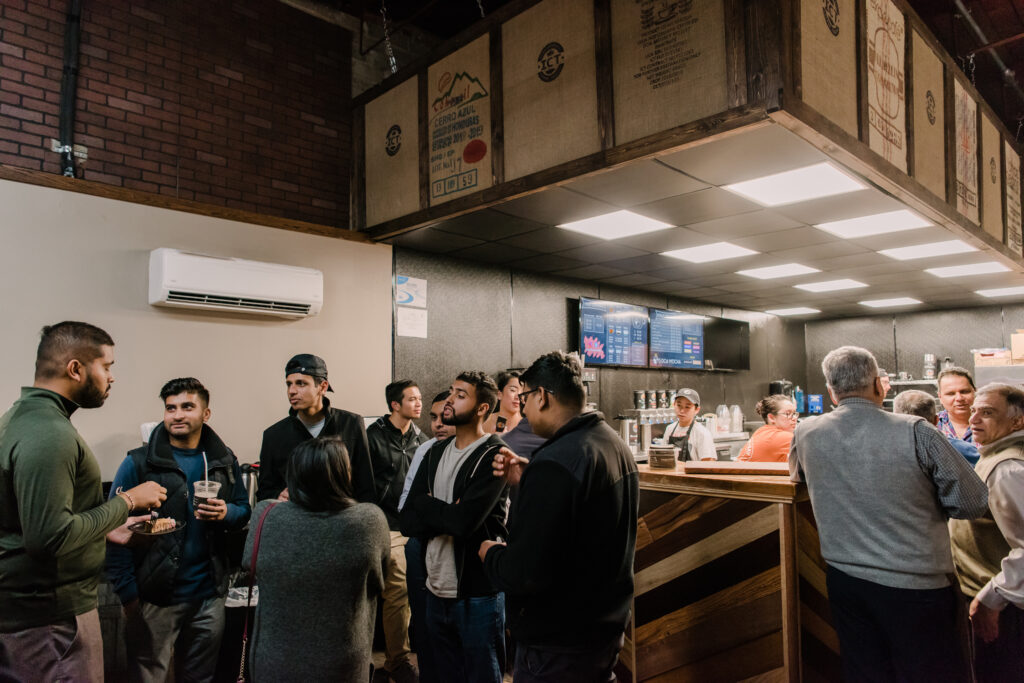
Two and half years and a lot of lattes later, in fall 2019, OCA Mocha opened its doors on East Drive in neighboring Arbutus. What started as an empty shell full of potential became a warm, welcoming student-run space with a coffee bar, community meeting room, entertainment stage, and gallery wall featuring works by local artists.
As students, Michael Berardi ’19, media and communication studies, and Deep Patel ’19, biological sciences and financial economics, were in the class that created the concept; as alumni, Patel is a co-owner of the coffee shop, and Berardi is the general manager.
Since running with the idea born in Mason’s class, the OCA Mocha team has learned firsthand about planning, construction, relationship-building, and the ups and downs of starting a business from scratch. And the learning didn’t stop when OCA Mocha opened its doors; in addition to the financial and organizational aspects of making the project a reality, Patel says he has learned “how to work with a team to accomplish a goal.” Berardi adds that he is now “more comfortable with uncertainty and ambiguity” and has learned “the power of positivity—people notice it and want to be part of it.”
Community members gather to celebrate the opening of OCA Mocha in fall 2019. Photo by Marlayna Demond ’11.
In their opening months, the place buzzed with activity from morning to night, with students studying, groups playing board games, impromptu meetings in the booths, friends and families gathering for coffee and conversation, and people running into old friends—or making new ones—over the signature OCA Mocha or frozen hot chocolate.
And even after temporarily closing its physical location due to COVID-19, the OCA Mocha team has continued its community-focused work. A virtual open mic night drew ten performers and more than 600 views on social media. In partnership with the UMBC Office of Sustainability, the team took a planned OCA Mocha Kids Club event online with video tutorials on how to make Earth Day–themed crafts from on-hand items otherwise destined for the landfill.
Building on OCA Mocha’s existing partnership with Retriever Essentials, UMBC’s food pantry, the team offered a one-time no-cost lunch delivery to local kids in need. As a result, Patel and Berardi made and delivered 35 lunches and Kids Club activity packs.
Berardi said it was eye-opening to see how many people, including in his own neighborhood, needed help. A mom posted her thanks on social media, saying this gesture “brought so much joy” to her three kids. The team continues to partner with Retriever Essentials to serve UMBC’s food insecure community.
Bettina Tebo, president of the Greater Arbutus Business Association, is one of the project’s earliest supporters. At the grand opening, she called OCA Mocha “ just the beginning of the amazing things that can happen from this relationship…and from the connections that we’re building.”
Along East Drive, other businesses noticed an uptick in foot traffic after OCA Mocha opened. A new bus route from campus to East Drive certainly helped. Sheena Herron, owner of Finders Keepers Thrift Store and Consignment Store, says, “We’ve gained so many new and loyal customers…simply because they were at OCA Mocha and noticed we were next door.“
When OCA Mocha eventually reopens, Berardi and Patel look forward to the familiar buzz of activity. They already have plans to expand the coffee shop’s menu and live entertainment offerings, enhance their community-focused programming, and “serve the community in ways we haven’t even thought of yet.”
— Mary Ann Richmond ’93
Update: OCA Mocha is now open for curbside pick-up and delivery.
During this time in America, each of us is faced with the challenge of understanding our position in society and our role in dismantling structural racism.
It is important to say the names on our minds—George Floyd, Breonna Taylor, Ahmaud Arbery, Tony McDade, Sandra Bland, Korryn Gaines, Freddie Gray—and speak out against the police brutality that resulted in their deaths and the deaths of so many other Black people in this country. Action is essential to the future of our society, and action can take many forms, including protest, voting, and publicly acknowledging the pain of others.
It is also important to name the countless other forms of inequality that are just as deadly, including inadequate educational opportunities, lack of living wages and affordable housing, and unequal access to healthcare, healthy food, and high-quality public transportation. It is clear from recent protests across the nation and world that more people of all races and ages are seeing that structural racism permeates our society—our policies, laws, financial institutions, workplaces, academic and faith institutions, and our own actions and inactions. This recognition, while painful to many of us in different ways, should lead to actions that can build a stronger society.
Many in our community are asking what actions UMBC is taking now and how we can do more, both as individuals and as a campus. One of the most important things we can do is acknowledge that we as a campus and a community still have much work to do. We must take action, both on campus and through our engagement in the larger community, to address the impact of structural racism and inequality.
Moving forward with “business as usual” without acknowledging the lived experience of Black and other marginalized community members contributes to a pattern of harm for those directly affected. It is also important to learn about the historic roots of white supremacy, structural racism, sexual violence, gender discrimination, and other forms of systematic oppression and marginalization—in the wider world, and on our own campus.
We will continue to communicate about ways in which we are addressing these issues. Here are some examples of work that is underway.
The Division of Student Affairs has developed a five-part workshop series focused on equipping faculty and staff with the tools and skills to engage in ongoing advocacy, self-work, and self-care in response to ongoing racial injustice and our current climate. Sessions will be open to faculty and staff across campus.
There is a new [Free]dom Fridays weekly Webex. This student-centered program is designed to provide a virtual space to have an open dialogue about social justice and identity-based issues.
The Black Faculty and Staff Association will be holding a Community Care Space for a facilitated discussion focusing on self-care, healing, shared processing, and resource sharing to support community members who may be feeling overwhelmed and angry.
UMBC was founded in 1966 in the midst of the Civil Rights Movement. Our campus continues to partner with public officials and communities across the state and nation to address societal challenges. Faculty, staff, and students are supporting teachers, children, and families in Baltimore and surrounding school systems; helping young people develop job skills; activating communities to tell their stories through the arts and humanities; using the social sciences to address inequalities resulting from racial status and poverty; and working to address violence and enact criminal justice policy reforms, with special emphasis on youth.
We realize there is much more work for all of us to do. As we grieve over the many lives unjustly lost or limited by racism, we are encouraged by the outpouring of statements of solidarity and caring conversations happening within our campus community and beyond. Recalling Civil Rights protests of the 1960s led by Black children, we are moved to see people of all races and ages around the world risking their health and lives to demand an end to systemic racism. We must not let this opportunity pass.
– President Freeman Hrabowski and Provost Philip Rous
Preventing deaths from COVID-19 depends on people who get it seeking treatment – which also allows authorities to track down whom they came in contact with to reduce spread.
But, as the economic pain and joblessness caused by the statewide lockdowns continue to grow, more Americans are experiencing severe strains on their personal finances. This threatens our ability to contain the pandemic because those feeling the most financial stress are much less likely to seek medical care if they experience coronavirus symptoms, according to my analysis of a recent Federal Reserve survey.
The Fed conducts a survey of the economic health of U.S. households every quarter, most recently near the end of 2019. In April, it conducted a supplementary but similar survey to quickly gauge how people were handling the coronavirus crisis. Results of both surveys were released on May 14.
The Fed tries to measure financial stress in three key ways. Its surveys ask respondents if they are unable to pay all their monthly bills, couldn’t cover a US$400 emergency expense, or are “just getting by” or worse.
Even before the pandemic hit, the picture wasn’t pretty. In October, when the fourth-quarter survey was conducted, 42% of employed respondents reported fitting at least one of these descriptions, while over 8% said they fit all three. Those figures jumped to 72% and 20% for low-income workers.
But by April, tens of millions of people who had jobs in October lost them as most nonessential businesses across the U.S. either closed or reduced their services. The unemployment rate shot up to 14.7% that month – the highest since the Great Depression – and is expected to climb further when the May data are released on June 5.
The Fed’s April survey, however, paints an even broader picture of the economic impact of the pandemic. In that survey, about 28% of the previously employed respondents said they either lost their job, were being furloughed, had their hours cut or were taking unpaid leave. This has been financially devastating to many, with 68% of this group reporting one of the stresses listed above and 28% saying they were experiencing all three, regardless of income level.
Forgoing medical care
Separate questions in the surveys demonstrate just how strong the link is between financial and physical health.
The October survey also asks those respondents if they had skipped a doctor’s visit during the previous 12 months because of the cost. More than 20% of those who reported one of these financial stresses said they had, while almost 46% of those with all three said so.
In April, the Fed asked a more timely question: “If you got sick with symptoms of the coronavirus, would you try to contact a doctor?”
A third of those respondents who also said they’re experiencing all three financial stresses said “no.” This is especially significant because, unlike the October question, it describes a current, known threat, rather than referring to a previous medical issue of unknown severity. And the widely reported urgency and seriousness of the coronavirus suggests someone wouldn’t treat the decision to seek a doctor’s care or advice lightly.
Relieving the stress
That was back in April, less than a month into the coronavirus lockdowns. If the same questions were asked today, I believe the numbers would look a lot worse.
In the middle of a serious pandemic, we don’t want sick people avoiding treatment because they’re worried they won’t be able to put food on the table. This would likely worsen the spread of the coronavirus and make it a whole lot harder to contain.
As Congress debates additional measures to mitigate the economic and financial effects of the pandemic, it would be wise to keep in mind the connection between financial stress and individual decisions to seek medical care.
Maybe you’ve learned to dislike the smell. Maybe your socks are full of gross bacteria. Or maybe, it’s both. Our team studies the brain and sense of smell – it’s one of our favorite topics. But first, how do you smell?
What is that smell?
The air is filled with many small odor molecules which are released from “smelly” things like perfume or food. Your nose has the astonishing ability to smell thousands of different scents because in your nose are millions of smell receptors – cells that can recognize odor molecules. When you sniff the air, these special cells are alerted.
These receptor cells then send a signal to your brain. Your brain recognizes many scents when different types of odors enter your nose. The smell of baking cookies, for instance, is composed of many odor molecules. Your brain can piece together all this information and let you know there are cookies baking in the oven.
Smells that make memories
Your brain is very good at memorizing good and bad experiences and associating particular smells with them. Scientists call these “olfaction-associated memories.”
One example of this is when you smell a favorite meal. It might remind you of someone who makes it for you, which triggers your brain to release chemicals that make you feel good and comforted.
Of course, smell can also be associated with unpleasant experiences. You have probably eaten some food that went bad, and you might find that you hate that food now. This is your brain associating getting sick with a certain smell, which stops you from eating something that could be bad for you. Memories linked to smells can form because of good and bad feelings.
Smells to warn you
But what about things that you know smell good or bad even if you’ve never experienced them? Scientists have found that although a lot of the smells people like come from past experiences, instincts play a big role.
Scent tells you a lot about your environment, and your instincts help to decide what is safe or dangerous. For example, blood has been shown to repel humans and many prey species, like deer, but attract predators, like wolves. This guides people away from predators that might want to eat us, but lets the predator get its meal.
Smell can warn you when something could make you sick. When eggs rot, bacteria multiply like crazy inside them, breaking down proteins that release a toxic chemical called hydrogen sulfide. This produces a stench that makes you want to stay far away, stopping you from eating the egg and becoming ill.
As for your socks… if they smell bad now, don’t wait. Wash them with soap and water! The bacteria growing on your socks will be killed, which will stop that nasty smell.
Hello, curious kids! Do you have a question you’d like an expert to answer? Ask an adult to send your question to CuriousKidsUS@theconversation.com. Please tell us your name, age and the city where you live.
And since curiosity has no age limit – adults, let us know what you’re wondering, too. We won’t be able to answer every question, but we will do our best.
As election season heats up and campaign posters begin to cram our sidewalks, the public eye is often drawn to government leaders. In UMBC’s own community, you’ll find alumni serving in impressive positions, including state legislators and the speaker of Maryland’s House of Delegates, a county executive, and even the surgeon general of the U.S.
But beyond the red, white, and blue banners are folks who contribute to the system in quieter—but just as vital—ways. Students learning to be engaged citizens, professionals protecting our census and voting data, artists finding ways of illustrating complex ideas, and more—Retrievers are proving that when it comes to democracy, every voice really does count.
Peek Behind the Scenes
Most of the work at all levels of government happens beyond public view. Matt Clark ’00, history, and Yaakov “Jake” Weissmann ’06, social work, know this firsthand. Clark served as chief of staff to Maryland Governor Larry Hogan while Weissmann is chief of staff to Maryland Senate President Bill Ferguson.
Both agree that the behind-the-scenes nature of their roles helps them get things done. Clark explains that “if you are doing it right, politics and public policy are all about compromise and patience” and that you need to “build coalitions and trust with others to move your agenda forward.” Weissmann emphasizes the importance of relationships, noting that his social work major has aided his work in Annapolis.
Public service is “at its core a people business,” Weissmann says. Jim Bembry, associate professor of social work, taught him that: “You need to be where your clients are”—words he says help him understand what senators and their constituents need and how to help fill those needs.
Clark says his undergraduate history studies taught him “how to blend multiple points of view to construct your own ideas and perspectives,” a helpful skill for both the political and public policy aspects of his job. Clark adds that his ongoing public policy graduate studies at UMBC “help [him] to think about how theoretical concepts and actual policy-making interact.”
Clark explains that “not all public service [jobs involve] politics,” but rather “public service is about choosing to look beyond your own needs to serve your community.” Weissmann agrees, noting that the General Assembly consists of people “who all want to make a difference,” he says, and Maryland’s legislature is an example of “how government is supposed to function.”
UMBC is well-represented in Annapolis, and both Clark and Weissmann interact with fellow alumni—including each other—on a regular basis. Clark attributes the prevalence of Retrievers in public service as “a testament to the quality of the University as well as the values and grittiness that we pick up there.” Weissmann agrees, sharing “UMBC is where I fell in love with the General Assembly” as part of a student group that met with legislators about and testified against proposed tuition increases.
Clark advises fellow Retrievers who want to pursue a career in public services to “put your heart into the work and believe in what you are doing,” noting that “it can take years to see the fruits of your labor, but it’s well worth the wait.”
— Mary Ann Richmond ’93
Predictive Polling
As the November elections draw near, we are flooded with polls anxious to tally how we will vote. But, have you ever wondered about the science behind these polls? Designing surveys to help understand American voting behavior is what gets Ian Anson out of bed and excited for the day.
During the 2018 midterm primaries, Anson, a professor of political science, saw an opportunity for his voting and polling class. Thus the 2018 UMBC Retriever Exit Poll was created.
“I wanted to expose my students to the real-life experience of tapping into the mind of the public and figuring out what the public thinks, and how they react to political stimuli,” says Anson.
The class created a 34-question, voluntary, anonymous, and scientific exit poll. Questions covered the Maryland economy, voting behavior along party lines, the state income tax, and switching party lines for specific items. On a rainy mid-term Election Day, 25 undergraduate students, wearing UMBC Political Science T-shirts, stationed themselves in eight precincts across Baltimore County in four-hour shifts. They organized and coded the answers on-site.
At the end of the day, Anson processed the data. Everyone gathered at UMBC’s Election Night Extravaganza where they presented their data and correctly predicted Governor Hogan would be reelected. The students gained insight into the voting behavior of Maryland Democrats who voted for a Republican governor and the issues that concerned them.
“We left the bubble of campus to see how real voters act and think instead of just reading and writing about them,” says Samuel Deschenaux ’20, political science, now a legislative aide in the Maryland General Assembly for state Sen. Kathy Klausmeier. Anson looks forward to the next Retriever Exit Poll this fall.
— Catalina Sofia Dansberger Duque
Outsmarting the Hackers
During election years, if there’s one thing scrutinized more than the candidates themselves, it’s the security of electronic voting machines. Because this technology can be susceptible to hacks and other vulnerabilities, it is incredibly important to know how best to keep voting safe and accessible for all.
Enter Rick Carback ’05, M.S. ’08, Ph.D. ’10, computer science, who has spent his career deflecting would-be hackers, and who helped develop Scantegrity, a technology that since 2007 has influenced improvements to election systems nationwide. At UMBC, he worked alongside and was mentored by Alan Sherman, professor of computer science and electrical engineering.
As an undergraduate at UMBC, Carback first heard David Chaum, a cryptographer known for his work on privacy-centered technology, talk about the security of voting machines and the voting technology that he was working on. Carback approached Chaum after the event and expressed his interest in being involved with the building of the technology that Chaum had discussed. From there, a lifelong interest in security took off.
First tested with student elections at the University of Ottawa and later broadened to handle higher stakes cases, Scantegrity connects each submitted vote with a confirmation number so that people can make sure their votes were counted. It helps verify election ballots submitted and allows individuals to essentially audit the election— while protecting individuals’ data.
Carback’s work also takes accessibility into account. The initial version of Scantegrity included ballot marking systems, which can make voting easier for people with disabilities. The ballot marking system used invisible ink that would not show up outside the official voting space on the ballots. With this system, the machine would only count a vote based on where the ink is most dense on the ballot, Carback explains.
“I view [voting security] as a national security issue,” says Carbeck, who also does computer security, risk assessment, and software development from Boston. “If you can control an election, you can then you can direct the entire course of a country.”
— Megan Hanks Mastrola
Stories Are Everything
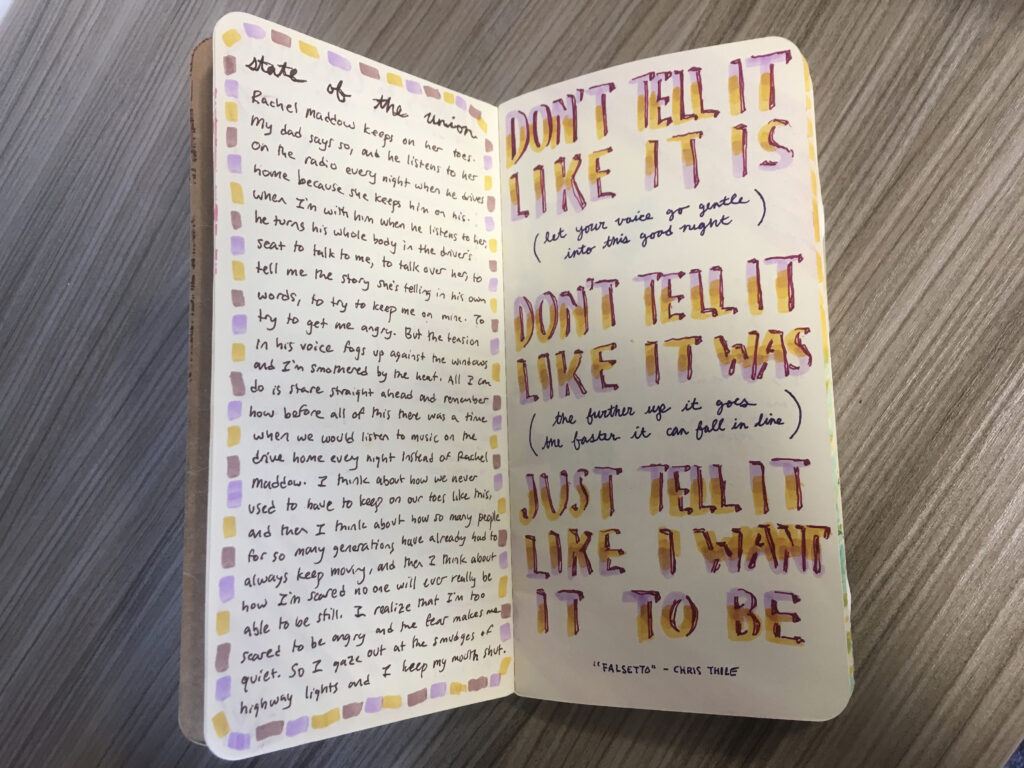
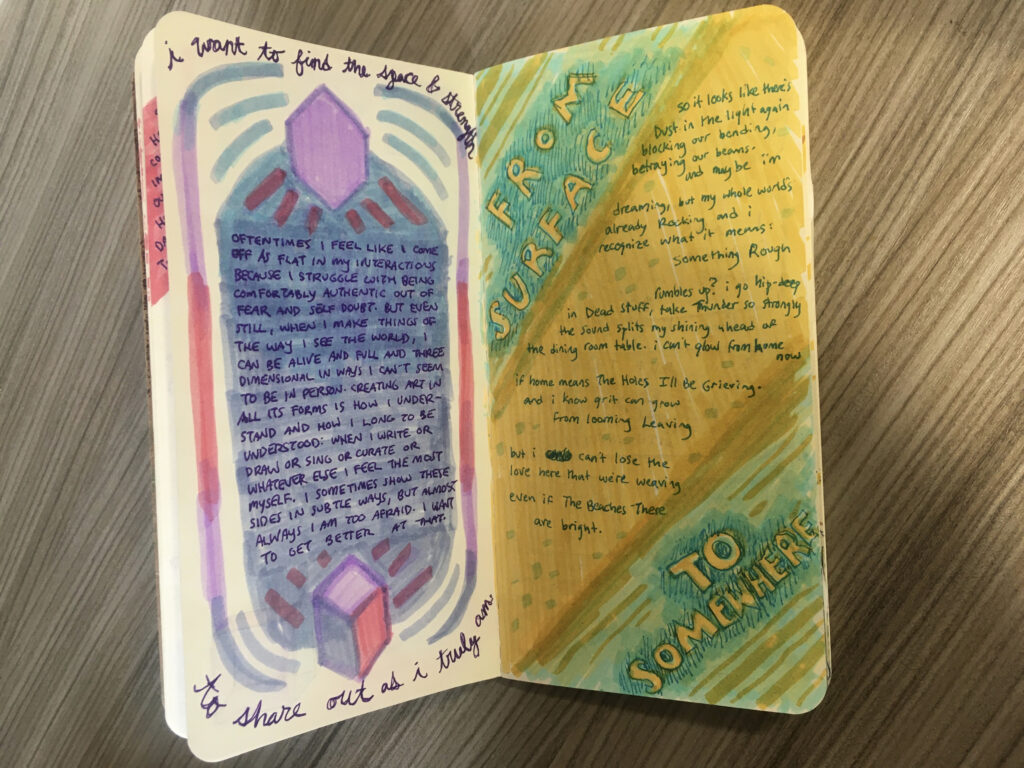
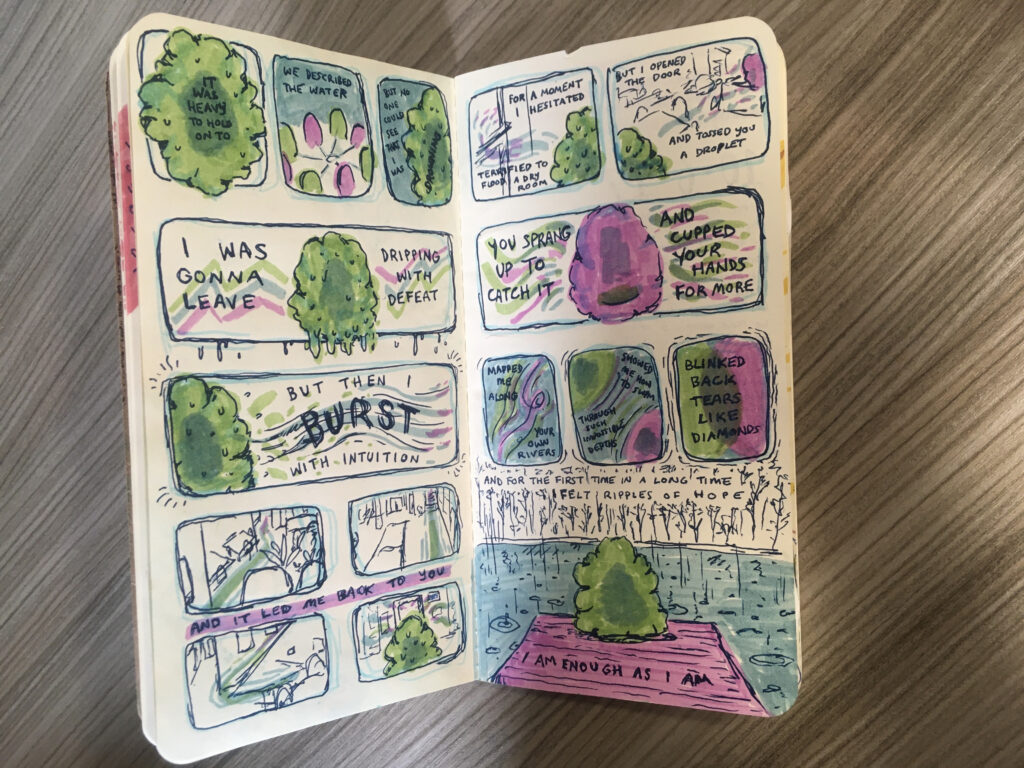
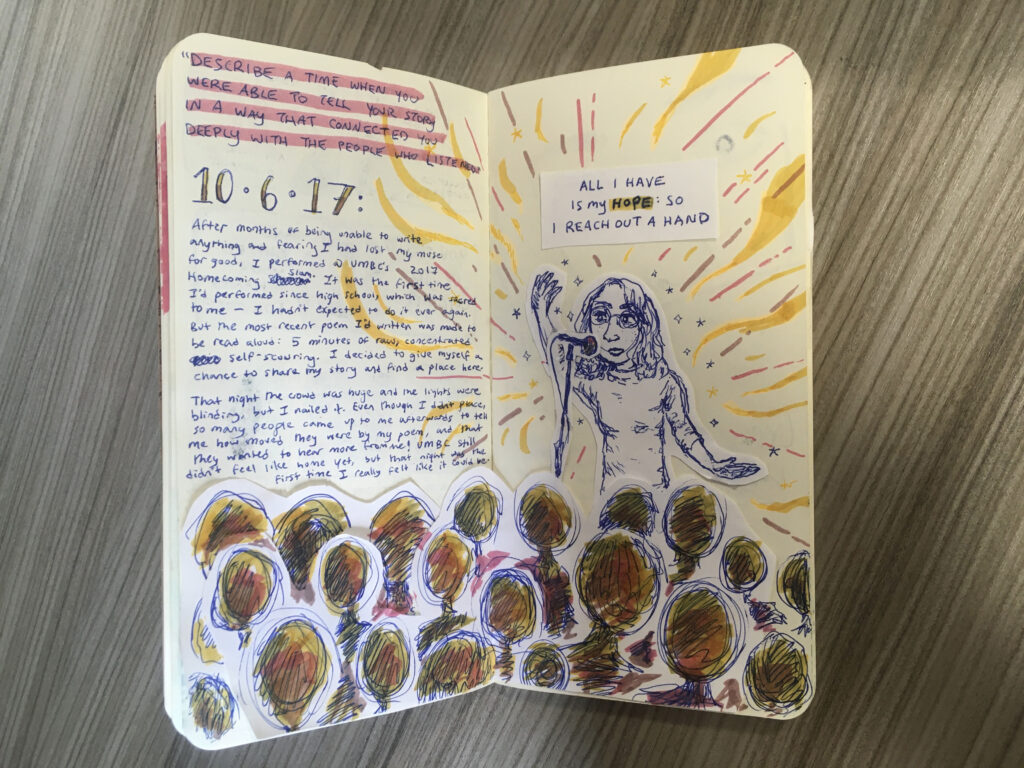
In grade school, we learn about the importance of voting. At UMBC, we learn that civic life can really mean much more. It is a mindset, strengthened by places and relationships, to empower change at big and small levels. And the Civic Courage Journaling Project, launched last year by UMBC’s Center for Democracy and Civic Life, is helping students imagine exactly what that might mean on an individual basis.
Art courtesy of Tess McRae ’21.
“We give them a way to really see themselves without all of the kind of filters that are placed on you when you’re under so much pressure and when you have all these different tensions,” says Tess McRae, a junior English major who both participates and shares prompts with the group. Members respond in visuals as well as with words. Then, they all circle up to discuss and discover.
“People don’t realize that we talk about civic life everywhere, even in our day-to-day interactions, even in the conversations that we have with each other, even in spaces where we didn’t realize,” says McRae, who personally prefers using muted highlighters in her drawings. “We kind of give people a space to just really be authentic and honorable about their stories. It’s wonderful.”
— Jenny O’Grady
Safety in Numbers
Every 10 years, the U.S. Census Bureau conducts a massive survey to answer one question: Who lives in the United States? The results inform federal funding allocations for things like schools and parks and determine the number of congressional representatives for each state. The raw data are also used by researchers all over the country, whose findings can inform decisions at the state and local level about medical services, urban planning, job training programs, and so much more.
Analyzing all that data—consisting largely of personal information about members of communities across the U.S.—can lead to a lot of good, so it’s important that researchers can access it. But even with obvious identifying information like names, addresses, and social security numbers removed, it still wouldn’t be hard for skilled hackers to identify some people using the remaining information, putting them at high risk for identity theft. That’s why Bimal Sinha, professor of mathematics and statistics at UMBC, has been working with the Center for Statistical Research and Methodology at the U.S. Census Bureau for the last seven years to help safeguard people’s information.
It turns out the “raw data” the Census Bureau delivers to researchers doesn’t exactly match the real data. “Before releasing the data, some sensitive items are changed,” Sinha explains. That can include numeric responses, such as salary, or categorical ones, like whether a person owns a car and what type. The process of changing the data is called perturbation,” and the techniques used depend on the kind of data.
The tricky part is that the “perturbed” version of the data still has to accurately reflect reality in the country. Change it too much or in the wrong ways, and it becomes useless. “It’s a balance between perturbation and utility,” Sinha says. As a statistician, it’s Sinha’s job to develop techniques to change the data in ways that protect people’s privacy but don’t render it unusable.
Once that’s been done, it’s also critical to help researchers analyze the data effectively. The method for analyzing a perturbed dataset is different than for a standard data set. So Sinha also helps develop a toolkit that researchers receive with the census data.
Overall, Sinha’s work allows researchers, state and local governments, non-profits, and others nationwide to make use of the largest dataset about humanity in the United States, without compromising people’s privacy or safety.
— Sarah Hansen, M.S. ’15
Walking the Walk
We all know the importance of getting an internship—real-world experience, networking opportunities, a chance to confirm you’re on the right career path. For these UMBC students, it was also the opportunity to see the inner workings of the political realm as they embarked on semester-long internships with Maryland delegates.
You might think a legislative internship would be all work and no play, but that’s not always the case. One day when Wangui Nganga ’22, global studies, was answering phones in Del. Mike Griffith’s office, she got a bit of a surprise on the other end of the line.
“I heard ‘hello’…and they proceeded to tell me a joke and hung up,” she remembers. “I told my coworker I thought I was prank called by a constituent, but she started laughing and said it was her. This was one of my favorite moments because it showed that people don’t take everything super seriously.”
Nganga’s involvement as a research assistant for a professor in UMBC’s School of Public Policy and speaker of UMBC’s Student Government Association prepared her to do the research necessary to succeed in her internship. The environment itself is welcoming and understands that the purpose of everyone’s work, regardless of political affiliation, is to improve the lives of Marylanders.
Through the Maryland General Assembly Internship Program, Matthew Harrington ’20, political science, had the chance to explore his passions even further.
“I chose to work for Del. Julie Palakovich Carr because she sits on the Ways and Means Committee, which deals with tax policy, which is my policy area of interest,” says Harrington.
In his short time there, Harrington had the opportunity to present a bill about reforming zone programs in the Ways and Means Committee on behalf of his delegate. In addition to the numerous hands-on ways he’s able to be part of the process, Harrington also notes that the free food at Annapolis receptions doesn’t hurt either.
— Kait McCaffrey
Seeing Is Believing
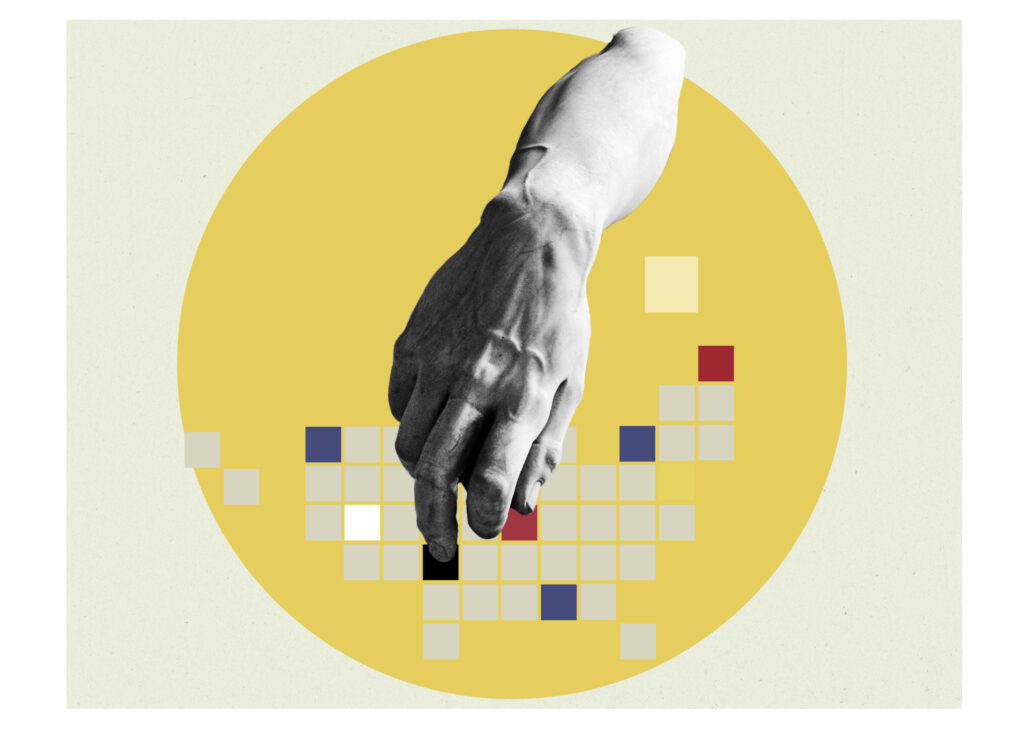
Many of us have trouble digesting straight numbers. And for every hour a journalist might put into clearly explaining a complex topic in a story, an accompanying image can either support or derail that work for the reader in a matter of seconds.
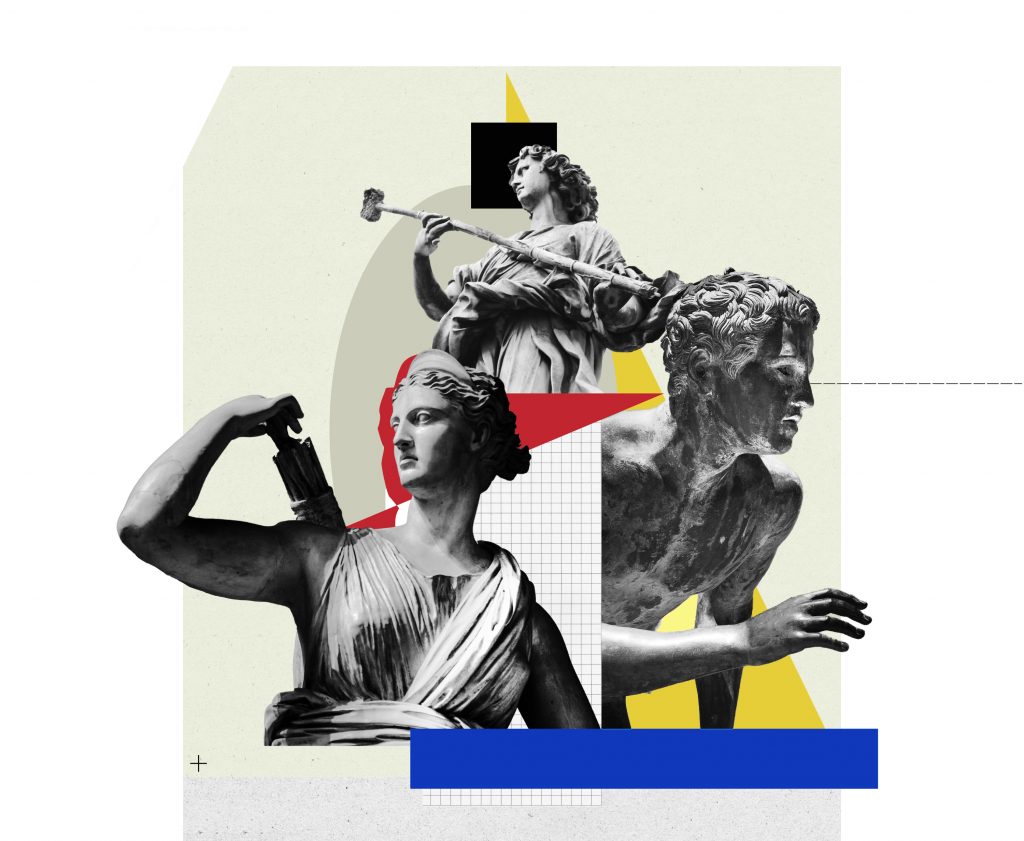
That’s where Christina Animashaun ’13, visual arts and media and communication studies, comes in. As a data journalist for places like Vox, and formerly Politico and The Washington Post, she marries art and data to make the big numbers tangible.
It often starts with a simple question, says Animashaun, who grew up watching the evening news and reading comics before coming to UMBC as a Linehan Artist Scholar.
“A lot of times we have a lot of ideas, and in order to turn them into something tangible—art, or an article—you really have to be able to hone in one question. One big idea.” In the case of a recent major news topic like coronavirus, for example, that might mean drilling through dozens of numbers to help quantify a question like “What do I need to be safe?” Animashaun has made some equally beautiful and scary coronavirus charts recently but also loves to layer archival photographs in fun and surprising ways.
Of course, with great power comes great responsibility. Because Animashaun understands just how much a color or shape choice can sway opinions, she does everything she can to stay as neutral and accurate as possible and bring an ethical point of view to her work.
“You’re not going to see any pinks from me,” she says. “And if it’s blue, it’s going to be a partisan blue.”
There is so much to mourn at the moment. Even those of us spared the worst of the coronavirus pandemic are missing things: favorite pastimes, places and people.
At the same time, pleasure takes unexpected forms, as we find ways to sustain ourselves and others despite sadness and upheaval.
To document the everyday ways people are living and coping with this catastrophe, I launched “Coronavirus Lost and Found,” an online public archive where anyone can log any losses they’re mourning or solaces they’ve found in recent months. Since mid-April, dozens of people from across the United States and the world have contributed posts.
I never intended to inventory a pandemic. My academic research usually focuses on the role of emotion in American wartime culture, especially the forms of suffering that often get overlooked in periods of crisis.
But like most people, I spent much of the early spring unmaking plans. Canceling weekend adventures, gatherings with family and friends and professional opportunities I had worked so hard to arrange was dispiriting enough. I found the thought they would vanish without record to be unspeakably sad.
I created the archive as a space for people to memorialize what could have been – and to record what can now emerge, in its absence.
What’s been lost
Alyssa Samek, a communications professor in Southern California, is expecting her second child and had been looking forward to more frequent swims in the campus pool as her pregnancy progressed.
With the pool closed now, Samek writes, she misses “the feeling of gratitude for the gentleness of the water holding my body so softly, the beauty of the sunny blue sky above me as I lie back at the end of my swim.”
Jessica Grim of Ohio, a retired academic librarian and published poet, lost her “other life” – as a Peace Corps volunteer in Myanmar. Grim was 14 months into her 27-month term teaching English to middle schoolers there when coronavirus forced a hasty evacuation.
The pandemic snapped Grim out of a landscape of “pomelo, rambutan, snakefruit, durian, jackfruit, 15 varieties of mango, 25 varieties of banana,” she writes. Lost, too, are the “quiet streets at dawn in the Muslim quarter.”
Other contributors to the archive lament creative projects interrupted and disconnection from the communities that animated their work. For 15 years Steve Loya, an elementary school art teacher in Sterling, Virginia, has run a popular after-school art club, now canceled.
In one favorite project, Loya encourages experimenting when the kids build whatever they want out of scrap wood. Normally, the final product is a “physical testament to what young people are capable of doing when their imaginations are unlocked and free to wander,” Loya writes.
This year, the sculptures remain unbuilt.
What’s been found
I’ve been astonished by the weight of all the loss shared in “Coronavirus Lost and Found.” But I’m also amazed by the ingenuity with which people have sought and found comfort, even delight.
As the pandemic has scrambled routines, for example, some people have discovered new ways to be with their loved ones.
For weeks, the aggressive pandemic response in Israel compelled Ilana Blumberg, who teaches literature and writing at Bar Ilan University, to stay within 100 meters of her Jerusalem home. That made getting her 10,000 steps a day exasperatingly difficult.
So on “one of the many corona nights,” Blumberg writes, she and her 16-year-old daughter threw themselves an impromptu dance party. As they laughed and sweated, Blumberg found renewed wonder at parenthood, marveling “that I gave birth to the body now next to me, independent and strong and eager.”
Family is a theme of the ‘Coronavirus Lost and Found.’ okeyphotos
Jessica Sanfilippo-Schulz’s “Coronavirus Lost and Found” contribution reflects her perspective as both a mother and a daughter. Time feels different these days, she realizes, opening up new ways to experience both those roles.
Reflecting on a routine maintained for more than two months now, Sanfilippo-Schulz – who lives in Germany – says she has “found every morning a pleasure for long slow phone calls” with her mother, who lives near hard-hit Milan, Italy. And then, “I found in my teenage daughter a keenness to cook slow recipes at lunchtime with me.”
Mara, a health researcher from Seattle, wanted to set new arrangements for co-parenting her two boys, ages 3 and 9, in the midst of her pandemic routine of “juggling, improvising, cleaning, half-working, trying to breathe.”
Ensuring the kids get one-on-one time with both parents under these circumstances, Mara writes, she has learned to be more “patient, understanding, responsive, and appreciative” of her ex-partner. She has even discovered “compassion for his days without [the children], because I know that emptiness and loss.”
But as “Coronavirus Lost and Found” reveals, the losses that truly stagger us are often much smaller. They can’t easily be counted, and they’ll never make the news. The selected stories I featured here, with permission of the authors, testify to the magnitude of a calamity affecting every facet of our lives.
And although the archive requires contributors to categorize their entries as “lost” or “found,” the distinction is not so tidy. (Add an entry to “Coronavirus Lost and Found” here.)
When we grieve a loss, we realize how much something meant before it was gone – a mournful accounting of past pleasures. And any happiness we “find” during the pandemic may well be tinged with sadness.
As the archive grows, accounts of refreshed hope stack up next to stories of days emptied out. The losses and founds do not diminish one another, but simply continue to accumulate, side by side, no end in sight.
The stunning first-round upset of top-ranked and top-seeded Virginia in the NCAA Tournament two years ago put the UMBC men’s basketball program on the map in the United States. But the truth is, there are Retrievers who’ve been playing professionally around the world for years.
In fact, three key players from the 2017 – 18 team—top scorer Jairus Lyles ’17, sociology; starting point guard Jourdan Grant ’18, media and communication studies; and K.J. Maura—are sharing their Retriever gifts in Germany, Latvia, and Portugal, respectively.
For those who want to play basketball professionally beyond the boundaries of the NBA, going out of the country to make a career is a popular option. In fact, some make long careers out of it either in one place or in several.
Cavell Johnson ’09, American studies, played just one season at UMBC, transferring in for the 2007 – 08 season, when the 6-foot-8-inch forward became extremely valuable during UMBC’s first-ever NCAA appearance for basketball. Though the team lost to Georgetown in the opening round, Johnson graduated into a professional career, hopscotching around the world to play for teams in Finland, Hungary, China, and Greece.
Cavell Johnson ’09 dunks during a game.
While playing for the KW (KitchenerWaterloo) Titans, located about 75 minutes outside of Toronto, during their 2017 – 18 season, Johnson took over as coach. He’s now coach and general manager for the team, a part of the National Basketball League of Canada.
“There’s so much love and support here; the people, you hear it all the time…the people in Canada are so nice,” Johnson says. “I get to impact lives now. That’s one of my favorite things I get to do.”
Andrew Feeley ’06, sociology, who played at UMBC from 2001 to 2005, left the United States in the fall of 2006 and played in Japan for three years. After that came a year in France before going to Uruguay, where he’s played for the past eight years. Feeley is 6-foot-10-inches tall and loved being able to both play basketball and see the world.
“I just did it because I had the opportunity, and I thought this is awesome,” he said in a recent interview. “Someone’s going to pay me to play basketball…and I’m going to travel the world on somebody else’s dime. If I had to do it all again, I’d do it the exact same way.”
Feeley’s world may be changing now, though. The league he plays in suspended their season in late March and was scheduled to re-evaluate at the beginning of April. Plus, the 36-year-old got married last August and after a long career playing, the Philadelphia resident says he might like to go into college coaching.
Other former Retrievers play basketball professionally overseas, as well, such as former student Will Wise in Latvia; Ryan Cook ’14, economics, in Kazakhstan; Quentin Jones ’15, business technology administration, in the Bahamas; and Will Darley ’19, environmental studies, in Malta, among others.
In the end, these athletes are getting to fulfill their dreams—playing professional basketball.
“We have been fortunate to have multiple guys go off and play professionally,” UMBC coach Ryan Odom says. “Those guys gain invaluable experience and have a chance to see the world and continue to play the game they love. And once their playing careers are over, they have a degree from UMBC that means a lot when they go enter the workforce.”
— Jeff Seidel ’85
*****
Header image: K.J. Maura takes a shot against Virginia in the 2018 NCAA Tournament.Photos courtesy of UMBC Athletics.
UMBC Magazine caught up with UMBC President Freeman Hrabowski at his home office to talk about alumni leadership during the pandemic, UMBC’s Golden Commencement, and a symbol of hope in tough times.
UMBC Magazine: Given the challenges we’re all facing, it’s wonderful to hear about UMBC alumni making a difference in so many ways. We see Retrievers in health leadership, such as Kizzmekia Corbett ’08, M16, working at the National Institutes of Health on COVID-19 vaccines; U.S. Surgeon General Jerome Adams ’97, M4; Baltimore Health Commissioner Letitia Dzirasa ‘03, M11; and Kaitlyn Sadtler ’11, leading a new COVID study at NIH on asymptomatic patients. We have Mark Doms ’86, the new chief economist of the Congressional Budget Office, and artists like Jill Fannon, M.F.A. ’11, photographing healthcare providers…and so many other inspiring people. How does it make you feel to see our alumni making their mark in these ways?
Freeman Hrabowski: We have produced well-prepared leaders who are committed to the public good all along, from the Maryland Speaker of the House and the Baltimore County Executive to the Chief of Staff for the Governor and the Maryland Secretary of Labor, all the way over to the heads of the Associated Black Charities and the Center for Urban Families. All of these people in a variety of policy and public service roles are leading our country and our communities in supporting children and families.
And we’ve got alumni leading and doing important work across the board, from the arts to the sciences. So across the disciplines, looking through different sets of lenses, people are working to understand and support people in their time of need. And it is very inspiring.
UMBC Magazine: We’ve been thinking a lot about our graduating class, the Class of 2020, and what this semester meant to them, but it’s also the 50th anniversary of UMBC’s first Commencement. Do you feel there are connecting points between the Class of 1970 and our newest graduates?
Hrabowski: I think many people would call the period of the ’60s another generation-defining moment in American history. From the Civil Rights Movement to Vietnam to changes in voting rights in our country, we saw civil unrest, and we also saw some progress. We saw the assassination of a president, John Kennedy, the assassination of Martin Luther King Jr., and the assassination of Senator Robert Kennedy—all in an eight-month period during the ’60s. People who were graduating in the ’70s had been through those times of great uncertainty and tragedy, very much so, and I relate to and resonate with UMBC’s Class of 1970 because that is also the year I graduated from college. My wife and I were supposed to be going down to Hampton University this spring for our 50th reunion.
The Class of 1970 experienced those things in high school and college—the unrest, the tragedy, and fear—and right now our graduating class of 2020 is having the same type of experiences. Yet beyond the fear about the future, the uncertainty, and the tragedy, we also are seeing Americans come together with people from around the world to help each other. The most important message in both periods, in the midst of the uncertainty, is that we will get through this.
And so there’s this theme of hope in the midst of the chaos and fear and uncertainty. In 2020, as in 1970, we are at a point where we are being tested as human beings and as a society to show who we are at our very core. And the good news, the encouraging news, is that when we as human beings get knocked down, we have this indomitable spirit that pushes us to get back up and to say we can do this. We can go through this, and we can do this. And that’s why the celebration of 2020, as it was in 1970, is a message of hope for humanity.
You know, I saw this picture of the sunrise on campus, and one word popped into my head—hope. My grandmother used to always say, “Just remember that the sun will come back.” That’s a powerful message.
Even before the COVID-19 pandemic, fewer and fewer international students were coming to study in the United States.
While the number of international students who newly enrolled in U.S. colleges and universities during the 2015-2016 school year stood at more than 300,000, by the 2018-2019 school year, that number had fallen by about 10% to less than 270,000.
This trend will undoubtedly accelerate in the fall of 2020 due to the coronavirus pandemic. The American Council on Education predicts that overall international enrollment for the next academic year will decline by as much as 25%. That means there could be 220,000 fewer international students in the U.S. than the approximately 870,000 there are now.
As an international education professional, I foresee six major ways that the expected steep decline in international enrollment will change U.S. higher education and the economy.
1. Higher tuition
International students often pay full tuition, which averages more than US$26,000 per year at public four-year institutions and $36,000 at private nonprofit four-year institutions. That matters because the tuition from foreign students provides extra funds to subsidize the costs of enrolling more students from the U.S. At public colleges and universities, the revenue generated from international enrollment also helps to make up for cuts in state funding for higher education.
One study found that for every 10% drop in state funding for higher education, international enrollment increased by 12-17% at public research universities from 1996 to 2012.
According to the Institute of International Education’s 2019 Open Doors Report, 872,214 international students are enrolled in U.S. colleges and universities.
As states cut budgets due to the loss of tax revenue brought on by the economic crisis caused by COVID-19, many institutions of higher education will be forced to raise tuition. While this may help college and university finances in the short term, in the long term it will make it more difficult for international students to be able to afford to study in the U.S., which in turn will make the U.S. a less attractive study destination.
2. A weaker economy
International students contribute an estimated $41 billion to the U.S. economy. However, the actual figure is surely much higher considering these students also pay various taxes to federal, state and local governments.
While a decline in international enrollment will financially hurt American colleges and universities, it will also decrease the profits of local businesses and the tax revenues of state and local governments. While college towns are likely to be the first affected, the long-term impact of fewer international students will ultimately be fewer jobs for Americans. How? Well, consider the fact that former international students founded nearly 1 out of every 4 startup companies in the U.S. individually valued at $1 billion dollars or more. Fewer international students now means fewer startups later.
3. Less innovation
One of the strongest factors that influences future international scientific cooperation is having students study in different countries. This ability to collaborate across borders is critical to addressing the world’s greatest challenges, from combating climate change to eliminating COVID-19.
Additionally, economists at the World Bank estimate that a 10% increase in the number of international graduate students in the United States raises patent applications in the U.S. by 4.5% and university patent grants by 6.8%.
Worldwide, research and development is valued at nearly $2 trillion. The U.S. share of that research and development is smaller today than it was in 2000. I believe having fewer international students will only serve to make it even smaller.
International students who participate in Optional Practical Training – a program that allows these students to gain practical experience in their field of study by working temporarily in the U.S. – help employers fill critical positions when they are unable to locate qualified U.S. workers. This is particularly true in certain science and engineering fields. The Trump administration is looking at putting restrictions on the program, it was reported on May 24.
As international enrollment declines, U.S. employers will have a harder time filling jobs. This may lead companies to look for talent in other countries – or possibly relocate jobs abroad.
Since only 10% of U.S. students study abroad prior to earning their bachelor’s degree, international students play an important role in exposing U.S. students who never go abroad to international perspectives. In essence, international students bring the world to campus and increase access to global learning for all. The result is a more globally competent workforce, which is important considering that 1 in 5 jobs in the U.S. is tied to international trade and 93% of employers value employees who can work effectively across national and cultural boundaries.
6. Less U.S. influence
While more than 300 current and former world leaders were at one time international students in the U.S., other nations are making concerted efforts to catch up. If there are fewer students from other countries studying in the U.S., it will lessen the ability of the United States to touch the hearts and minds of future world leaders.
We can all agree it was not supposed to be this way. Commencement—as President Freeman Hrabowski often reminds graduates during the ceremony—is a dignified occasion, deserving of the phrase “pomp and circumstance.” It’s also a day for jitters, lining up with your classmates in the hallways of the Event Center, and being mindful of your feet when crossing the stage. It’s a day for loud, celebratory shouts and enough clapping to make your palms feel sore afterward. Commencement is a day for shaking hands with your mentors, for hugging your suitemates and best friends so hard your mortarboard cap falls off. In short, the culmination of your time at UMBC is a full-body experience, and our class of 2020 deserved to have that day.
With traditional end-of-studies rites of passage not possible this May, our 2020 graduates are finding ways to acknowledge what they’ve lost but also celebrate their hard-earned achievements. Until we’re able to commemorate them in person, UMBC Magazine wanted to give a special shout out and send off to our 50th graduating class.
Graduating college was just something everyone in my life expected me to do—why celebrate it in a three-hour ceremony? The diploma would be mailed either way.
But as the second semester of my senior year got closer and closer, I started thinking about my “lasts” and I realized that I wanted to experience the culmination of four years’ worth of blood, sweat, and grit, and I wanted to do it with my friends.
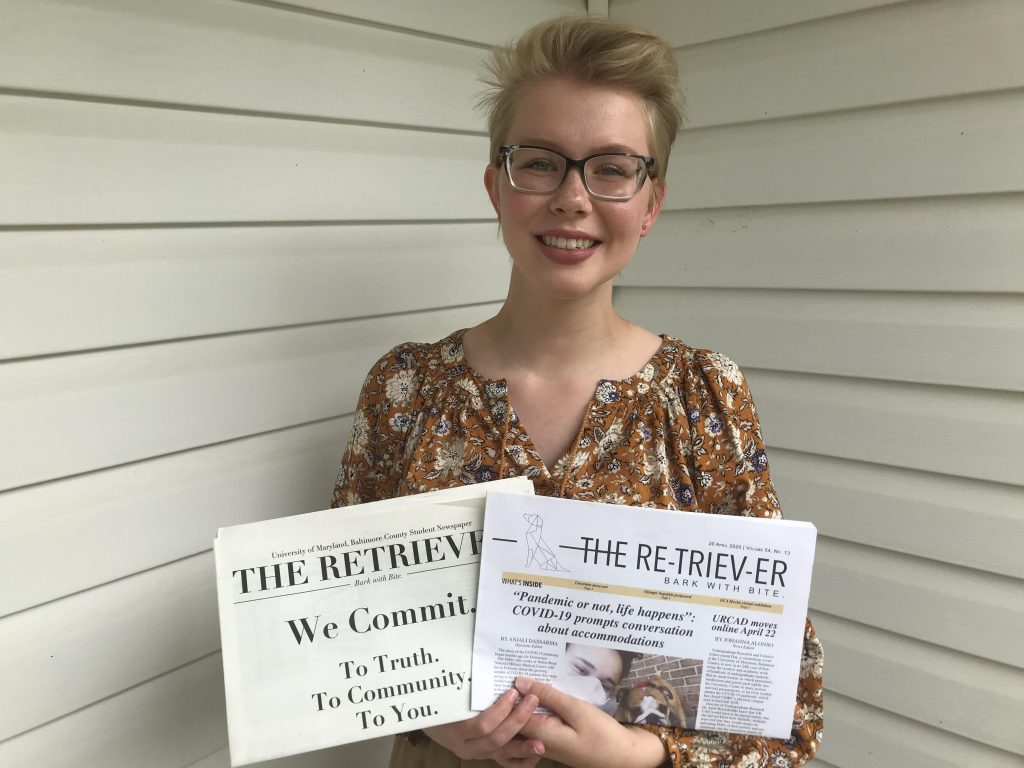
Julia Arbutusis the outgoing editor-in-chief of the campus newspaper, The Retriever, and a proud member of the Class of 2020.
We’ve all spent four years of our lives—some, even more—working towards our degrees, and it’s difficult to think of the last moments we have missed.
We’ll never get to experience our last day of classes, or our last club meetings, or our last late night chicken tenders. We’ll never get to experience the butterflies in our stomachs as we wait for our names to be called so we can walk across the stage after a (last) week of finals, pretending that we can pick out our moms in the crowd.
While it hurts that we weren’t able to have the same May graduation ceremony as the 49 classes before us, it helps to know that if we could make it through college, we can make it through this, too. And though the future’s uncertain, one thing I know for sure is that we’re all in this together, just as we have been for the last several years.
We’ve conquered Chem 101, given our first 15-minute presentation, written countless essays, and survived distance learning. We’ve pulled all-nighters in the Retriever Learning Center to complete assignments due at 8 a.m. the next day, spent days running on coffee, and have ordered more Domino’s pizza than we might care to admit.
We’ll remember the “plagues” that struck campus, causing campus-wide losses of power and water; the tree that mysteriously appeared on Erikson Field during the 2017 fall semester finals week—appropriately dubbed the Finalmas tree—and the first time we got really and truly spooked by a campus squirrel eating Chick-fil-A. We’ll remember the feeling of staying up late with friends, living exclusively on Admin sandwiches, and scrambling to find last-minute parking.
Personally, I’ll also miss the baristas at Starbucks, who remembered my name and my order, the newsroom tucked away on the second floor of the University Center, and the ground floor of Fine Arts, where I could often be found pretending to dance for an upcoming Musical Theatre Club production.
All of these memories have people attached to them, and they’re perhaps the most important. We haven’t done it alone, and while it was hard to have to give up our last, perhaps most formative, semester, it’s easy to remember the people who were there by our sides, helping us through.
Professors who have had our backs from the beginning and don’t mind if we drop by their office hours unannounced. Staff who have taught us more than we seem to be able to get from a classroom. Advisors who have checked in on us outside of advising season to make sure we’re okay. Friends who have been there since freshman orientation, and friends we were only just beginning to make this semester.
Though we may not have been able to give everyone a proper goodbye, and we might now wish that we took a little extra time to relax, we will remember the moments with each other more than anything else.
So I think we deserve it when I say:
Congratulations, Class of 2020.
We made it.
Julia Arbutus is the outgoing editor-in-chief of the campus newspaper, The Retriever, and a proud member of the Class of 2020. A double major in financial economics and English, her next step is a master’s in journalism at the University of Maryland, College Park.
Nothing Left to Say, but ‘Thanks’
We reached out to the graduating class to ask about warm memories and shout-outs to fellow Retrievers they’d like to share. From an ode to the campus squirrel population to words of gratitude to mentors; from virtual hugs of suitemates-turned-best friends to memories of closing curtain bows, what we heard was a genuine outpouring of love for our UMBC community.
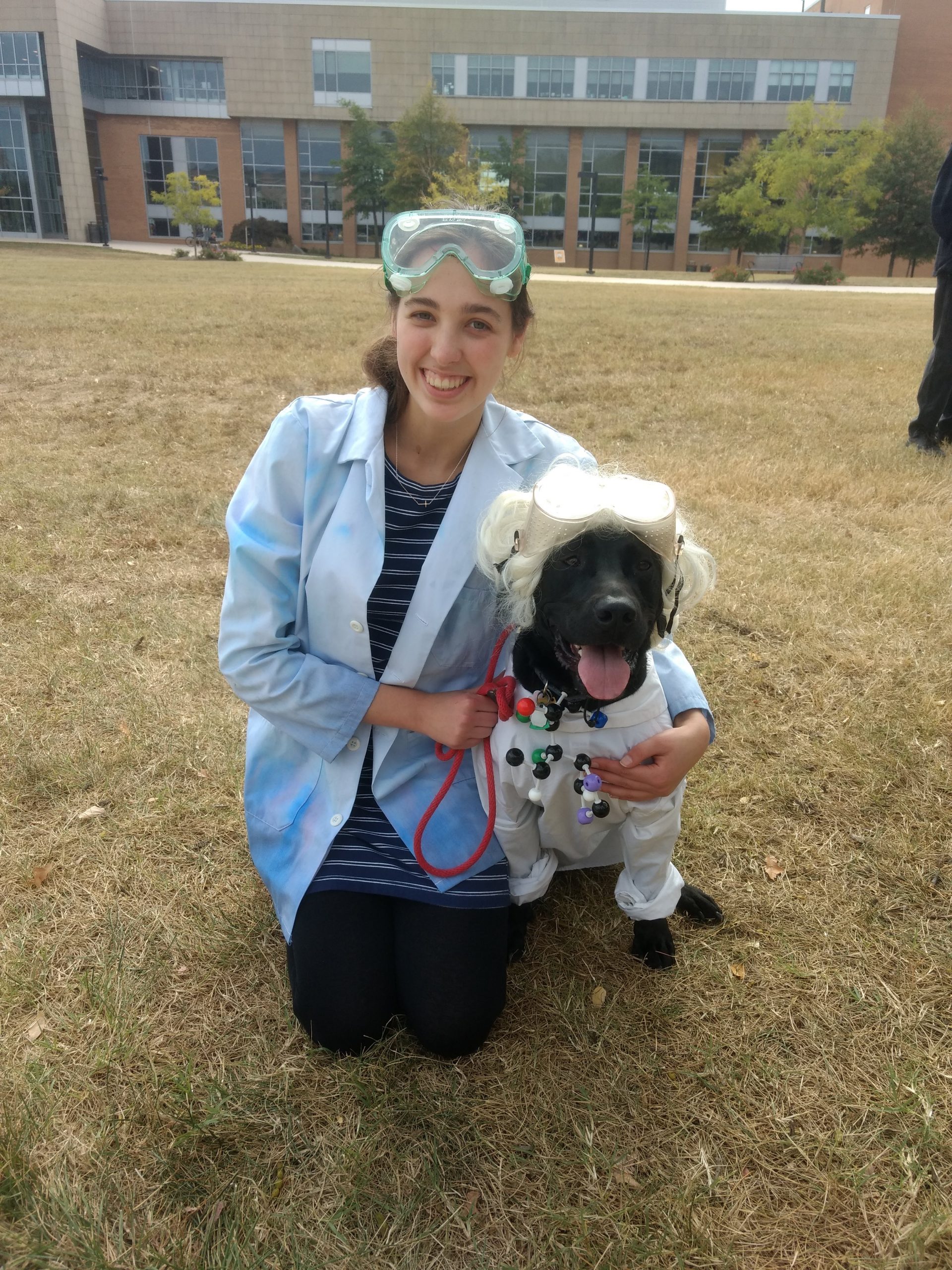
As a biology major who spends a lot of time in labs, I’ve always joked that Stella-Blue—my sweet Labrador Retriever—is my “lab assistant” or my best “lab partner.” For the UMBC Homecoming Puppy Parade, I brought Stella to campus dressed as a scientist, complete with an Einstein wig! I was delighted when Stella won the Puppy Parade Costume Contest. Finally, her role as a “lab assistant” was made official!
—Anna Marie Schuster, biological sciences with her “lab partner” and human friends.
One of my favorite memories is the last day of my first semester of teaching the cinematic/animation course Visual Concepts 4. It was my first time teaching a college-level course, and I felt a great sense of accomplishment in myself and in my students as we screened their impressive short films.
—Adan Martinez Rodriguez, M.F.A., intermedia and digital art, at Homecoming 2019.
Residential Life Facilities is a group that made my time at UMBC amazing. I was a maintenance assistant for three years. Every year, the group’s dynamic changed with new MA’s added, but yet every semester was always so memorable. Working with the MA’s, I learned about how to fix various things in the residential buildings, but I also learned about each MA’s different cultures and experiences at UMBC. My entire UMBC experience would be very different if I was not an MA.
—Sarah Sinnokrot, mechanical engineering, back row, fifth from left, with the other members of the maintenance assistance staff.
One person who has made my time at UMBC amazing is Professor Susan Blunck, part of the elementary education department. Dr. Blunck has been not just my professor for many years, but my friend, support system, mentor, and confidant. She’s pushed me to my full capacity and I cannot wait to take everything she has taught me into my future elementary classroom this fall. You rock, Dr. Blunck!
—Brooke Lauren Edwards, psychology, interning at Relay Elementary School. She’s since accepted an elementary teacher position at this same school in the fall.
I remember the first day I walked into the Women’s Center. I finally found a space where I felt that I belonged. This was so important to me because I felt as though I was the only non-traditional student and would not find a community where I felt I belonged. As a single parent, this gave me a safe place to concentrate on work, and if I needed anything such as extra food, supplies, or just to talk to someone, I had Jess and her wonderful staff.
—Joanna Riley, social work, with her son Christian Jackson at Patapsco State Park.
I came to UMBC because of Cyberdawgs. My first year on the team, we placed second at Mid-Atlantic CCDC and failed to qualify for nationals. Being a newcomer, I always believed it was my fault. The next year, I resolved to work harder. That was also the point when I was named team captain, something I also wasn’t expecting. Then at Mid-Atlantic CCDC, we fell short again. As captain, I still felt that a large chunk of the blame could be placed on me. With a little shoving from my teammates Zack Orndorff, Seamus Burke, RJ Joyce, and Cyrus Bonyadi I realized it couldn’t entirely be my fault. They eventually pushed me to run for president. Since then, we’ve won the Department of Energy’s Cyberforce Competition, Maryland Cyber Challenge, SANS Netwars Tournament of Champions, and most recently Mid-Atlantic CCDC. I am constantly amazed at the brilliance of the people I’m surrounded by. I truly believe I’m working with the best in the field.
—Anna Tegla Staats, computer science, has been a member of the UMBC Running Club all four years and was a walk-on track and field athlete.
Just one of my favorite memories at UMBC is my first day of work as a Graduate Assistant for Assessment in Residential Life. It was my first day interacting with the department and also my first department meeting where we had homemade ice cream made with dry ice as an “ice breaker.” What makes that memory so special to me was the amount of warmth and level of inclusivity I felt from my supervisor, the department, and my fellow graduate assistants. I did not attend UMBC for my undergraduate years, so I was beyond touched by how welcomed I was made to feel. That feeling has absolutely continued throughout the last two years and I will be sad to leave upon graduating next month.
—Katherine Edwards, MPP, with her fellow graduate assistants.
Special thanks has to be given to my parents who always support and encourage me. I am eternally grateful. My fellow Humanities Scholars have helped to make my time at UMBC amazing. I’ve gained and learned so much from having classes with you, living with you, and just being with you. To each of the graduating Humanities Scholars (as well as those to come), I am so proud of you. You will amaze the world with your brilliance.
—Kara Deonna Gavin, English, center, with friends on the first day of school in 2016.
Retriever Rally
To encourage the class of 2020, UMBC alumni from the past five decades of graduating classes submitted notes to cheer them on as they launch to their next adventure. Here is a small selection.
The next few months will feel like being pushed off a cliff and being expected to fly. While it can feel scary, embrace and enjoy this time of growth—the world is just starting to open for you.
—Mandy ’09, psychology
Incredible opportunity will come from every circumstance, if you continue to apply your grit!
—Bennett Moe ’88, visual and performing arts
Sharp, friendly graduates are always in high demand. Celebrate your accomplishment and keep moving forward fearlessly—you got this!
—Kristen Avery ’16, MLLI
Through your strength and creativity, confidence and humility, you will lift every voice and solve the hardest problems ever faced.
—Patrick Ellis ’04, geography
You have worked so hard, and deserve to celebrate yourself and your huge accomplishment! You are enough and filled with good for yourself and the world.
—Fio Haire, ’17, computer science and mathematics
Tune in!
Even without an in-person Commencement this May, you can still hear the Class of 2020’s valedictorian speeches and more graduation celebration content online at umbc.edu/classof2020 and umbc.edu/together.
Lydia Coley, Valedictorian for CAHSS, Erickson, and Social Work
Zakary Newberry, Valedictorian for COIET, CNMS, and INDS
*****
Header image by Marlayna Demond ’11. All other images submitted courtesy of the subjects.
In his more than a decade of service to UMBC through the Alumni Association Board of Directors, outgoing president John Becker ’01, information systems, has seen a little bit of everything. As he passes the torch of leadership, Becker thinks back to some of the moments—and the people of our community—that have meant the most to him.
I’m writing this column from my dining room table, while my wife leads my two children in a home-schooling session on peregrine falcons. There are no pressing activities. There is nowhere to be—in fact, we are not allowed to be anywhere else. (I can’t say “gotta run” at the end of phone calls anymore.) This is strange for us, and I’m sure some of you have also felt a sense of surrealism. We’re sheltered in place, waiting for the seemingly inevitable house call we will be receiving from the novel coronavirus.
While our inability to work during this lock-down is a dark cloud on the horizon, I am finding silver linings. We are spending more time (and more meaningful time) together. We are closer now than ever with our neighbors and we are in touch daily with our out-of-state parents. I have also had time to pause and reflect on the past several years in a way that I rarely can when we are rushing around with daily routines and extracurriculars.
The 10 years that I have served on the UMBC Alumni Association Board of Directors have been among the most rewarding years of my life. Some of that reward comes from a sense of debt repayment—a sense of fulfilling an obligation for the many gifts I was given while I was a student here in the late ’90s. But in thinking about it more deeply, I realize it is something else— Retriever pride—that feeds the beast.
Reaching Together
Our UMBC has been accomplishing great things for decades socially, academically and athletically. There are bread crumbs trailing all the way back to 1966 that a nostalgic alum or prospective Board member could discover or remember that would kindle that fire—that pride—within them. Among my fellow Board members, I found a common interest in recalling formative years, assisting those students we recognize so clearly as a reflection of ourselves, and planning for an enduring legacy.
The highlights of my time on the Board could fill this magazine, but one thread that shines through is that the alumni have become increasingly involved over time. This truth reflects the hard work of our Director of Alumni Engagement, Stanyell Odom, and her team, the acknowledgement of the role we play in the university by Vice President of Institutional Advancement, Greg Simmons, M.P.P. ’04, and of course the curiosity of our great alumni, which often foments into a desire to return and help in a meaningful way.
Exceptional by Example
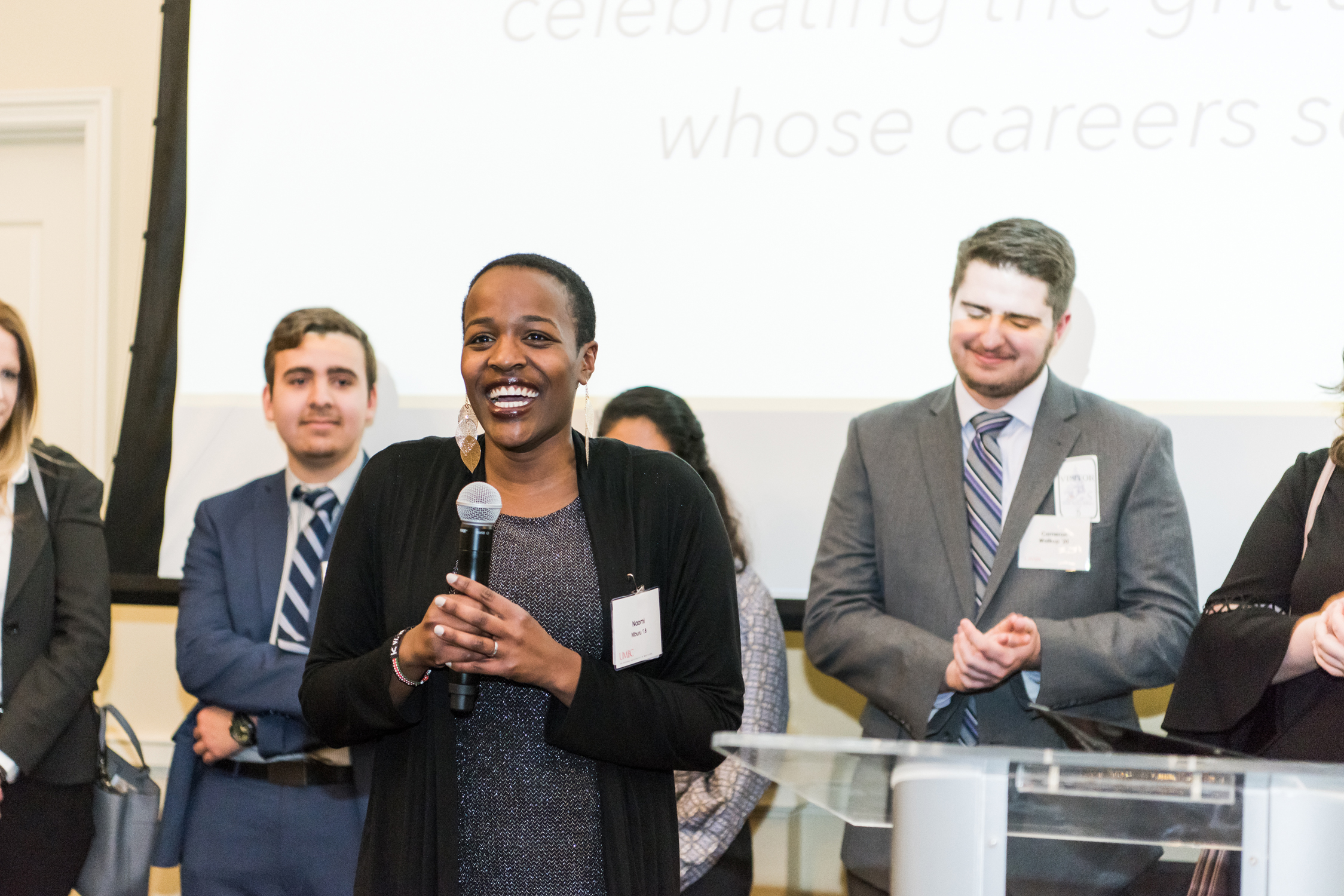
I vividly recall meeting Naomi Mburu ’18, M26, chemical engineering, UMBC’s first Rhodes Scholar at our Annapolis Alumni Reception, learning her story and being inspired by her determination. This reception, held in winter each year and hosted by the Board of Directors has allowed us to meet our state’s leaders who are UMBC alumni themselves, learn their perspectives, and find common interests through our ties to UMBC.
Naomi Mburu ’18, M26, chemical engineering, UMBC’s first Rhodes Scholar speaks at the 2018 Annapolis Alumni Reception.
Jerome Adams ’97, M4, biochemistry and molecular biology, the Surgeon General of the United States speaks at the 2019 Alumni Awards.
The growth of the annual Alumni Awards gala has been another source of pride for me. What began for me as an intimate affair in our library’s gallery has blossomed into a spectacle with hundreds of guests held in the Linehan Concert Hall in the Performing Arts and Humanities Building. I’m stunned every year by the unique, inspirational alumni I meet across all disciplines and from all walks of life. Last year I had a chance to speak with Jerome Adams ’97, M4, biochemistry and molecular biology, the Surgeon General of the United States, who is now at the tip of the spear in handling the COVID-19 pandemic. What struck me about Dr. Adams was how down to earth and family-oriented he was. He demonstrated a sense of perspective that was refreshing to see in a person in his position of national leadership.
And I am proud of leading the effort to develop and successfully reach an audacious fundraising campaign for the Alumni Endowed Scholarship, doubling our market value in four years and allowing the funds raised by the Board to leave an enduring legacy of scholarship on generations of deserving students.
A Proud Legacy
The thread linking these events and milestones is the people. UMBC is ripe with talented alumni, faculty, staff and, of course, talented students and student-athletes. My engagement with bright, energetic, and driven individuals is what keeps me coming back for more. If you haven’t been back to campus lately, please accept this invitation. I want you to see the intelligence, diversity, passion, grit, and greatness that I have enjoyed, and maybe in the process find something you left behind.
Dr. Hrabowski likes to remind us every year at Commencement that “success is never final.” As we embark on a new fundraising campaign for the Alumni Endowed Scholarship and I pass the torch to Brian Frazee ’11, M.P.P. ’12, I am at ease knowing that our success will continue and our future is bright. Thank you for the opportunity to serve you.
***** Learn more about ways of engaging with UMBC at alumni.umbc.edu.
Header image: John Becker with President Hrabowski and the U.S. Surgeon General, Jerome Adams. All photos by Marlayna Demond ’11.
In 1980, while spending the summer with family in South Carolina, 13-year-old Karsonya “Dr. Kaye” Wise Whitehead noticed that the corner grocery store owner had kept up the “Whites Only” and “Colored Only” signs. She was offended and wanted him to take them down. The teen decided to stage her first protest. She told her grandmother that she was going to march every day in front of his store until he took the signs down.
The proprietor took them down from the counter. But he later had them framed and put on the wall to make them “art.”
“My grandmother gave me a similar framed ‘Colored Seating Only’ sign so that I would always remember that moment in my life,” says Whitehead, Ph.D. ’09, language, literacy, and culture.
While she didn’t get the exact result that she wanted, Whitehead did see that her actions could make a direct change in her community. This lesson would guide Whitehead as she found ways to amplify her voice.
“It changed my life,” Whitehead says of the language, literacy, and culture program. “I knew that I wanted to be in a field where I could research, write about, and teach Black women’s history.”
After living in New York City—working first at MTV and then at a PBS affiliate making documentary films—Whitehead, along with her husband Johnnie and their sons, Kofi and Amir, moved to Baltimore 16 years ago. She taught in Baltimore City middle schools for four years and was named Maryland History Teacher of the Year before she left to pursue her Ph.D. in language, literacy, and culture in 2006 at UMBC.
From teacher to student
In 2005, Whitehead was still working as a teacher when a friend sent her copies of the 1863–1865 diaries of Emilie Davis. “I started reading the diaries at night, and when I realized that I was reading the diaries of a free black woman, I knew that I wanted to transcribe and publish them,” recalls Whitehead. Because she didn’t know how to do this kind of work, she started looking into Ph.D. programs that could guide her.
Whitehead settled on UMBC, remembering the impression President Freeman Hrabowski had made on her years before after hearing him speak at an event. “Like most people, I was amazed by the depth of his passion, his ability to take complicated issues and make them understandable, his desire to get [people] motivated to push beyond their comfort zone, and his dedication to helping Black students—and all students of color—receive their doctoral degrees,” she says. “When I decided to apply to a doctoral program, the only place I wanted to attend was UMBC.”
“Dr. Wise Whitehead’s commitment to both local and national social justice issues exhibits the best of UMBC,” says Kimberly Moffitt, associate professor and LLC program director, “and how we work to support our graduate students in their desires to excel and thrive beyond a classroom setting.”
“It changed my life,” Whitehead says of the language, literacy, and culture program. “I knew that I wanted to be in a field where I could research, write about, and teach Black women’s history.”
And that writing Whitehead wanted to do about Emilie Davis? It became her dissertation as well as her first book, Notes from a Colored Girl: the Civil War Pocket Diaries of Emilie Frances Davis.
Taking it to the airwaves
In 2015, Whitehead was approached by Beverly Burke, then-news director of WEAA, 88.9, out of Morgan State University, about coming on to do one- or two-minute African American history spots on the station. At first, she appeared monthly, but then Whitehead began getting requests to come on other hosts’ shows and progressed to being a guest host. Three years ago, the station’s general manager Malarie Pinkard Pierre approached Whitehead with the idea of giving her an afternoon slot for her own talk show.
Whitehead was thrilled.
Her show, “Today with Dr. Kaye” runs on WEAA, Monday through Friday from 3 to 5 p.m. “It’s unbelievable! That’s prime drive time, when you’ve got three generations in the car listening,” says Whitehead. “To be in that time slot is really exciting. The reception has been phenomenal.”
Whitehead is one of only a handful of black women in the country who have afternoon drive time radio talk shows. Building on the blocks of her early activist efforts and her continued education at UMBC, Whitehead knows that her voice has power. At the start of every show, she begins with, “We have conversations that matter.”
“[We have] conversations that are designed to challenge us, to make us think, to make us laugh, and sometimes to make us cry,” explains Whitehead, who wants her radio show to help make changes in Baltimore. “When I got into doing this show, I made a commitment to speak to, with, and for the people of Baltimore City.”
Whitehead says that her listeners range in age from young children to 85-year-olds, and because the show is on Facebook Live, she has listeners from all over, including callers from Alaska, Canada, and Jamaica. “I tell people that we have a two-hour window where they can come and wrestle with some questions with us and join us at the kitchen table,” says Whitehead.
In addition to her radio show, Whitehead writes a bi-monthly column for the AFRO, op-eds for The Baltimore Sun, and works full-time as an associate professor of communications and African American studies at Loyola University.
While she loves her activist work, Whitehead admits that her greatest joy is being a wife and mom. “Before I had the show, I was a black mommy activist. I was involved in a lot to help my sons…to help carve out a world where they can get home safe,” she recalls.
“Baltimore is a city that’s in a lot of pain, and people are searching for someone who’s going to tell them the truth, listen to them, and fight for and with them. I’ve made a lot of good friends and colleagues who are willing to do battle with me,” says Whitehead. “I’ve fallen in love with this city, and I’m willing to fight to bring about changes.”
*****
All photos courtesy of Karsonya Wise Whitehead Ph.D. ’09.