All posts by: Magazine Editor


Drones to track one of the largest dam removals on the Eastern Seaboard

Matthew E. Baker
Professor of Geography and Environmental Systems, UMBC

This month, the Bloede Dam will be removed from the Lower Patapsco River near Ilchester, Maryland.

The restoration is a one-of-a-kind natural experiment that will help test how relatively inexpensive drones can help scientists like me understand the integrity of streams and rivers.

My collaborators include students and researchers from the University of Maryland Baltimore County, Maryland Geological Survey, Maryland Department of Natural Resources, National Oceanic and Atmospheric Administration and U.S. Geological Survey.

If our approach works, it will allow us to track sediment movement more completely and accurately than ever before, at a fraction of the expense.

What will change

Completed in 1907 and operational for 30 years, the Bloede Dam contained the first submerged hydroelectric plant in the U.S. At 26.5 feet high, it represents one of the largest dam removals on the Eastern Seaboard.

Why remove the dam? The state, federal agencies and nonprofit American Rivers hope to eliminate a derelict public safety hazard.

Taking out the dam will also complement restoration from previous dam removals upstream and expand connected habitat for fish and other aquatic creatures. The Patapsco once hosted major freshwater runs of shad, alewife and American eel, which were blocked by the dam. A fish ladder has proven ineffective at connecting upstream sections of the river with the downstream estuary and the Chesapeake Bay.
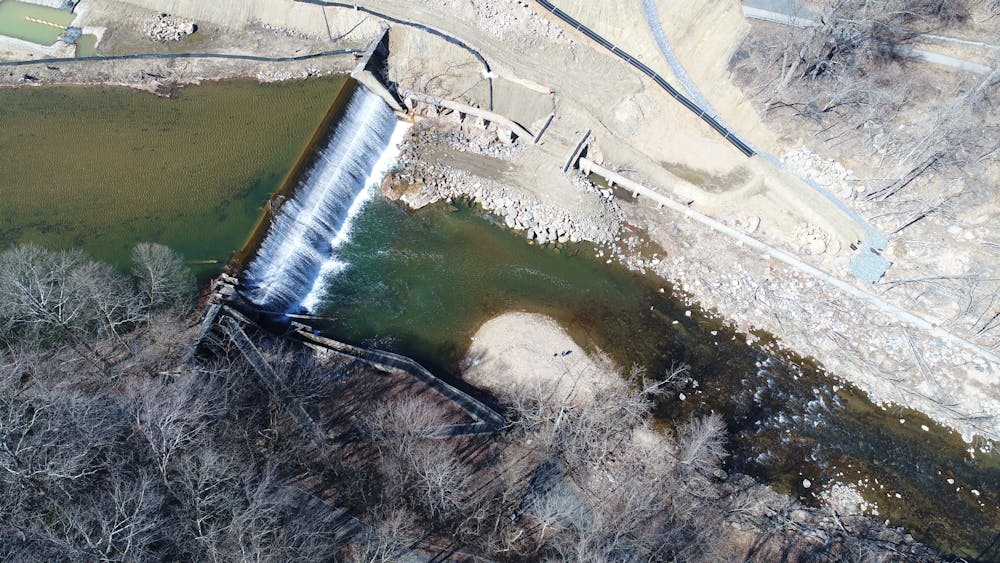
The Bloede Dam in March. The obsolete fish ladder is in the foreground.
Matthew Baker/UMBC

Despite a prominent role in early U.S. manufacturing, the Patapsco Valley has suffered its share of environmental challenges. Colonial shipping was forced to relocate to Baltimore after the original port at Elkridge Landing was choked by sediment from shipping ballast, river bank mining and upstream forest clearing. Once a 10-foot channel surrounded by a saltwater marsh, today the site is fresh and the channel less than two feet deep.

Periodic floods have also wreaked havoc in the narrow gorge, occasionally with catastrophic results. In the past few years, flash floods just upstream in Ellicott City have ruptured the sewer main that runs along the valley bottom and reorganized large quantities of sand, wood and rock in the downstream channel.

Today, the dam stores approximately 2.6 million cubic feet of stratified silt and sand less than eight miles from Chesapeake Bay tidewater. When the dam is removed, we want to know how this much sediment is going to move and how fast.

Why sediment movement?

Understanding sediment movement is critical for river management in every jurisdiction of the Chesapeake Bay watershed.

Sediment helps balance water flow to maintain channel shape and stable habitats for aquatic plants, invertebrates and fish. River sediment is necessary to help estuarine coastlines combat sea level rise. However, fine sediment can also be a pollutant in, or carry nutrients and heavy metals to, downstream estuaries.

Aerial image of the Patapsco River channel showing gravel, cobble and sand deposits.
Matthew Baker/UMBC

Although it’s easy to observe evidence of sediment erosion from riverbanks or hillsides, it’s often unclear where and how much of that sediment is redeposited and stored. Management of sediment storage, particularly behind dams, can be somewhat controversial.

After studying several other dam removals, we expect sediment trapped behind the dam to rapidly evacuate and redistribute downstream over a period of several years.

However, there’s still much we don’t know. Floods following intense storms can move huge quantities of sediment, altering the valley bottom in just hours. Will such storms redeposit sediment elsewhere in the gorge or the coastal floodplain, or deliver it to the bay?

New ways to track changes

It’s logistically difficult to accurately measure large and potentially rapid channel changes.

In a typical field survey, technicians measure water depth, flow, bottom substrate and other information at specific locations. Though stream channels can vary tremendously over space as well as through time, we scientists are rarely able to represent such variability in our measurements. Instead, we collect isolated snapshots in time. That leaves us with less understanding of dynamic sediment movement, devastation wrought by flood waves or the diversity of conditions necessary to support aquatic life.

Gauging stations located upstream and downstream of the dam measure water flow and estimate suspended material like fine silts and clays, but not coarser sands and gravels moving along the channel bottom. Surveys of 30 cross-sections distributed over eight miles provide information about how channel shape and composition vary as one crosses the channel, but relatively little about the thousands of feet in between each transect.

What’s more, after a major flood, scientists must conduct new cross-sectional surveys, taking up to a month in occasionally in risky conditions.

Our team is attempting to add to our measurements by deploying small, off-the-shelf drones that photograph the entire valley bottom. Repeat photographs before, during and after removal can help us track the location of a sediment plume as it moves downstream. They also allow new perspectives of the river.

3D view of a Patapsco River channel point cloud.
Matthew Baker/UMBC

Relying solely on overlapping photos collected both before and after dam removal, we will create 3D computer models of the channel bottom and water depth – not just at the surveyed cross-sections, but every few inches along the channel. Although this technology works best in shallow water, our models should allow us to vastly improve estimates of both the amount and location of channel change as sediment moves downstream.

3D view of the Patapsco River point cloud.

With the new approach, our team collects a photo set of all eight miles in just a few days, and further work occurs within a desktop computer. That means measurements can be repeated or made anew at any time using archived images.

Although we are certainly curious to see how this much sediment moves, we are especially interested in how well we can capture it. If it works, this technology will likely change the way scientists collect measurements and monitor rivers.The Conversation

* * * * *

Matthew E. Baker, Professor of Geography and Environmental Systems, University of Maryland, Baltimore County

Header photo: Bloede Dam (ca. 2016) near Ilchester, Maryland. Matthew Baker/UMBC CC BY-SA 

This article was originally published on The Conversation. Read the original article.

How to conserve half the planet without going hungry

Zia Mehrabi, University of British Columbia; Erle C. Ellis, University of Maryland, Baltimore County, and Navin Ramankutty, University of British Columbia

Every day there are roughly 386,000 new mouths to feed, and in that same 24 hours, scientists estimate between one and 100 species will go extinct. That’s it. Lost forever.

To deal with the biodiversity crisis we need to find a way to give nature more space — habitat loss is a key factor driving these extinctions. But how would this affect our food supplies?

New research, published in Nature Sustainability, found it could mean we lose a lot of food — but exactly how much really depends on how we choose to give nature that space. Doing it right could mean rethinking how we do agriculture and conservation altogether.

A fair deal

OK, but how much space are we talking about here?

There have been numbers flying around since the early 1990s. Some researchers say a quarter of all the space on earth, while others say three-quarters of all land and sea. Those in the middle ground, however, seem to suggest one half.

Leading scientists are increasingly endorsing the figure, including natural scientist E.O. Wilson, who wrote a book on it, and the former chief scientist at the World Wildlife Fund, Eric Dinerstein. These individuals are mobilizing funds, researchers, computing power and social capital to see what it takes to achieve this vision — through their organizations, The Half-Earth Project and Nature Needs Half.

The idea might seem crazy, but then again, maybe we need crazy ideas to get us to think about the better world we might be able to create.

And there is something about handing over half of the planet to nature that has an air of fairness to it — well, on the side of nature at least.

The global agricultural footprint

The reality is, most people would likely want to help save other species too (aside maybe from mosquitoes and some other pesky creatures). The upside seems massive and obvious — not in the least that our children will be able to enjoy these beautiful beings for generations to come.

But is it possible to conserve so much land and still feed everyone?

Agriculture and settlements already cover 37 per cent of the Earth’s ice-free land, so it’s difficult to see how we could set aside half the planet in a way that honours the needs of other species, without losing some of our agricultural lands.

Dinerstein and his colleagues found that some locations, such as the Midwest United States produce so much food that it would be “delusional” to even suggest returning them to nature.

But previous research didn’t quantify or map the scale of these trade-offs at a fine enough resolution to identify what’s really at stake.

Feeding people and conserving species

Our new research did just that.

It found that conserving habitats for other species could cost up to 29 per cent of the calories we currently produce from our food crops. But it also found that these food losses can be minimized to as little as three per cent depending on how that land is allocated to conservation.

If people manage landscapes so they are shared between agriculture and nature conservation — and make agricultural landscapes more kind to other species — it may bring effective results while avoiding large losses in food availability.

The trick here is making our agricultural landscapes less hostile to other life. This is no small ask.

Calorie losses under different Half-Earth scenarios. Land allocations were made by minimizing calorie losses to show the lowest possible caloric costs to Half-Earth under current production.
Mehrabi, Ellis, and Ramankutty 2018

At the country scale, the study identified places where food losses would be large, including India (22 per cent) and China (12 per cent). These two countries have the greatest number of undernourished people on the planet, 195 million and 134 million respectively. It also identified other areas, such as in Indonesia, that may be less available for conservation than previously thought.

Clearly, conflicts between nature and agriculture need to be navigated carefully. Protecting the world’s most vulnerable, malnourished and food insecure populations must remain a priority. And synergies between conservation and poverty reduction need to be the primary focus.

Large potential co-benefits

But it isn’t all bad news.

The study also showed that giving half the planet to nature could increase temperate and tropical forest cover by 30 to 40 per cent, which would help tackle climate change and so likely reduce the agricultural losses from extreme weather.

What’s more, giving nature space might increase aspects of biodiversity important for crop yields like bees — boosting the amount of food we can produce in a given area — and help to offset some of the losses that might come from conservation.

Paula Ehrlich, the president and CEO of the E.O. Wilson Biodiversity Foundation and head of the Half-Earth Project, shared her thoughts on the scientific study:

“Identifying where conservation areas can protect the most species is key to reversing the species extinction crisis and ensuring a healthy planet for all of life, including people. Once identified, conservation protections must integrate into their planning and management systems the cultures and economies of Indigenous peoples, who are de facto the original conservationists.”

A bee pollinates a flower. Photo by Kaj Schmidt.

There can be little doubt that the idea of giving half the planet back to nature is visionary and aspirational. We think these new findings have important implications for how humans see their needs against those of other species.

* * * * * *

The ConversationHeader image by LiCheng Shih.

The authors gratefully acknowledge the contributions of Carly Vynne Baker and Eric Dinerstein to the writing of this article, and Paula Ehrlich for her comments.

Zia Mehrabi, Research Associate, University of British Columbia; Erle C. Ellis, Professor of Geography and Environmental Systems, University of Maryland, Baltimore County, and Navin Ramankutty, Professor, University of British Columbia

This article was originally published on The Conversation. Read the original article.

Why fewer kids work the kind of summer jobs that their parents used to have

Elliot Lasson,
Professor of the Practice and Graduate Program Director, UMBC

Back in the day, most teens had some sort of job lined up for the summer. For some, it was an extension of an after-school job they held during the year. For others, it was a seasonal type of job such as working at a drugstore or as a lifeguard in a pool.

Recently, however, that seems to be no longer the case.

While the presence of teenagers in the summer workforce in July 1978 was at 72 percent, the Bureau of Labor Statistics’ Current Population Survey reported a July 2016 teen labor force participation rate of 43 percent. A recent report by the Pew Research Center analyzed the average summer employment rate for 16- to 19-year-olds in June, July and August 2017 and found that only 35 percent of teens has a summer job.

So, what has happened? Speaking as a scholar who studies generational workforce changes, I can say that there isn’t just one answer but several.

Are today’s teens lazier?

A 2017 Bureau of Labor Statistics white paper provides some reasons that might account for the downward trend in teen employment, including increased summer school attendance, increased parental emphasis on education and competition from other demographic sectors.

One common stereotype is that teens have become lazier. In addition, it’s a ubiquitous observation that teens are tethered to technology and have higher obesity rates than in the past. Both of those contribute to the stereotype. However, 2016 data on “NEETs,” young people who are “Neither in Education, Employment, or Training,” put their number at just 7 percent. The relatively stable and low NEET percentage runs contrary to the idea that today’s teens are lazier.

The role of the gig economy

One explanation is that it’s difficult to track employment in today’s gig economy. For example, a teenager may be working building a website for her aunt’s small business and managing the Instagram account for 10 hours a week. Yet, she will fly below the Bureau of Labor Statistics’ radar and is not likely to be counted as employed.

A second explanation may be a function of changes in the national economy and workforce. For example there is the “Amazon effect.” While in the past, jobs selling T-shirts at the mall or boardwalk were quite common, more people are buying their “stuff” online. As a result, retailers and small shops can likely get by with their existing workforce. So, those jobs are not in abundant supply.

Furthermore, Christopher L. Smith of the Federal Reserve has conducted research that found lesser-educated immigrants are taking on jobs that were traditionally teen-occupied summer jobs. Interestingly, there is also competition from older workers who either remain in the workforce longer or are willing to take “bridge” jobs. In 2015, the percentage of participation in the labor force for those 55 and older was 39 percent, compared to 34 percent for those ages 16 to 19.

In some cases, more young people have been interested in nonpaying educational, experiential or social justice programs. Additionally, there is an ongoing interest in “camps” that combine focus on certain skills like coding and writing with some physical activity.

Higher education quests

Other high schoolers may be taking summer courses to better position themselves for college. This is likely more of a factor in middle- to upper-class families for whom a college-bound trajectory is more automatic, yet is perceived as highly competitive by helicopter parents who are often hyper-involved in facilitating the college goal in high school and as far back as day care.

In addition, there are now clearinghouses for travel opportunities and social justice missions which have become more popular among not only college students but also high schoolers. Having one or more of these on a college application is deemed by teens and parents to possibly be the necessary edge to get into an elite college. In fact, according to Andy Challenger, vice president of Challenger, Gray, and Christmas, a national firm that follows workplace trends, parents are not exactly pushing their kids out the door. “Their parents aren’t forcing them to get a job,” Challenger said. “Parents are saying there are other things you can do over the summer that will create value for you – and you don’t have to go flip burgers.”

Finally, there are problems regarding how employers view young workers in general. According to a survey by the National Association of Colleges and Employers, 89.4 percent of recent graduates rated themselves as proficient in their work ethic and professionalism. Yet, only 42.5 percent of employers shared that view.

* * * * *

Elliot Lasson, Professor of the Practice and Graduate Program Director, University of Maryland, Baltimore County

This article was originally published on The Conversation. Read the original article.

Header image by jessp713

Student Voices for Higher Education and Democracy

Each June, faculty, staff, and students from across the U.S. gather to discuss higher education’s work preparing students to engage in civic life. Below are reflections from five students who participated in this year’s Civic Learning and Democratic Engagement (CLDE) Meeting as members of UMBC’s delegation. The meeting took place in Anaheim, California, from June 6-9, 2018.


Markya D. Reed ’18, Psychology, immediate past Executive Vice President, UMBC Student Government Association

CLDE has helped me recognize the power of the student voice, especially as it pertains to higher education.

The student perspective is unique. If you are a student, higher education is focused on you. The entire existence of this institution (should) revolve around your education, your success, and your development. If an institution is based on your very existence, you (should) have power in that situation. You (should) have the power to challenge the status quo, the power to tackle unhealthy power dynamics, to question tradition, to propose new and exciting ideas, and to voice your opinion regarding how you are experiencing your education. CLDE is beginning to allow students to do just that. This makes for more fruitful discussion, yes, but more importantly it re-enforces the idea of community, ACTUAL community. If we are going to call ourselves a community and function as one, each part of it needs to have a say. All of our voices need to be taken into account and valued. I see that play out in some pockets of campus, but not enough of them. This is precisely the reason I’ve taken an interest in higher education as a career. How can we further communicate the value of student voices? How can we uplift those voices?


Tess McRae ’21, English, immediate past Election Board Member, UMBC Student Government Association

CLDE 2018 was my first foray into the world of civics and democracy. Admittedly, this experience was somewhat overwhelming for me, and the decidedly performative presence of students at the conference only deepened my general sense of displacement. That being said, I left CLDE feeling energized by both my peers from UMBC and the other students I met from schools around the nation to help make the civic landscape on our campus more accessible and inclusive. I now understand the vitality of genuine student inclusion in the process of moving towards a more democratic future, and I believe the experience I had at this conference will help me to shape my own time at UMBC as I find new ways to share and demonstrate the lessons I learned with other students.


Julia Arbutus ’20, English, Editor-in-Chief, The Retriever

This past June, a group of UMBC students attended the 2018 Civic Learning and Democratic Engagement conference in Anaheim, California. I was honored to be a part of this delegation, which was composed mostly of students active within our Student Government Association. As Editor-in-Chief of The Retriever, I was a bit unsure why David, UMBC’s campus coordinator for the American Democracy Project and my former professor, originally invited me to attend this conference – it seemed like it reached student political platforms a bit more than student journalism. Nevertheless, I was positive I would find other students who wrote for their own university paper. However, attending the conference made me realize how underrepresented student journalists – and student activists on the whole – are within academic spaces set aside specifically for democratic engagement. This was why David invited me to attend, to learn to use my own platform with The Retriever to foster (and also seek out and report on) democratic happenings throughout our campus. The role of a newspaper within a thriving democracy is to responsibly educate the public on current events and to encourage – and sometimes facilitate – the public to engage in democracy with each other. I am excited and extremely fortunate to be a part of a platform on campus that can influence so many people in such a positive way, and I intend to bring what I have learned about civic engagement through journalism to further enhance and empower our UMBC campus community.

Scott Buchan ’20, Political Science, Finance Board Representative, UMBC Student Government Association

I went into CLDE 2018 fully expecting that this conference would be a faculty meeting students would be infiltrating. My goal was to connect with other students and gain knowledge from my peers rather than from faculty who I knew wouldn’t take me seriously, and because of this mindset, CLDE 2018 was a wonderful experience for me. I spent my time talking to students and getting to know them better, learning about their experiences, and reflecting on this information. I was able to meet Anna Williams, Israel Alford, and Madelyn Genao from Rutgers University and spent the vast majority of my time with them having many in-depth political conversations about issues such as free speech and immigration. I meet with Oballa Oballa from Riverland Community College and had a meaningful conversation talking about how to increase engagement in student government. I meet with LeAnn Whitley from Georgia College and learned about an amazing program to bring former congresspeople to campus. My take away from CLDE is hope for our democracy. I was taken aback by how extremely well educated and active all of these people are. Everyone I had the pleasure of talking to was doing amazing things in their schools and communities and it inspired me to do the same at UMBC.

Brandon Liu ’19, Biology and Visual Arts, Senator, UMBC Student Government Association; President, Sign of Life

Before the CLDE meeting, I had made two assumptions without realizing it. One was that I would experience the same free-flowing, non-hierarchical communication I had come to expect through my experiences as a member of UMBC’s student government and as a representative on campus shared governance committees. The other was that I would need to monitor my own tendency to over-participate and inadvertently crowd out other voices. 

My actual experience of the CLDE meeting deviated from both assumptions. I was surprised to find that, in a meeting that was centered on civic engagement specifically from students, most sessions were in a lecture format, with the presenters speaking at the front and the audience silent and listening. Very few times did I see the knowledge and prior experiences of the attendees brought into a session, other than as tools for audience engagement (i.e., where are we from//who has experienced this at their institutions?). That teacher-centered session format implies that the lecturers are the only individuals in the room with knowledge worth sharing: that we participants are there only to learn from them, and they are there to teach to us. I could have spoken up and tried to create space for more of us to share (especially students), but I was inhibited by my hesitation to crowd out other voices. I realize now that I need to tailor my participation to the context: giving space to others who have knowledge to share, but also making space when they don’t recognize that I have knowledge as well.

Weaponized information seeks a new target in cyberspace: Users’ minds

Richard Forno
Senior Lecturer, Cybersecurity & Internet Researcher, University of Maryland, Baltimore County

The Russian attacks on the 2016 U.S. presidential election and the country’s continuing election-related hacking have happened across all three dimensions of cyberspace – physical, informational and cognitive. The first two are well-known: For years, hackers have exploited hardware and software flaws to gain unauthorized access to computers and networks – and stolen information they’ve found. The third dimension, however, is a newer target – and a more concerning one.

This three-dimensional view of cyberspace comes from my late mentor, Professor Dan Kuehl of the National Defense University, who expressed concern about traditional hacking activities and what they meant for national security. But he also foresaw the potential – now clear to the public at large – that those tools could be used to target people’s perceptions and thought processes, too. That’s what the Russians allegedly did, according to federal indictments issued in February and July, laying out evidence that Russian civilians and military personnel used online tools to influence Americans’ political views – and, potentially, their votes. They may be setting up to do it again for the 2018 midterm elections.

Some observers suggest that using internet tools for espionage and as fuel for disinformation campaigns is a new form of “hybrid warfare.” Their idea is that the lines are blurring between the traditional kinetic warfare of bombs, missiles and guns, and the unconventional, stealthy warfare long practiced against foreigners’ “hearts and minds” by intelligence and special forces capabilities.

However, I believe this isn’t a new form of war at all: Rather, it is the same old strategies taking advantage of the latest available technologies. Just as online marketing companies use sponsored content and search engine manipulation to distribute biased information to the public, governments are using internet-based tools to pursue their agendas. In other words, they’re hacking a different kind of system through social engineering on a grand scale.

Old goals, new techniques

More than 2,400 years ago, the Chinese military strategist and philosopher Sun Tzu made it an axiom of war that it’s best to “subdue the enemy without fighting.” Using information – or disinformation, or propaganda – as a weapon can be one way to destabilize a population and disable the target country. In 1984 a former KGB agent who defected to the West discussed this as a long-term process and more or less predicted what’s happening in the U.S. now.

The Russians created false social media accounts to simulate political activists – such as @TEN_GOP, which purported to be associated with the Tennessee Republican Party. Just that one account attracted more than 100,000 followers. The goal was to distribute propaganda, such as captioned photos, posters or short animated graphics, purposely designed to enrage and engage these accounts’ followers. Those people would then pass the information along through their own personal social networks.

Starting from seeds planted by Russian fakers, including some who claimed to be U.S. citizens, those ideas grew and flourished through amplification by real people. Unfortunately, whether originating from Russia or elsewhere, fake information and conspiracy theories can form the basis for discussion at major partisan media outlets.

As ideas with niche online beginnings moved into the traditional mass media landscape, they serve to keep controversies alive by sustaining divisive arguments on both sides. For instance, one Russian troll factory had its online personas host rallies both for and against each of the major candidates in the 2016 presidential election. Though the rallies never took place, the online buzz about them helped inflame divisions in society.

The trolls also set up Twitter accounts purportedly representing local news organizations – including defunct ones – to take advantage of Americans’ greater trust of local news sources than national ones. These accounts operated for several years – one for the Chicago Daily News, closed since 1978, was created in May 2014 and collected 20,000 followers – passing along legitimate local news stories, likely seeking to win followers’ trust ahead of future disinformation campaigns. Shut down before they could fulfill that end, these accounts cleverly aimed to exploit the fact that many Americans’ political views cloud their ability to separate fact from opinion in the news.

These sorts of activities are functions of traditional espionage: Foment discord and then sit back while the target population becomes distracted arguing among themselves.

Fighting digital disinformation is hard

Analyzing, let alone countering, this type of provocative behavior can be difficult. Russia isn’t alone, either: The U.S. tries to influence foreign audiences and global opinions, including through Voice of America online and radio services and intelligence services’ activities. And it’s not just governments that get involved. Companies, advocacy groups and others also can conduct disinformation campaigns.

Unfortunately, laws and regulations are ineffective remedies. Further, social media companies have been fairly slow to respond to this phenomenon. Twitter reportedly suspended more than 70 million fake accounts earlier this summer. That included nearly 50 social media accounts like the fake Chicago Daily News one.

Facebook, too, says it is working to reduce the spread of “fake news” on its platform. Yet both companies make their money from users’ activity on their sites – so they are conflicted, trying to stifle misleading content while also boosting users’ involvement.

Real defense happens in the brain

The best protection against threats to the cognitive dimension of cyberspace depends on users’ own actions and knowledge. Objectively educated, rational citizens should serve as the foundation of a strong democratic society. But that defense fails if people don’t have the skills – or worse, don’t use them – to think critically about what they’re seeing and examine claims of fact before accepting them as true.

American voters expect ongoing Russian interference in U.S. elections. In fact, it appears to have already begun. To help combat that influence, the U.S. Justice Department plans to alert the public when its investigations discover foreign espionage, hacking and disinformation relating to the upcoming 2018 midterm elections. And the National Security Agency has created a task force to counter Russian hacking of election systems and major political parties’ computer network.

These efforts are a good start, but the real solution will begin when people start realizing they’re being subjected to this sort of cognitive attack and that it’s not all just a hoax.

Richard Forno, Senior Lecturer, Cybersecurity & Internet Researcher, University of Maryland, Baltimore County

This article was originally published on The Conversation. Read the original article.

Header image by www.cwcs.co.uk

A cooler ocean predator than sharks? Consider the mantis shrimps

Thomas Cronin
Professor of Biological Sciences

When you think about fearsome predators in the ocean, the first thing that pops into your mind is probably a shark. Sure, sharks are OK, with their sleek, menacing shape and their gaping jaws with rows of jagged teeth. But if you were a fish living on a coral reef or cruising along the shore over the sands of a tropical island, you would fear a far more terrifying predator.

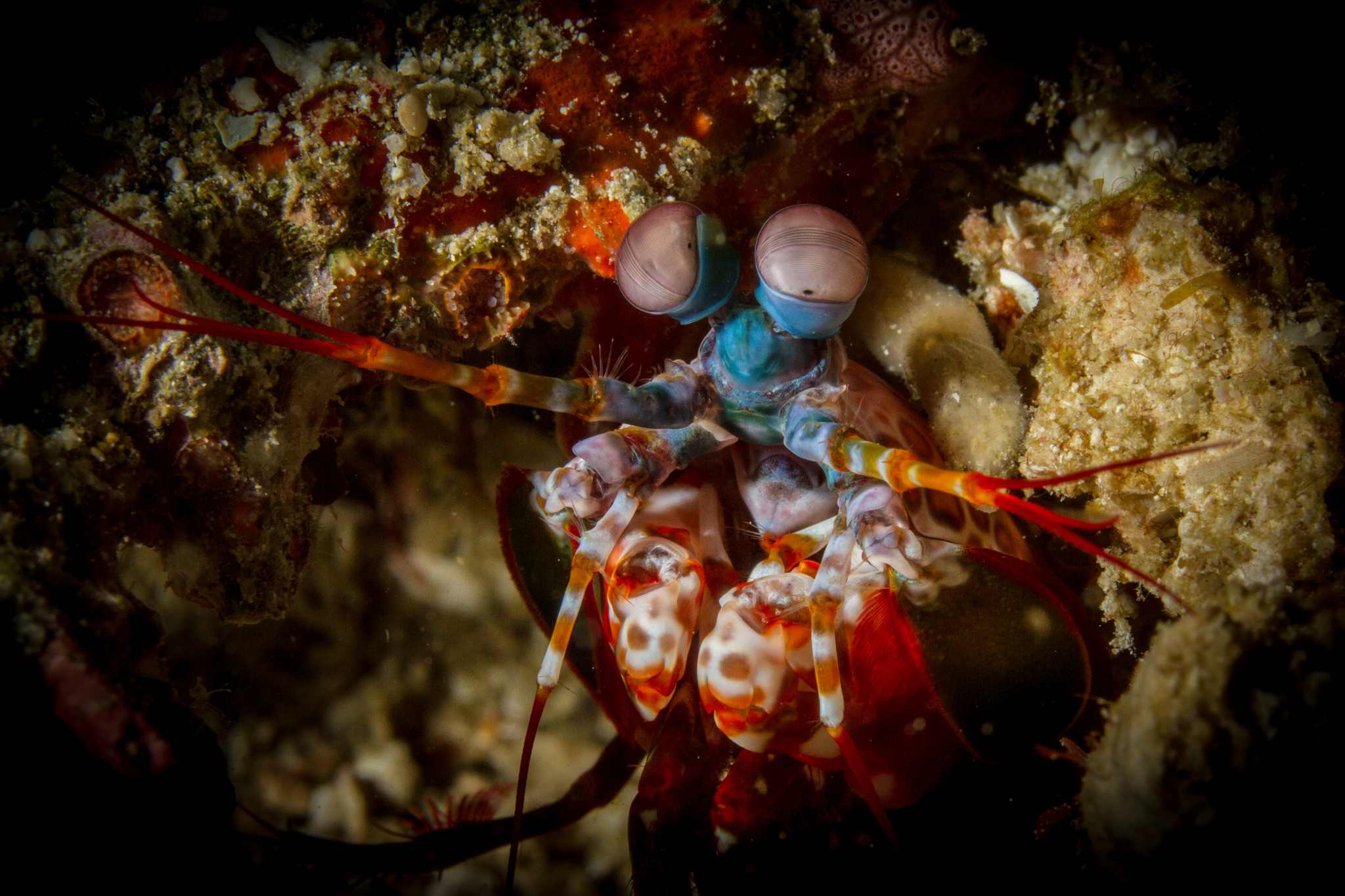
Consider an armored, tank-like creature looking something like a lobster. Most are quite small, often tinier than your little finger, though some can be as long as your forearm. This animal doesn’t swim around like a shark; instead, it hides in the sand or in rocky holes in coral, searching the water above with constantly roving eyes. It can snatch prey right out of the water in a tiny fraction of a second.

And it accomplishes this feat without claws. Instead, it’s armed with a powerful pair of what scientists call “raptorial appendages” that end in a brutal hammer or a series of vicious, pointed spines. These prey-catching arms look somewhat like the front legs of a praying mantis, which gives these creatures their name – mantis shrimps.

They’re crustaceans – the group of hard-shelled animals that includes crabs, lobsters and shrimps. The strength of the mantis shrimps’ raptorial arms together with their amazing eyes make them perfect predators.

Massively powerful predators

Mantis shrimps’ raptorial appendages contain massive muscles that can extend them to their full length in hundredths of a second, producing strike forces that in some species can smash through the glass wall of an aquarium or instantly dismember a crab. These smashing attacks are so forceful they produce tiny bubbles in the water. When these cavitation bubbles collapse in a flash of light, they release additional energy onto the target. Boat propellers and turbine blades are often ruined by cavitation forces; mantis shrimps use them to crack the hard shells of their victims.

Other species, with spiny raptorial appendages, impale fish or shrimp with a vice-like grip that allows the mantis shrimp to drag them down into its burrow – often, in the blink of an eye.

Mantis shrimps – properly called stomatopod crustaceans – first appeared in the oceans about 400 million years ago, and have been evolving on their own route to perfection ever since. By now, they are only distantly related to any other living animal, including ones that arose from their crustacean ancestors. They’re so unusual that they seem to have arrived from another planet – in fact, vision scientist Mike Land jokingly calls them “shrimps from Mars.”

There are almost 500 known species of mantis shrimp. However, they stay well concealed in their rocky and sandy burrows, and only a few scientists study them, so there are probably many new mantis shrimps yet to be discovered. Almost all live in shallow, marine waters, and most inhabit the tropics.

Remarkable eyes of the mantis shrimp

Like all crustaceans (insects, too), mantis shrimps have compound eyes – think of the eyes of crabs, bees, or butterflies. Each eye has hundreds of separate facets, each of which is a single unit of the entire compound eye. But mantis shrimp eyes are far more specialized than all other compound eyes, in some ways more than any other eyes biologists have ever discovered.

For one thing, each eye is like three eyes squeezed into one. The three parts all look at the same point in space, much as our two separate eyes focus on the same scene. We use our two eyes to locate an object in space. Mantis shrimps can work out the distance to objects they’re looking at using a single eye.

Two eye parts, at the top and bottom of the eye, are probably involved in this distance vision. The third part is built from parallel rows of facets that run around the middle of the eye like a belt. Usually there are six rows, though a few species have only two. This part of the eye is called the “midband,” and it supports many special abilities.

Further, most mantis shrimps see ultraviolet light – part of the electromagnetic spectrum that causes sunburn in you or me and that is invisible to our eyes. Mantis shrimps not only sense this light, but with their specialized midbands they even see separate colors of it.

This feature is on top of another set of color detectors that see the same visible light we’re used to – but in eight color channels as opposed to the three primary colors we see. Imagine trying to build a TV that looks right to a mantis shrimp. Besides the red, green, and blue colors that your TV uses to create a vivid picture, it would require pixels for violet, indigo, blue-green, orange and a deeper red than we can see.

And the midband can do even more. It can detect the polarization of light – where all the waves vibrate in the same plane. Our eyes cannot see this property of light. Mantis shrimps image things using it.

So putting together all its visual talents, when a mantis shrimp sees a fish, it’s in patterns of ultraviolet colors, eight primary regular colors and polarized light. Their eyes gather all this information and pass it on to the animal’s brain, so it can decide what to attack, when to attack it, how far away it is, and what it looks like in a dozen different ways. It’s hard for a human to even imagine the visual world of a mantis shrimp.

Letting down its defenses

With superpower vision coupled to explosive predatory arms, it seems like mantis shrimps would be invincible. But even these animals have their worries. Mantis shrimps can not only kill other animals, like fish, octopus or crabs. They can also kill each other. This raises a serious problem. Eventually, it’s time to reproduce – but how does a mantis shrimp know when another one it meets wants to mate rather than make a murderous assault?

Mantis shrimps have been forced to evolve ways to recognize when it’s safe to get intimate and to signal their own nonlethal intent. They use their special vision for this too. Mantis shrimps are often brightly colored, and they display patterns – invisible to us – in ultraviolet and polarized light. The complicated displays inform other members of their species, or of different ones, what they plan to do. If their plans include reproduction, and the viewer is of similar mind, then they can safely mate and initiate a new generation of their species.

So, yes – sharks are all right. But do they have bullet-like strikes? Do they have super-vision? Can they take down prey in milliseconds? It’s mantis shrimps that have these abilities, and they use them to become some of the world’s most impressive predators.

Thomas Cronin, Professor of Biological Sciences, University of Maryland, Baltimore County

This article was originally published on The Conversation. Read the original article.

Header image by jeff~

Americans distrusted US democracy long before Trump’s Russia problem

by Ian Anson,
Assistant Professor of Political Science, UMBC

White House special counsel Robert Mueller recently issued 12 indictments alleging that Russian intelligence agents sought to tilt the vote in Donald Trump’s favor by hacking prominent Democrats during the 2016 U.S. presidential campaign.

The Trump-Russia investigation has exposed flaws in the American democratic system – so much so that, according to many pundits, people now doubt not just the legitimacy of the Trump administration but the very foundations of the country’s political institutions.

According to a July 2018 Brown University opinion poll, only 16 percent of Americans truly believe their vote matters. Just 4 percent think the government listens to their opinion.

News of Russia’s meddling may have inflamed anti-government sentiment, but skepticism about U.S. democracy is not a new phenomenon.

I am part of a team of scholars from the University of Maryland, Baltimore County that studies American popular support for democracy over time. Historic surveys reveal a deep, long-lasting and bipartisan dissatisfaction with the U.S. government that started over three decades ago.

Measuring trust in government

The gold standard in political opinion polling is the American National Election Study, jointly run by Stanford University, the University of Michigan and the National Sciences Foundation.

Every two years between 1948 and 2016, the survey has asked Americans a variety of questions about their experience with American democracy.

Two of the survey’s questions are particularly useful for measuring public support for democracy.

One asks participants if they believe “people like me don’t have any say in what the government does.” Another asks if they think “quite a few of the people running the government are crooked.”

To understand how satisfaction with the U.S. government has changed over the past 65 years, I examined the percentage of Republicans and Democrats in each election year since 1952 who agreed with those two statements.

Changing public perception of democracy

The results varied widely over time, rising and dropping as the public reacted to political scandals, national tragedies and presidential malfeasance.

In the 1950s, after the U.S. emerged triumphant from World War II, Americans were fairly sanguine about government. In 1956, just 28 percent of people felt they had no say in government. In 1958, only a quarter of Americans saw public corruption as a major problem.

These numbers reflect a remarkable faith in U.S. democracy considering that black Americans and women – both of whom were included in the biannual survey – were still mostly excluded from politics.

Despite the gains of the civil rights movement and the feminist movement that would mark the next decade, the 1970s were so turbulent that they gave rise to an era of political alienation.

By 1974, reacting to the Vietnam War, Watergate and President Gerald Ford’s pardon of a disgraced Richard Nixon, around 41 percent of respondents agreed that they had “no say” in government decision-making.

Almost half – 48 percent – thought crooks were running the government.

Displeasure with American democracy continued to rise for the next three decades, reaching an all-time high under President Bill Clinton.

His administration started with a flurry of scandals. There was 1992’s “Travelgate,” when the White House fired its travel planners for mismanaging funds, followed by the Whitewater investigation into Hillary Clinton’s real estate dealings.

The American public was appalled. In 1994, 50 percent of Democrats and 51 percent of Republicans thought that government officials were mostly corrupt.

These events predated President Bill Clinton’s 1998 affair with intern Monica Lewinsky, which actually appears to have reduced antipathy towards the president.

Americans rally around the flag

Optimism in U.S. democracy resurged to pre-Watergate levels, if only briefly, after the Sept. 11, 2001, World Trade Center attacks.

In 2002, only 26 percent of Americans said they had no voice in government. Just 28 percent thought public corruption was widespread.

This uncritical support for government after a national disaster – often referred to as the “rally around the flag” effect – wouldn’t last long.

Soon, George W. Bush would justify invading Iraq by fraudulently claiming President Saddam Hussein had weapons of mass destruction. By 2008, as Bush’s second term ended, just over half of all Americans were once again convinced of widespread government corruption.

Secretary of State Colin Powell told the United Nations and the U.S. public that Iraq had chemical weapons. It didn’t.
Reuters/Ray Stubblebine

Skepticism about American democracy continued to rise throughout the early Obama years, following the 2010 Citizens United Supreme Court decision, which raised concerns about money in politics, and the crisis surrounding the 2012 terrorist attack on the U.S. Embassy in Benghazi, Libya.

Democratic discontent is bipartisan

One might be tempted to assume that the response to this litany of scandals has been partisan – that people react negatively only to the opposing party’s malfeasance.

But distrusting the government is not actually a particularly partisan issue, surveys show. In recent years, Democrats and Republicans have often differed little on their faith in government.

In the waning days of the Bush administration, 51 percent of Democrats and 45 percent of Republicans expressed concern that their voices were not being heard.

Under President Barack Obama, 69 percent of Republicans thought that most government officials were “crooked.” So did 59 percent of Democrats.

Democrats are somewhat more likely to feel that government is rife with graft and special interests when a Republican is in the White House, and vice versa.

But over the past six decades, Republicans and Democrats have been quite closely aligned in their views of American democracy – at least on these two measures.

Trump and democratic dissatisfaction

The American National Election Study won’t come out again until 2020.

We do not yet know how the Trump White House will impact public support for government.

The Trump administration is already swimming in scandals. In addition to the Russia problem, it has weathered Scott Pruitt’s resignation as head of the Environmental Protection Agency, Housing and Urban Development Secretary Ben Carson’s extravagant taste in furniture and alleged Trump family violations of the Constitution’s emoluments clause.

But the lessons of the past 66 years suggest that highly visible scandals do lead public dissatisfaction with government to rise.

The Watergate era triggered record growth in Americans’ collective dissatisfaction with government.

That record could still be broken.

* * * * * *

Ian Anson, Assistant Professor of Political Science, University of Maryland, Baltimore County

This article was originally published on The Conversation. Read the original article.

Header image: Historically, the high-water mark for American dissatisfaction with government was the 1970s — the era of Vietnam, Nixon and Watergate.
AP Photo/John Duricka

2018 Alumni Awards Announced

This year marks the 30th anniversary of the UMBC Alumni Association recognizing alumni and faculty who have made outstanding contributions to the University, their professions, and communities. In October, the individuals below will be honored. Interested in learning more about the award recipients? Profiles will be posted here at UMBC Magazine leading up to the awards ceremony.

REGISTER TODAY: Join us Thursday, October 4, to celebrate these individuals at the Earl and Darielle Linehan Concert Hall.

2018 UMBC Alumni Award Winners

Outstanding Alumna in Engineering & Information Technology
Kimberly Ellison Taylor ‘93, Information Systems
Global Strategy Director, Oracle

Outstanding Alumna in Humanities
Saira Khan ‘09, English
Director of Social Media, The New Yorker

Outstanding Alumnus in Natural & Mathematical Sciences
Dr. Mark Doms ‘86, Mathematics and Economics
Former Undersecretary for Economic Affairs, US Department of Commerce

Outstanding Alumna in Social Sciences
The Honorable Wanda Keyes Heard ‘79, Political Science
Chief Judge, 8th Circuit Court of Maryland (Baltimore City)

Outstanding Alumna in Visual & Performing Arts
Dr. Mina Cheon M.F.A ‘02, Imaging & Digital Arts
Professor, Maryland Institute College of Art (MICA)

Distinguished Service
Mimi (Haw) Dietrich ‘70, American Studies
Quilter,  Teacher, Writer

Rising Star
Zainab Alkebsi ‘09, Political Science
Policy Counsel, National Association of the Deaf

Outstanding Faculty Award
Mariajosé Castellanos
Senior Lecturer and Undergraduate Program Director, Department of Chemical, Biochemical & Environmental Engineering, UMBC

* * * * *

For more information about the Alumni Awards, please contact Sara Lerma Jones, Associate Director of Alumni Relations, at 410-455-2276 or via email at slj@umbc.edu.

Read more about past Alumni Award winners here.

Video compliments of VPC. Company President Eli Eisenberg ’86 received Distinguished Service Alumni Award in 2007.

School safety commission misses the mark by ignoring guns

F. Chris Curran, Assistant Professor of Public Policy
University of Maryland, Baltimore County

A federal school safety commission that formed after the Parkland, Florida, school massacre won’t be focusing on guns.

That’s according to Secretary of Education Betsy DeVos, who stated recently that firearms were “not part of the commission’s charge per se.” She made the remark in response to a U.S. senator who asked if the commission would consider the role of firearms in school violence.

Of course, if the commission were to focus on just guns, they would miss the mark. But as a scholar who studies school safety, I similarly believe if the commission ignores one of the main contributors to school shootings – particularly one as important as the instruments used to carry out the shootings – it could discredit any other recommendations the commission makes.

A broad approach needed

Given the composition of the Federal Commission on School Safety – which includes the attorney general, the secretary of Health and Human Services, and the secretary of Homeland Security – the commission is poised to take a broad view on solutions to school violence. That broad view includes education and mental health issues as well as law enforcement and security.

Such a broad approach is what’s needed. As Americans have seen in recent school shootings, these tragic events often are the result of a variety of factors. Those factors include mental health issues, interpersonal conflict, a failure to identify students of concern and intervene before they become violent – and, yes, access to firearms.

In fairness, the importance of addressing guns is not entirely lost on the commission. When it was formed in the wake of the Parkland shooting, U.S. Attorney General Jeff Sessions stated that his department had “taken new steps” to ban bump stocks, get better information on background check systems, and aggressively prosecute those who lie on background checks. Likewise, the commission’s original charge included considering age restrictions on firearms.

Shortly after DeVos stated that the commission would not focus on firearms, the Department of Education issued a clarifying statement that DeVos and the commission “continue to look at all issues the President asked the committee to study and are focused on making recommendations that the agencies, states and local communities can implement.” However, the statement added this caveat: “It’s important to note that the commission cannot create or amend current gun laws – that is the Congress’ job.”

While DeVos is correct that the commission is not in a position to change federal firearms laws, I believe it should still provide guidance to state and local jurisdictions that may want to address school violence through further regulating firearms.

Local action taken

In the last several months, a number of states and locales have moved to enact gun control laws. Some states have banned bump stocks and others have limited the capacity of magazines. Similar proposals are currently moving through state legislatures. They are also being discussed by candidates for political office.

In contrast, DeVos’ most direct discussions of firearms in the wake of the recent school shootings have been the potential for schools to arm teachers. She has suggested more than once that this option should be on the table and at the discretion of state and local leaders.

DeVos could just as easily apply this local control argument to removing guns from schools. While some states and locales are already taking steps to better regulate firearms, the backing of recommendations from a federal commission could both serve to summarize evidence on the most effective approaches while also providing political support to such efforts.

Additionally, while the appetite for federal action on gun control may be limited at the moment, providing recommendations to Congress with regard to firearms’ role in school violence is a proper role for the commission. Just as the Department of Education’s recent statement indicates, Congress has the power to take action on gun control. Congress would, however, be in a better position to do so with concrete recommendations from the commission.

Making recommendations to policymakers, whether local or federal, would be consistent with the commission’s likely action around other contributors to school violence. These include consideration of medication for troubled youth, the effects of press coverage on school shootings, and rating systems for entertainment or video games. In short, lacking direct control over federal gun laws is no more a reason to not consider the issue than a lack of direct control over other contributors to school violence.

The ConversationThe bottom line is students deserve to be safe in school. The Federal Commission on School Safety can only make schools safer if it takes an honest look at all of the factors that contribute to school violence. In my opinion, the role of firearms is not an issue the commission can afford to ignore.

F. Chris Curran, Assistant Professor of Public Policy, University of Maryland, Baltimore County

This article was originally published on The Conversation. Read the original article.

Header image: 1/28/2010 – Waiting for the Bell by Eric Langhorst

Jurassic Park’ made a dinosaur-sized leap forward in computer-generated animation on screen, 25 years ago

by Adam Bargteil, Assistant Professor, Computer Science and Electrical Engineering
University of Maryland, Baltimore County

With 25 years of hindsight, “Jurassic Park” marks a pivotal point in the history of visual effects in film. It came 11 years after 1982’s “Star Trek II: The Wrath of Khan” debuted computer-generated imagery for a visual effect with a particle system developed by George Lucas’s Industrial Light and Magic to animate a demonstration of a life-creating technology called Genesis. And “Tron,” also in 1982, included 15 minutes of fully computer-generated imagery, including the notable light cycle race sequence.

The Genesis demonstration from ‘Star Trek II: The Wrath of Khan.’

Yet “Jurassic Park” stands out historically because it was the first time computer-generated graphics, and even characters, shared the screen with human actors, drawing the audience into the illusion that the dinosaurs’ world was real. Even back then, upon seeing the initial digital test shots, George Lucas was stunned: He’s often quoted as saying “it was like one of those moments in history, like the invention of the light bulb or the first telephone call … A major gap had been crossed and things were never going to be the same.”

Since then, computer graphics researchers have been working to constantly improve the realism of visual effects and have achieved great success, scholarly, commercial and artistic. Today, nearly every film contains computer-generated imagery: Explosions, tsunamis and even the wholesale destruction of cities are simulated, virtual characters replace human actors and detailed 3D models and green-screen backgrounds have replaced traditional sets.

Years of progress

I have been researching computer animation for nearly two decades and witnessed the transition from practical to virtual effects; it didn’t happen overnight. In 1993, the film industry didn’t really trust computer graphics. For decades, filmmakers had relied on physical models, stop motion and practical special effects, many of them provided by ILM, which was founded to create the effects in the original “Star Wars” trilogy and, notably, provided effects for the “Indiana Jones” movie series. When he made “Jurassic Park,” therefore, director Steven Spielberg approached computer-generated sequences with caution.

By some counts, computer-generated dinosaurs were on screen for only six minutes of the two-hour movie. They were supplemented with physical models and animatronics. This juxtaposition of computer-generated and real-world imagery gave audiences the illusion of realism because the computer-generated images were on screen along with real footage.

Computers bring the extinct back to life.

The 3D animated movies that followed in the late 1990s – like “Toy Story” series and “Antz” – were stylized, cartoonish films limited even by the era’s best computing power, lighting models, and geometric modeling and animation packages.

The bar for realism is much higher when computer-generated images are mixed with live-action footage: Audiences and critics complained that mapping an actor’s face onto a younger virtual body didn’t work well in 2010’s “Tron: Legacy.” (Even the director admitted the effect wasn’t perfect.) In fact, small infidelities can be especially jarring when they look quite close but just a little bit off.

Early successes of computer special effects – such as “Starship Troopers,” “Armageddon” and “Pearl Harbor” – focused on adding events like explosions and other large-scale destruction. Those can be less true to real life because most of the audience hasn’t experienced similar events in person. Over the years, though, computer graphics researchers and practitioners tackled cloth, water, crowds, hair and faces.

Learning to use the innovations

There were important practical advances as well. Consider the evolution of performance capture for virtual characters. In the early days, live actors would have to imagine their interactions with computer-generated characters. The people playing the computer-generated characters would stand nearby, describing their actions out loud, as the human actors pretended to see it happening. Then the virtual-characters’ actors would record their performance in a motion capture lab, supplying data to 3D animators, who would refine the performance and render it to be incorporated in the scene.

The process was painstaking and especially difficult for the live-action actors, who couldn’t interact with the virtual characters during filming. Now, more advanced performance capture systems allow virtual characters to be interactive on the set, even on locations, and provide much richer data to the animators.

Performance capture pioneer Andy Serkis explains how his work has transformed over the years.

With all this technological ability, directors have to make big choices. Michael Bay is famous – among fans and critics – for extensive use of computer-generated special effects. True masters remember Spielberg’s lesson and skillfully combine the virtual and real worlds. In the “Lord of the Rings” movies, for example, it would have been easy to use computer graphics techniques to make the hobbit characters seem smaller than their human counterparts. Instead director Peter Jackson used carefully chosen camera locations and staging to achieve this effect. Similarly, the barrel escape scene from “The Hobbit: The Desolation of Smaug” combined footage from real river rapids with computer-generated liquids.

The ConversationMore recently, makeup and computer magic were combined to create a merman lead actor in much-lauded “The Shape of Water.” Looking toward the future, as synthetic images and video become ever more realistic and easy to produce, people will need to be on guard that those techniques can be used not just for entertainment but to mislead and misinform the public.

Adam Bargteil, Professor of Computer Science and Electrical Engineering, University of Maryland, Baltimore County

This article was originally published on The Conversation. Read the original article.

Header image: Computer-generated dinosaurs walk the Earth. Universal Pictures Studios

The next big discovery in astronomy?

Scientists probably found it years ago – but they don’t know it yet

Eileen Meyer, University of Maryland, Baltimore County

Earlier this year, astronomers stumbled upon a fascinating finding: Thousands of black holes likely exist near the center of our galaxy.

The X-ray images that enabled this discovery weren’t from some state-of-the-art new telescope. Nor were they even recently taken – some of the data was collected nearly 20 years ago.

No, the researchers discovered the black holes by digging through old, long-archived data.

Discoveries like this will only become more common, as the era of “big data” changes how science is done. Astronomers are gathering an exponentially greater amount of data every day – so much that it will take years to uncover all the hidden signals buried in the archives.

The evolution of astronomy

Sixty years ago, the typical astronomer worked largely alone or in a small team. They likely had access to a respectably large ground-based optical telescope at their home institution.

Their observations were largely confined to optical wavelengths – more or less what the eye can see. That meant they missed signals from a host of astrophysical sources, which can emit non-visible radiation from very low-frequency radio all the way up to high-energy gamma rays. For the most part, if you wanted to do astronomy, you had to be an academic or eccentric rich person with access to a good telescope.

Old data was stored in the form of photographic plates or published catalogs. But accessing archives from other observatories could be difficult – and it was virtually impossible for amateur astronomers.

Today, there are observatories that cover the entire electromagnetic spectrum. No longer operated by single institutions, these state-of-the-art observatories are usually launched by space agencies and are often joint efforts involving many countries.

With the coming of the digital age, almost all data are publicly available shortly after they are obtained. This makes astronomy very democratic – anyone who wants to can reanalyze almost any data set that makes the news. (You too can look at the Chandra data that led to the discovery of thousands of black holes!)

These observatories generate a staggering amount of data. For example, the Hubble Space Telescope, operating since 1990, has made over 1.3 million observations and transmits around 20 GB of raw data every week, which is impressive for a telescope first designed in the 1970s. The Atacama Large Millimeter Array in Chile now anticipates adding 2 TB of data to its archives every day.

The Hubble Space Telescope. NASA

Data firehose

The archives of astronomical data are already impressively large. But things are about to explode.

Each generation of observatories are usually at least 10 times more sensitive than the previous, either because of improved technology or because the mission is simply larger. Depending on how long a new mission runs, it can detect hundreds of times more astronomical sources than previous missions at that wavelength.

For example, compare the early EGRET gamma ray observatory, which flew in the 1990s, to NASA’s flagship mission Fermi, which turns 10 this year. EGRET detected only about 190 gamma ray sources in the sky. Fermi has seen over 5,000.

The Large Synoptic Survey Telescope, an optical telescope currently under construction in Chile, will image the entire sky every few nights. It will be so sensitive that it will generate 10 million alerts per night on new or transient sources, leading to a catalog of over 15 petabytes after 10 years.

The Square Kilometre Array, when completed in 2020, will be the most sensitive telescope in the world, capable of detecting airport radar stations of alien civilizations up to 50 light-years away. In just one year of activity, it will generate more data than the entire internet.

These ambitious projects will test scientists’ ability to handle data. Images will need to be automatically processed – meaning that the data will need to be reduced down to a manageable size or transformed into a finished product. The new observatories are pushing the envelope of computational power, requiring facilities capable of processing hundreds of terabytes per day.

The resulting archives – all publicly searchable – will contain 1 million times more information that what can be stored on your typical 1 TB backup disk.

Unlocking new science

The data deluge will make astronomy become a more collaborative and open science than ever before. Thanks to internet archives, robust learning communities and new outreach initiatives, citizens can now participate in science. For example, with the computer program Einstein@Home, anyone can use their computer’s idle time to help search for rapidly-rotating neutron stars.

It’s an exciting time for scientists, too. Astronomers like myself often study physical phenomena on timescales so wildly beyond the typical human lifetime that watching them in real-time just isn’t going to happen. Events like a typical galaxy merger – which is exactly what it sounds like – can take hundreds of millions of years. All we can capture is a snapshot, like a single still frame from a video of a car accident.

However, there are some phenomena that occur on shorter timescales, taking just a few decades, years or even seconds. That’s how scientists discovered those thousands of black holes in the new study. It’s also how they recently realized that the X-ray emission from the center of a nearby dwarf galaxy has been fading since first detected in the 1990s. These new discoveries suggest that more will be found in archival data spanning decades.

A black-hole-powered jet of hot gas in the giant elliptical galaxy M87. NASA, ESA, E. Meyer, W. Sparks, J. Biretta, J. Anderson, S.T. Sohn, and R. van der Marel (STScI), C. Norman (Johns Hopkins University), and M. Nakamura (Academia Sinica)

In my own work, I use Hubble archives to make movies of “jets,” high-speed plasma ejected in beams from black holes. I used over 400 raw images spanning 13 years to make a movie of the jet in nearby galaxy M87. That movie showed, for the first time, the twisting motions of the plasma, suggesting that the jet has a helical structure.

This kind of work was only possible because other observers, for other purposes, just happened to capture images of the source I was interested in, back when I was in kindergarten. As astronomical images become larger, higher resolution and ever more sensitive, this kind of research will become the norm.

The ConversationThis article has been updated to correct what Einstein@Home searches for.

Eileen Meyer, Assistant Professor of Physics, University of Maryland, Baltimore County

This article was originally published on The Conversation. Read the original article.

Header image: An artist’s illustration of a black hole “eating” a star. NASA/JPL-Caltech

The Shot Heard ‘Round the World

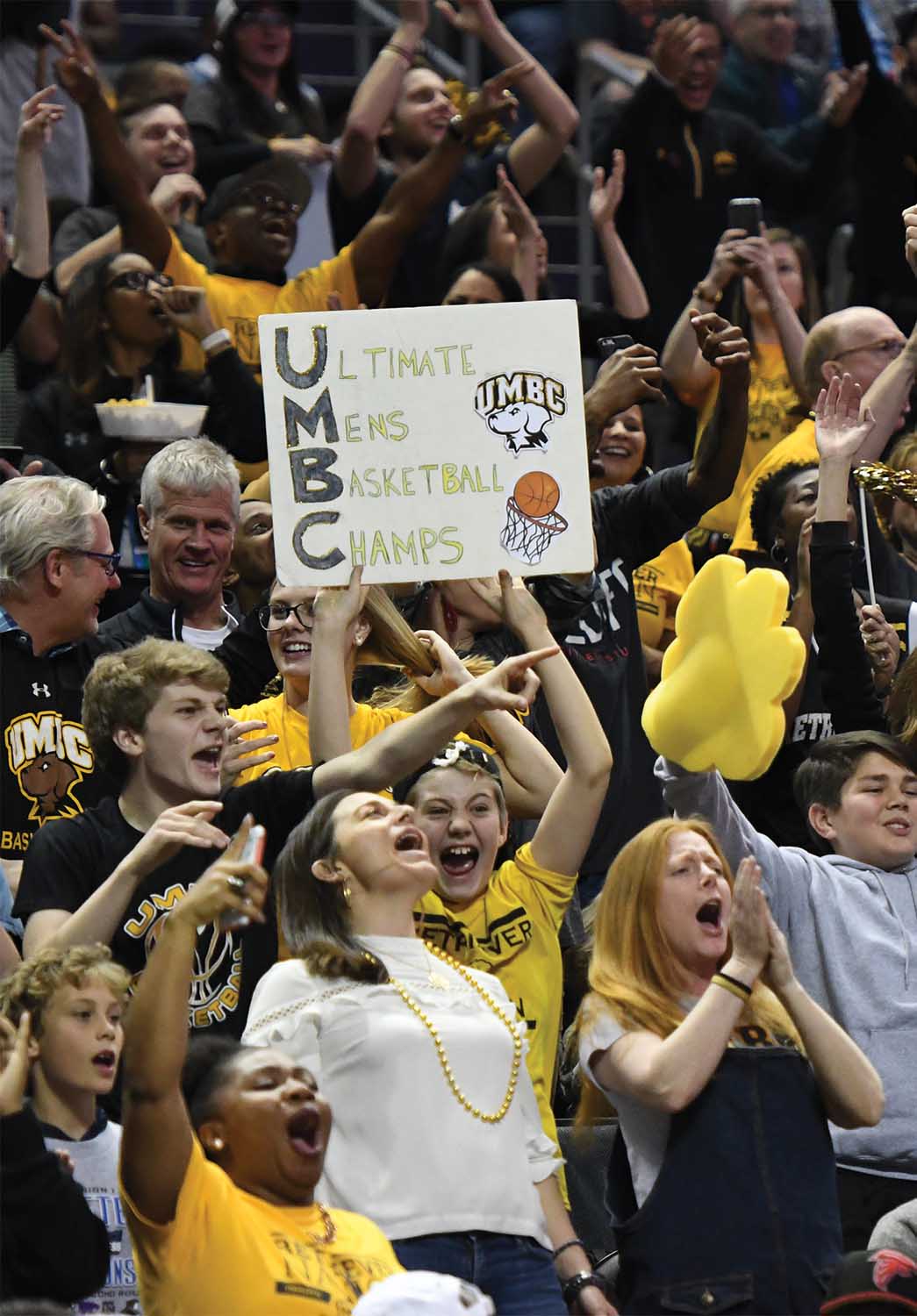
When UMBC dethroned the University of Vermont, 65 – 62, to win the America East men’s basketball champion ship on March 10, few anticipated the journey ahead. A stunning three-point shot by Jairus Lyles, with less than a second left on the clock, didn’t just catapult UMBC to the NCAA tournament, it set the tone for the nail-biting, heart-pounding, history-making run that would follow.

By Dinah Winnick and Jenny O’Grady
Photos by Marlayna Demond ’11, Ian Feldmann, Gail Burton, Brian Jenkins, and Mitchell Layton

University of a Million Brackets Crushed

Selection Sunday arrived and joyful fans crowded into the Retriever Sports Zone, surrounding the men’s basketball team as the live broadcast announced they would take on no. 1 seed University of Virginia. Cheers erupted as if UMBC “were announcing itself to the world,” wrote Jonas Shaffer in the Baltimore Sun. “It was less ‘Here we are, America’,” said Shaffer, “and more ‘Here we go.’”
That victory-focused mentality held strong. As the team headed off to North Carolina two days later, guard K.J. Maura ’18, sociology, told local press, “We don’t go to the game thinking we’re underdogs … We go [with] the mindset that we’re going to win the game.” And his vision became a reality.
Basketball fans watched in awe that Friday night as UMBC made history. The Retrievers became the first-ever no. 16 seed to defeat a no. 1 seed in an NCAA men’s basketball championship tournament.
And they didn’t just win. As NPR reported, UMBC “beat the stuffing out of Virginia, the best team in the country.” UMBC bested UVA by 20 points, earning a 74-54 victory. In an instant, UMBC became University of a Million Brackets Crushed. Sports reporters took to social media, proclaiming the win the biggest upset in men’s college basketball history.

How Did It Happen?

How did it happen? UMBC “played loose and fearless,” wrote the New York Times. “When most uber-longshots in the NCAA tournament get tight, the Retrievers instead went to the rim with reckless abandon,” USA Today reported. UMBC shot 54.2 percent from the floor, and as their lead over Virginia ballooned, the Cavaliers “played with nervousness while the Retrievers’ confidence grew.”

UMBC star guard Jairus Lyles ’17, sociology, M.A. ’18, education, again helped lead his team to victory, finishing with 28 points (82 percent from the floor). During the TNT broadcast, analyst Bill Raftery commented, “The kid’s on fire.”

Retriever fandom exploded. UMBC became the world’s top trending topic on Twitter. The university website, ready for an influx of visitors, slowed under the weight of millions of clicks. The UMBC Bookstore, closed for Spring Break, received 3,000 online t-shirt orders overnight. NBA star Steph Curry called to congratulate the Retrievers. Oh, and UMBC appeared on the front page of the New York Times, Washington Post, the NPR website, and Sports Illustrated.

The game grabbed the world’s attention, but news coverage and fan messages from around the globe quickly revealed that Retriever Fever was about more than the game alone. As New York Times reporter Erica Green wrote, “the U.M.B.C. Cinderella story transcends athletics, and has been decades in the making.” The Baltimore Sun captured that feeling in a headline: “Never heard of UMBC? MIT has. And Cal Tech. And Harvard. And Stanford …”

“It’s no coincidence that two of our strongest players, Jairus Lyles and Joe Sherburne, earned 4.0 GPAs this fall, or that Joe was just named a First-Team Academic All-American,” President Hrabowski noted in The Atlantic. He wrote that at UMBC, “our magic comes from questioning expectations, putting in the hard work, and staying focused,” from the court to the classroom.

Schooling the Nation

The victory over UVA certainly crushed millions of brackets, but for the UMBC community that success was emblematic of the university’s larger story of grit and greatness, where drive and support yield astounding achievements. “Our men’s basketball team embodies our definition of grit … bringing both passion and preparation to the game,” Hrabowski wrote.

The Retrievers returned to the court to battle Kansas State in a neck-and-neck round-two contest. Even as UMBC lost, 50-43, game announcers highlighted the Retrievers’ perseverance in fighting to the end, as walk-on and former team manager Isaiah Rogers ’18, biological sciences, sank one last shot while the buzzer rang out.

Changing the Landscape

Since UMBC’s NCAA appearance, accolades and congratulations have continued to pour in. UMBC celebrated as Coach Ryan Odom earned the 2018 Hugh Durham Award, which honors the nation’s top mid-major men’s college basketball coach of the year. Odom led the Retrievers to the 2018 America East tournament title, NCAA Championship first-round victory, and a total of 25 victories over the course of the season, a record for the program.

“Ryan Odom has completely changed the landscape at UMBC,” CollegeInsider.com’s Angela Lento said, calling him “one of the best young coaches in America.”

Even prior to the NCAA victory, UMBC Athletic Director Tim Hall shared, “Obviously, Coach Odom is first class — in all facets — and his student athletes bought in from day one.” Indeed, at the end of last season, Odom received the Joe B. Hall Award as the nation’s top first-year head coach.

CollegeInsider.com also named Lyles to the Lou Henson All-America team. This follows Sherburne ’18, financial economics, being named to the Academic All-America Division I Men’s Basketball First Team — the first UMBC player and first America East player to receive this top academic honor in NCAA Division I men’s basketball. Additionally, Maura was named America East Defensive Player of the Year.

Beyond the coach and players, UMBC Director of Multimedia Communications Zach Seidel ’12, media and communication studies, M.S. ’15, human-centered computing, developed a massive fan following during the Retrievers’ NCAA journey. CBS Sports called him a “March Madness hero” for live-tweeting the games through @UMBCAthletics with an exuberant spirit, gracious competitiveness, and self-deprecating humor. Since then, he’s done interviews with media across the U.S., offering tips to other universities on how to make the most of their NCAA appearances and have fun while they’re at it.

Hometown Heroes

The team also received a massive welcome home from elated fans in Maryland. On March 26, they traveled to Annapolis to meet with the state legislature and Governor Larry Hogan, who, heading into the championship, had selected UMBC as #1 in his NCAA bracket. A joyful UMBC community celebration in the university’s new Event Center followed, and when the Baltimore Orioles announced they would honor the team during a pregame ceremony on April 20, UMBC Pride Night tickets sold out in a day.

As the NCAA Championship came to a close on April 2 and the Retrievers had a chance to step back, take a breath, and reflect, it became clear that the echoes of UMBC’s March Madness journey will be heard for years to come.

“Our colleagues knew about us, but this was an opportunity for the world to better know us,” said President Hrabowski. “We prepared for that moment well,” and when the spotlight turned toward UMBC, “They saw substance. They saw values.” — Dinah Winnick

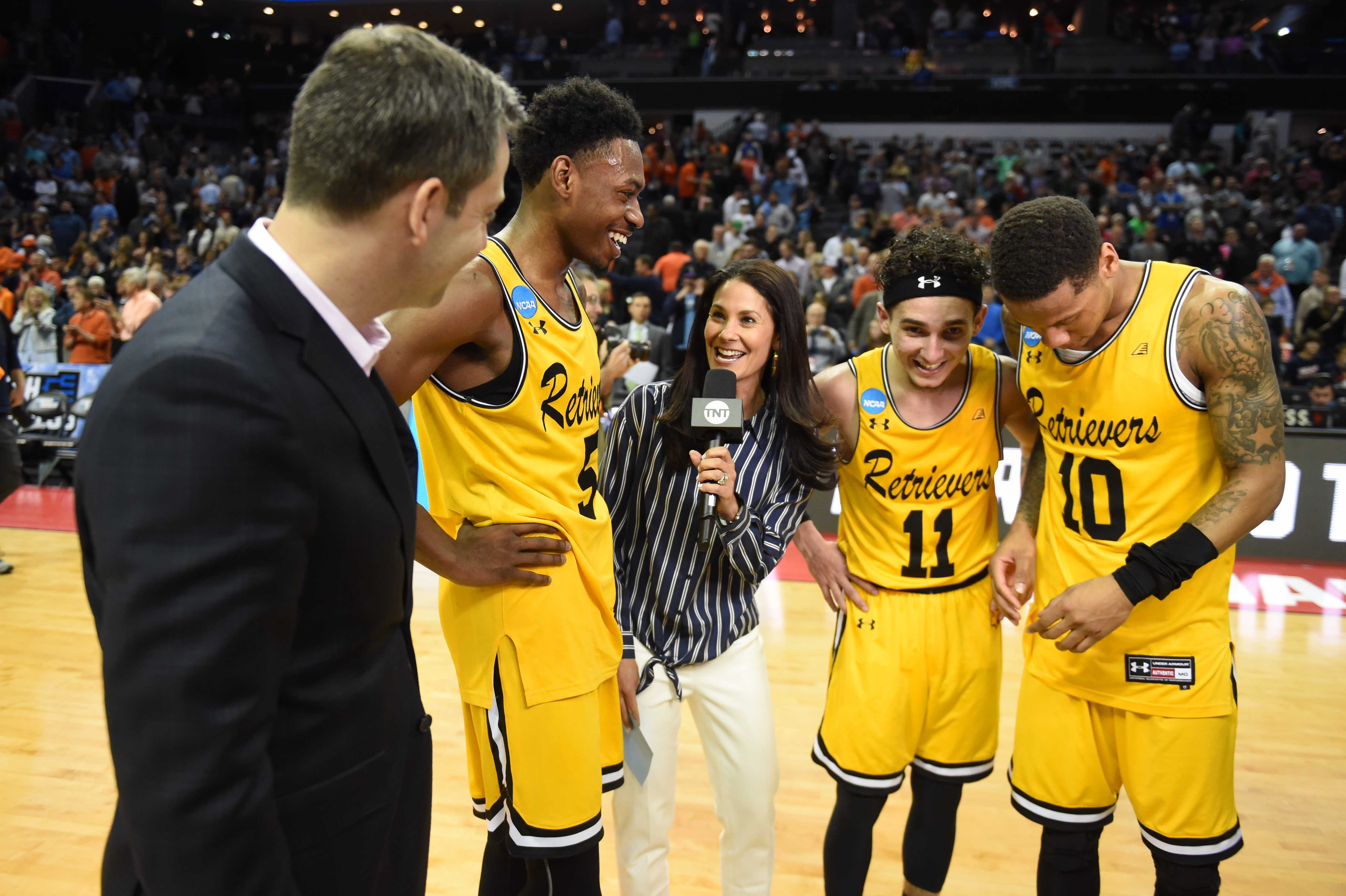
Members of UMBC's basketball team smiling in celebration, while a video camera records them.