All posts by: Magazine Editor


Sticking With It: Lacrosse Coach Lloyd Carter ’97, M.S. ’09

Though he never set foot on UMBC’s field as a player, the lacrosse career of Lloyd Carter ’97, M.S. ’09, emergency health services, began years before his time as a Retriever, and continues today through his role as head coach of Hampton University’s Division I squad.

Carter, who for years balanced coaching jobs with a lengthy leadership career in firefighting for Baltimore City, founded the program at Hampton just three years ago, making it the only team of its kind among the historically black college and university (HBCU) system.

It’s a fitting position for a man who spent much of his life making lacrosse accessible for anyone who might like to play it. “I have had a (lacrosse) stick in my hands since the 1960s,” says Carter, who grew up in Edmonson Village, just miles from campus. “My brother Bennett was nine years older, and he used to bring his stick home, and I would play with it around the house. That is how I got introduced to the sport. In my neighborhood in west Baltimore sports was our biggest outlet.”

Lacrosse Star Rising

Coming out of high school, Carter set his sights on a career in emergency services. He began his studies at Morgan State in 1977 and played lacrosse there for three seasons before the program folded in the early 1980s. While a frustrating turn of events, the loss of the program at Morgan forced Carter to put more emphasis on his future career as a firefighter in the EMS field.

“I went to Baltimore City College to get my certificate and then I was hired by the Baltimore fire department in 1983,” Carter says. “Once I got promoted in the fire department I went back and started going to UMBC to get my bachelor’s. Then I went back and got my master’s at UMBC.”

While a student at UMBC, Carter attended Retriever lacrosse games whenever he could. As he moved up in the ranks of the fire department, he continued to keep lacrosse in his life, coaching at Northwestern High for several years. Carter was named Baltimore City Lacrosse Coach of the Year in 2000 and 2011-13.

Still coaching at Northwestern, in 2002 Carter founded Blax Lax Inc., a club-level organization for high school and college players designed to promote diversity in lacrosse, improve exposure to the game, and create more opportunities in the African-American community. As Carter’s star continued to rise in the lacrosse community, a call from a stranger made his next steps clear.

Building a Lacrosse Program at Hampton

By chance, Carter became acquainted with the family of Michael Crawford, a lacrosse player who had been in the process of starting a team at Hampton before he passed away. As the family grieved and considered Crawford’s legacy, a Google search by Crawford’s mother brought the two together.

“She decided to keep his dream alive. She Googled ‘black lacrosse coach’ and my name came up. We had a real emotional conversation,” says Carter, who began commuting on weekends to Hampton from Baltimore for a stretch of about 18 months to help bring Crawford’s vision to life.

“I kind of fell in love with the area,” says Carter. “When I retired from the fire department (in Baltimore in 2014) I wanted to pursue a career in emergency services. I got an offer from Thomas Nelson Community College in Hampton and when I retired I relocated to Hampton to teach.”

He was successful in building up the club lacrosse program — so successful, in fact, that the team moved up to Division I in 2016. The team was 0-5 in its first season and was outscored 100-20 by the likes of Roberts Wesleyan, Thiel, Wagner, Ohio Valley, and Virginia Military Institute, but last season posted its first ever win over Greensboro of North Carolina.

A Growing Process

“It has been a growing process,” Carter says of the Hampton program. “We are starting to get guys who are going to Hampton who are really lacrosse players. It comes down to having the talent. The program is growing. The university is investing a lot of resources. We are right on time with my expectations. I would rather be undefeated and beat (the likes of) Syracuse and Notre Dame, but we are not there yet.”

One of Carter’s midfielders, Jacob Woodard, says what Carter has done is meaningful both for the school and for black lacrosse players in general.

“Overall it is a great experience to be part of history,” says Woodard. “To be honest, it is great just to have an opportunity to play lacrosse. It lets other kids know it doesn’t matter where you come from.”

— David Driver

Photo courtesy of Hampton University

Practice Makes Perfect: Students Network with Alums at Career Month

UMBC alumni network at Sweeten Up Your Network eventIf you could do it all over again, what would you tell your younger self?

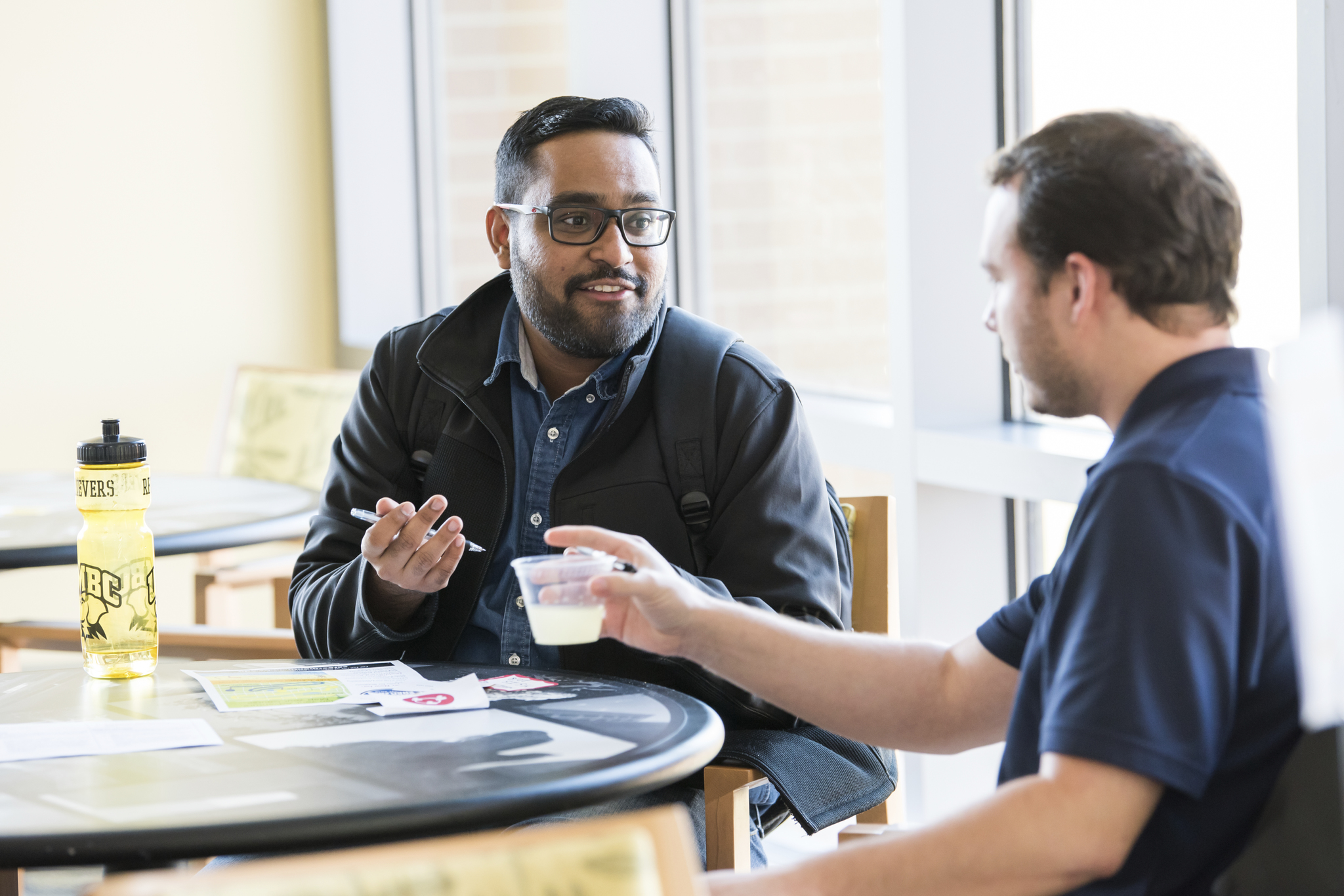
This is the concept behind “Interview an Alum,” a new initiative designed by the UMBC Alumni Board of Directors (AABOD) and the UMBC Career Center. During Career Month 2018, current students and alumni came together to network and discuss their academic journeys, career aspirations, and, at times, uncertainties.

“Even as a college senior, I’m not entirely sure what I would like to do with my degree,” admitted Casey Dahlgren, a senior majoring in business technology administration. “So, getting different perspectives on that seemed like it could help.”

In all, AABOD volunteers conducted 20 interviews as part of Interview an Alum during Career Month.

Sharing Networking Experience

“Interview an Alum gives us an opportunity to practice inclusive excellence by sharing what we have learned — sometimes the hard way — so that our current students can benefit from our experiences,” said AABOD President John Becker ’01, information systems management. “I am full of pride in my alma mater, and I have always felt like I should be helping our future professionals the way I was helped when I attended UMBC.”

Geeta Shanbhag, a senior majoring in media and communication studies, interviewed with two different alumni. “One that addressed my major in media and communications, and one that addressed my legal policy minor and my potential interest in law and public policy,” she said. “It was amazing.”

Alumni volunteers agreed with that sentiment. “I found the experience rewarding,” said alumna Andrea Thomson ’11, economics and political science. “I was able to connect with a current student. She asked a lot of intelligent questions and I was able to help her frame and think through her professional narrative, i.e., how her past experiences make her a good fit for the field she is hoping to pursue.”

— Bobby Lubaszewski Jr. ‘10

Pictured: Sweeten Up Your Network, another Career Month networking activity, brought alumni and students together in April.

Read more UMBC impact stories here.

Alums in the News: September 22-28, 2017

Our alumni are making headlines…let’s see what they’ve been up to this week!

Kavita Krishnaswamy ’07, mathematics and computer science, a current Ph.D. candidate at UMBC, has earned research funding through a Microsoft Fellowship and the Google Lime Scholarship, in addition to her grants from the Ford Foundation and the National Science Foundation. Krishnaswamy, who is paralyzed from the neck down due to spinal muscular atrophy and attends classes using a Beam telepresence robot, has focused her doctoral research on using robotics to aid people with disabilities and improve access.

Henrietta Akintoye ’07, biochemistry and molecular biology, has joined the Department of Obstetrics and Gynecology at Reliant Medical Group in Worcester, Massachusetts. Dr. Akintoye completed her OB/GYN residency at Mount Sinai St. Luke’s Hospital in New York City, and completed her medical degree at the Morehouse School of Medicine.

MaBelle Fomundam ’15, biological sciences and theatre, starred as Margaret in the play Vacation, written by Johns Hopkins University student Michael Feder and produced by the Tentative Digital Theatre Company, a student group that puts on performances in unconventional venues across the JHU area. Vacation tells the story of Margaret and Jerome, a couple who must face their grief over a lost child while packing for a trip.

Prachi Kochar ’17, psychology, spoke to WYPR’s On the Record with Sheilah Kast about the importance of diversity in comic books ahead of Baltimore Comic-Con. A former student staffer at the Women’s Center, Kochar has written on the subject of representation in comics before; you can check that post out here.

Got news to share with us? Submit a Class Note today!

Alumni Awards 2017: Sylvia Trent-Adams, Ph.D. ’06, Public Policy

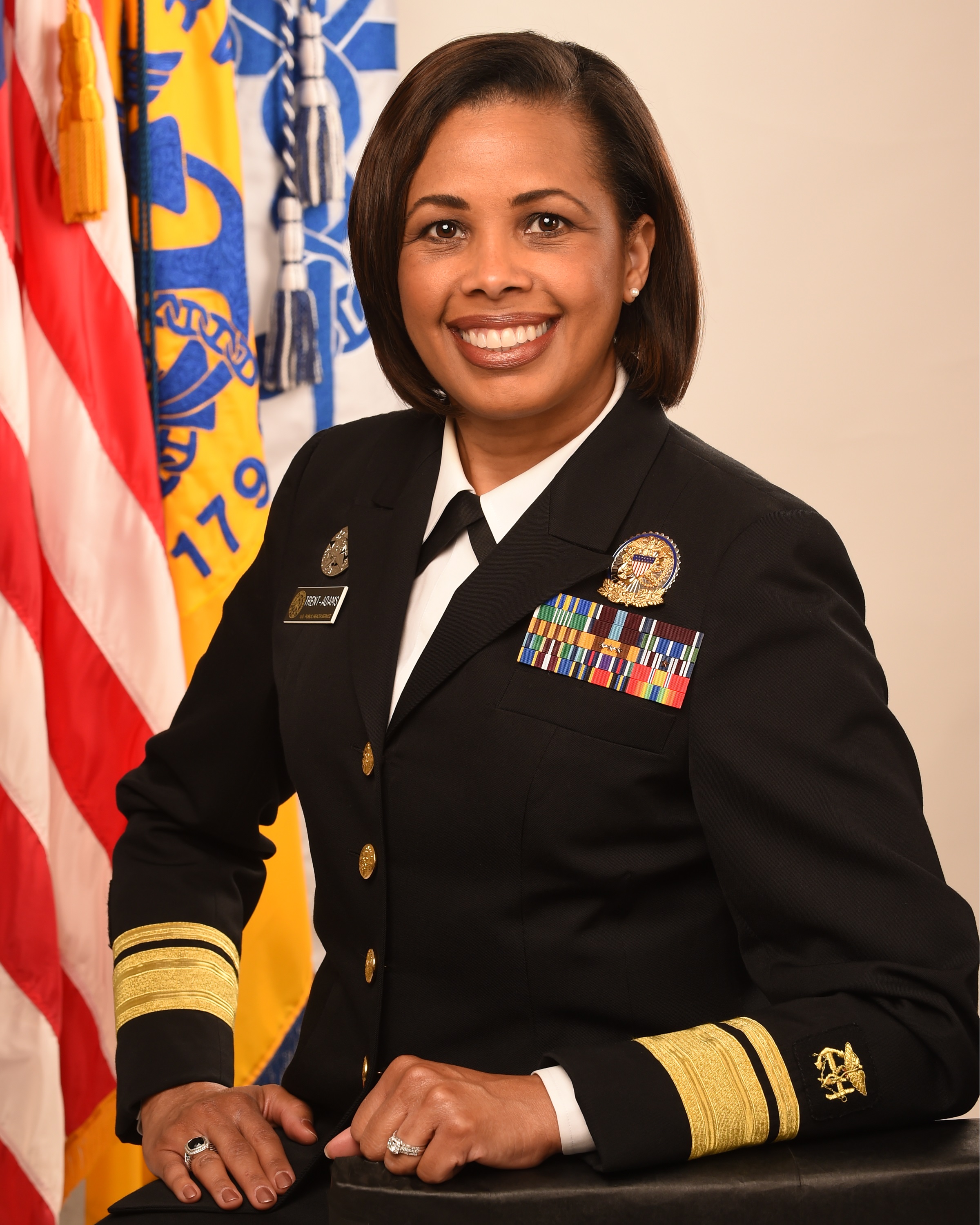
In the weeks leading up to the Alumni Awards Ceremony, we’ll be profiling each honoree in more detail here on our blog. Today, meet Rear Admiral Sylvia Trent-Adams, Ph.D. ’06, public policy, the current Deputy Surgeon General of the United States and our Outstanding Alumna in the Social and Behavioral Sciences.

Sylvia Trent-Adams, Ph.D. ’06, public policy, currently serves as the Deputy Surgeon General of the Unites States. She is a Rear Admiral (RADM) in the U.S. Public Health Service (USPHS) Commissioned Corps. In her role as Deputy Surgeon General she advises and supports the Surgeon General regarding operations of the USPHS Commissioned Corps and in communicating the best available scientific information to advance the health of the nation. She served as Acting Surgeon General from April 2017 through September 2017.

RADM Trent-Adams has held various positions in the Department of Health & Human Services, working to improve access to care for poor and underserved communities. As a clinician and administrator, she has had direct impact on building systems of care to improve public health for marginalized populations globally. She states, “The greatest success of my career has been the opportunity to assist in building programs both domestically and internationally, to serve the underserved.”

RADM Trent-Adams career spans 30 years of public service. She has served on commissions for the United Nations and the World Health Organization, worked to develop HIV/AIDS treatment plans in the U.S. and Sub-Saharan Africa, and presented her research on HIV, healthcare delivery, public health, nursing and emergency preparedness worldwide. Prior to joining the USPHS, RADM Trent-Adams was a nurse officer in the U.S. Army.

Trent-Adams holds a bachelor’s in nursing from Hampton University and a master’s in nursing and health policy from the University of Maryland at Baltimore. She was inspired to pursue her doctorate at UMBC by its “outstanding academic programs” and “the caliber of the policy faculty,” including Dr. Nancy Miller, Dr. Marvin Mandell, Dr. Kevin Eckert, Dr. Chris Hewitt, and Dr. Cheryl Miller. She often returns to campus to speak to classes and participate in panel discussions, and maintains a mentoring relationship with several undergraduate and graduate students.

As for life outside of work, she says, “I am blessed with a husband who is supportive of my career…[and] we have two amazing daughters who keep life interesting! My extended family keeps me grounded by accepting me for who I am, and constantly remind me that I am still a country girl from Virginia.”

Join us for the Alumni Awards Ceremony on Thursday, October 5!

“I’m a Water Dancer, Mom!”: On Bodies and Baltimore’s Premier Water Ballet

A reflection on body acceptance and positivity while being a part of a water ballet by Special Projects Coordinator, Amelia Meman ’15, gender and women’s studies.  Above photo: Amelia and friend Susie Hinz ’14, courtesy of the author.

* * * * *

I tend to not write about my body much. It’s not that I don’t think about it. I’m preoccupied by it, actually. Rather, it’s that I don’t want to continue to bring attention to something that seems, to me, like a glaring error that folks can already pick apart.

It’s not just that I’m sort of fat. I am fat, and that’s something I’ve been able to tease out through years of BMI charts. There’s also everything else: I’m broad shouldered, hairy, weirdly proportioned, and I have a really large tongue. I have weird chubby baby cherub hands and my feet are callused because I use them to climb (read: fall out of) trees.

I could spend many more words on my weirdo body (as I’m sure many others could, too), but this summer I signed up to be in Fluid Movement’s annual water ballet, and now I am actually proud of what my body does. It’s a weird and foreign feeling for me–being proud of my body. After I have somersaulted and tread water for an hour and pin-wheeled and held people’s ankles while floating like perverse otters, I think I’m starting to really love this body.

11807415_539743192840898_6838058522751122817_o

See, Fluid Movement’s water ballets are magic. They’ve been going on for almost 20 years now and they’re characterized by unabashed silliness, a heaping ton of glitter, and diverse folks from all over the place coming together in Baltimore’s public pools to dance in water.

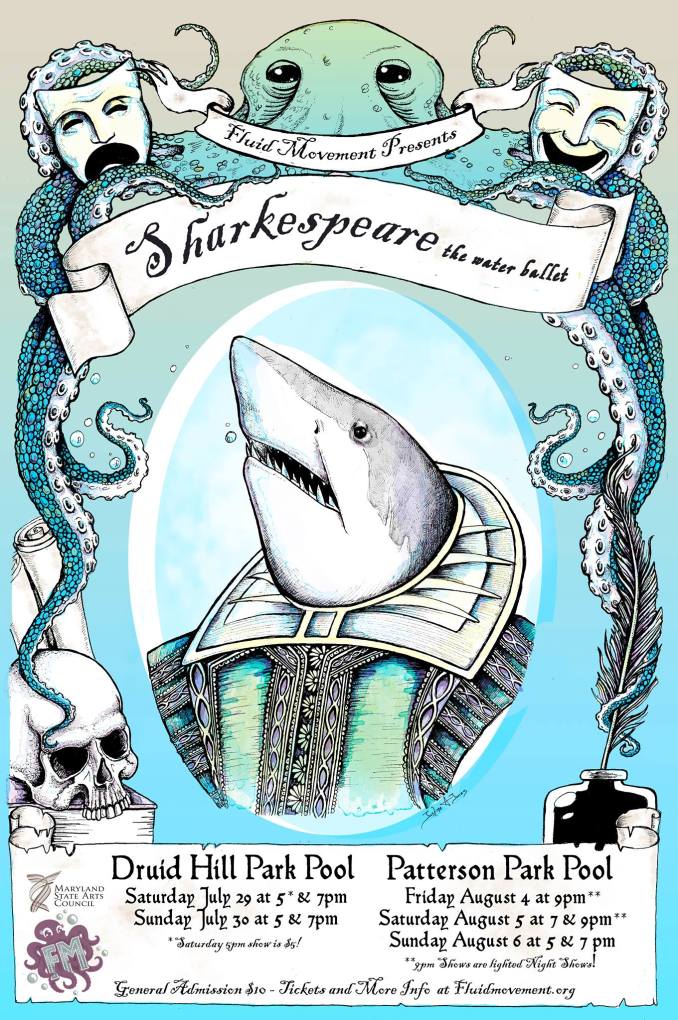
I first heard about them through, who else, but my former professor and all-around life hero Dr. Kate Drabinski who had thought of me for their 2014 production of the War of 1812. I wasn’t able to do it, nor did I make it to the show, but I followed their page on Facebook, only to find out that the next year they were doing a water ballet inspired by the life of Jeff Goldblum. I know. They’re amazing. Anyways, my best friend Susie and I went to this show, and we couldn’t keep from crying in awe at how wonderful this whole thing was. We vowed to join the troupe. Now it’s 2017 and we’re starring in the [The Scottish Play] in this summer’s Sharkespeare production.

19488767_888176484664232_7870839462343776544_o

Poster designed by Justine Jones.

Let me tell you about the phenomenon of being in a water ballet troupe with strangers: it is weird, it is awkward, it is incredible.

We started out doing land rehearsals and really spotting the whole production out. We would meet up at the Clifton Park Mansion where folks brought Jell-O Jigglers and clementines, and we would try our best to remember each other’s names. It felt a lot like marching band camp–we would move to the music, find spots, spin in circles, all that. Everyone was dressed in whatever they had come from work in or they had on some iteration of a “dealing with Baltimore heat” get up. It was all very comfortable and simple, but as we neared pool opening season, I became increasingly anxious.

I knew I would have to eventually strip down to a bathing suit and get in the water, but I still wasn’t all that ready when we finally did. It wasn’t just the bathing suit and all of the flesh it exposed, but that I was not a swimmer. Although I have a piscean affinity for being in water, I wasn’t some sort of avid water sportsperson. I only knew how to freestyle because I was obsessed with Michael Phelps’s arm flap stretch.

I was really afraid that not only would my body not work visually, but that it wouldn’t work physically.

But I think everyone was entering the pool with similar preoccupations. What if my body is too fat or too skinny? What if my butt is exposed? What if I can’t make it through the whole practice? What if I’m the first person to ever drown during a performance?

Getting in the water and futzing around with all of these other people who are just as adorably inelegant but enthusiastic as I am was the turning point. Many of us were new and doing something as simple as laying out was frustrating. But our directors were patient. Other folks who were returning to water ballet guided us through the moves. We kicked at each other and quickly apologized, only to laugh, because water ballet is just a very intimate activity. You trust and appreciate each other quickly, when you have to make a pentagram by spread eagle-ing in formation.

giphy1

Otters are the original water ballerin(x)s.

The other night at practice was unusually hard. We were in a different pool, I had had a long day. The water was also choppy because a water aerobics battalion had blasted their way through enough EDM and disco to make a club tired. I inhaled quite a bit of water (use a noseclip, kids) and my mind was exhausted. But even after everyone started getting ready to leave, I stayed in the water, egg beatering, sculling, and flipping around. I kicked at the water and propelled up and out, I whipped my arms in circles and somersaulted, I folded my body and sunk slowly down. My body does all of this. It’s capable of learning and exerting force and taking up space and being–of all things–beautiful.

Yes, the visual idiosyncrasies of my body are still here, but so are everybody else’s and I like everybody else’s. I like the dimples of cellulite if you have them. I like that “hip dip,” I like your hair (whether it’s on your head, your chest, your legs, your toes), I like the way our boobs are oppositely asymmetrical. It doesn’t even really matter if I like them–I guess I just appreciate you for you and think you are beautiful.

Our body diversity (although fairly narrow as it is in this instance), our weird little eccentricities, our way of working together and genuinely appreciating each other; it’s all just another thing pushing me to earnestly fall in love with home, whether that’s Baltimore or my own body.

* * * * *

Amelia Meman ’15, gender and women’s studies, is Special Projects Coordinator for UMBC’s Women’s Center.

Originally posted on the Women’s Center Blog; reprinted with permission.

Alumni Awards 2017: Kafui Dzirasa ’01, M8, Chemical Engineering

In the weeks leading up to the Alumni Awards Ceremony, we’ll be profiling each honoree in more detail here on our blog. Today, meet Kafui Dzirasa ’01, M8, chemical engineering, associate professor at the Duke University School of Medicine and this year’s Outstanding Alumnus in Engineering and Information Technology.

As an associate professor of psychiatry, behavioral science, neurobiology, and neurosurgery at the Duke University School of Medicine, Kafui Dzirasa ’01, M8, chemical engineering, has dedicated his career to creating a kind of “pacemaker for the brain,” a device that can effectively rewire neurological signals in patients with bipolar disorder, schizophrenia, and other illnesses. His research has earned him, among other accolades, the 2013 Sidney R. Baer Prize for Innovative and Promising Schizophrenia Research, as well as a 2016 Presidential Early Career Award for Scientists and Engineers (PECASE), the highest award given to young scientists by the U.S. government. According to Dalton Hughes ’14, M21, chemical engineering, now an M.D./Ph.D. student working in Dzirasa’s lab at Duke, he is not only “a powerhouse in the fields of engineering, neuroscience, and medicine,” but a “phenomenal research mentor, captivating speaker, compassionate physician, and exceptional educator.”

“[Dr. Dzirasa’s] demonstrated commitment to UMBC and its students is truly special,” writes Keith Harmon, director of the Meyerhoff Scholars Program, “is truly special, and an inspiring example of a selfless spirit determined to ‘pay forward’ all that was poured into him at UMBC.”

Join us for the Alumni Awards Ceremony on Thursday, October 5!

Dr. Dzirasa will also be giving a Grit-X Talk on Saturday, October 14…sign up to reserve your seat today!

Alumni Awards 2017: Marc Zupan, Department of Mechanical Engineering

In the weeks leading up to the Alumni Awards Ceremony, we’ll be profiling each honoree in more detail here on our blog. Today, meet Marc Zupan, associate professor and graduate program director of UMBC’s Department of Mechanical Engineering, and this year’s Outstanding Faculty Award winner.

In just over 14 years at UMBC, Marc Zupan, associate professor and graduate program director in the Department of Mechanical Engineering, has become known as a connection-maker. He connects students with internships, job opportunities, and graduate programs. He’s made international connections with Portugal’s Universidade do Porto through the Global Engineering Program. And he’s made connections across disciplines, bridging the gap between STEM and the humanities by incorporating elements of both into his own teaching.  Asynith Palmer ’06, English, a writer who worked with Zupan to secure funding and design the curriculum for the Global Engineering Program, says it’s his genuine interest in his students’ lives and experiences that makes him the kind of teacher and mentor that he is. “Marc…trains his creativity on helping his students,” she writes. “In fact, he feels energized by meeting with them, learning their interests, suggesting — or creating — possibilities for internships and research, and watching them thrive.” As a researcher, Dr. Zupan focuses on characterizing the behavior of and modeling materials across length scales. He earned his master’s and Ph.D. in mechanical engineering from the Johns Hopkins University in solid mechanics of materials and completed his undergraduate work at the University of Dayton. He came to UMBC after a postdoctoral fellowship at the University of Cambridge MicroMechanics Centre in the U.K., he is a visiting professor at the Universidade do Porto, Portugal and was an active abroad Fulbright Scholar from 2012 to 2013 at the Faculdade de Engenharia da Universidade do Porto.

Join us for the Alumni Awards Ceremony on Thursday, October 5!

Discovery – Spring 2017

Runaway Black Hole

A team of researchers including UMBC’s Eileen Meyer and Markos Georganopoulos have found strong evidence of a striking astrophysical phenomenon: a supermassive black hole traveling away from the center of its galaxy at an incredibly rapid pace.

A scenario like this has been predicted for some time.

“The theory is great, but we’ve got to have some observations to see if our simulations are correct,” says Meyer, assistant professor of physics. Those observations are now in hand, with copious lines of evidence all supporting the team’s explanation.

“There have been previous cases of systems like this,” says Georganopoulos, associate professor of physics, “but ours is the most solid case.” Meyer adds, “It’s the only one I can think of where all the little pieces of evidence line up in favor of this scenario very specifically.”

When two galaxies with black holes at their centers merge, gravitational forces pull the black holes to the center of the newly-formed galaxy. The black holes spin around each other, gradually slowing down. This process releases gravitational waves – ripples in the fabric of spacetime that travel outward at the speed of light. Depending on the relative rotational speeds of the two original black holes, once they merge, the new black hole may be kicked out of the galaxy’s center by the gravitational waves.

Data collected by the Hubble Space Telescope and other sources confirm that the black hole’s speed and position – approximately 4.8 million miles per hour, offset from the center of its galaxy – are consistent with the team’s explanation that the black hole has been powerfully ejected from the galaxy by the force of gravitational waves.

First author Marco Chiaberge, research scientist at the Space Telescope Science Institute at the Johns Hopkins University, approached Meyer and Georganopoulos almost two years ago to help interpret the surprising data. Georganopoulos shares, “For me, the most exciting thing was to go from the raw data to building up a scenario – gradually realizing that the other scenarios are very implausible.”

Although alternative explanations are unlikely, the team still wants to collect additional observations to further confirm their interpretation. They’re submitting a proposal for time on the Atacama Large Millimeter Array, a powerful telescope in Chile that could help them answer remaining questions.

“At the same time that it creates the opportunity to solidify our model, it’s also an opportunity to falsify it,” says Georganopoulos, of the possible opportunity to use the array in Chile and the importance of remaining open to new interpretations of the data.

Either way, it will be exciting research. “Even if it doesn’t turn out the way we’re expecting,” says Meyer, “this is still a strange and remarkable system that needs to be studied.”

— Sarah Hansen M.S. ’15

Image: NASA, ESA, and M. Chiaberge (STScI and JHU)

Read more about black holes at UMBC News.

Crossing the Digital Divide

Carla Hayden

U.S. Librarian of Congress Carla Hayden, former director of Baltimore’s Enoch Pratt Free Library, shared her thoughts on the expansion of digital access to libraries, “a treasure chest just waiting to be opened,” with audiences at UMBC in April.

Hayden recounted meeting with then-President Barack Obama before her nomination. Together, at the Library of Congress, they viewed personal letters that Rosa Parks wrote after her arrest in Montgomery, Alabama in 1955 for refusing to give up her bus seat and discussed the immense potential of historical records to directly inform, affirm, and inspire. What was needed, he expressed, was someone to bring the library’s 160 million items directly to the public.

In her new role, Hayden resolved to open the “treasure chest” for the nation, taking to Twitter with an open invitation for people to discover the library’s offerings. After all, Hayden noted, “This wonderful treasure chest is just a mausoleum if people can’t read and see [what’s inside].”

Many know about Thomas Jefferson’s handwritten draft of the Declaration of Independence and Abraham Lincoln’s Gettysburg Address. Fewer know about the personal correspondence between Jackie Robinson and scout Branch Rickey or the letters Sigmund Freud and Albert Einstein wrote to one another. It’s these discoveries that affirm for her that digital access is a core part of her mission, and that of the library itself.

“This is America’s library. This is your library,” Hayden shared. “We want to be part of people’s lives.”

— Dinah Winnick

Read more about Hayden’s visit to UMBC at UMBC News.

Tech for All Seasons

At the Keith R. Porter Imaging Facility (KPIF), a  team of undergraduates becomes the first to observe a new type of phage—a tiny virus that infects bacterial cells. Students view images of the robot-like virus formed by a high-powered microscope on a computer screen, bantering about what to name their discovery.

Meanwhile at Research Graphics (RG), a Ph.D. student produces an animation she’ll use during her thesis defense. Nearby at the Molecular Characterization and Analysis Complex (MCAC), staff from a Baltimore startup define the structure of a molecule they’ve synthesized, and at the Nano-Imaging Facility (NIF), electrical engineering faculty analyze a novel nanomaterial they’ve created. Down the lane, a 90-camera setup in a white room creates a 3D digital model of Baltimore City as it was in 1815 at the Imaging Research Center (IRC), and a curved wall plus a virtual reality headset allows visitors to immerse themselves in data visualizations at the π2 Hybrid Reality Lab.    

If this all sounds like a futuristic collection of high-tech labs, it is—except they exist right now at UMBC, and they’re here to support the scientific community on and off campus.

Tools in the labs “are all about the most fundamental aspect of science—observation,” says Dean Bill LaCourse, of the College of Natural and Mathematical Sciences (CNMS). A project 20 years in the making, the four facilities housed within CNMS (KPIF, MCAC, RG, and NIF) allow researchers to “leverage and extend our capabilities so we can look at everything from the atom to the ends of the universe.”

“The leaders of these facilities bring their expertise to your problem and work with you to get somewhere you may not have known you could go,” says Karl Steiner, vice president for research at UMBC. “It’s not the newest and latest instrument that makes a facility successful—it’s the people who run it and work with you.”

One of those people is Tagide deCarvalho, manager of the KPIF, who stresses the teaching and learning aspects of the facilities. “I’m really interested in helping people at all levels,” she shares, “from sample prep, to instrument training, to experimental design.”

Joshua Wilhide, manager of the MCAC, emphasized that the goals of the facilities extend beyond generating results researchers can publish. “We are a university—at the end of the day we have to look at how we’re teaching the next generation,” he shared.

“The instrumentation available and expertise offered by the staff allowed me to take an idea and see it to completion,” shares Gregory Winter Ph.D. ‘16, chemistry, who completed the entirety of his doctoral research at the MCAC. He adds, “The interdisciplinary exposure really improved my skill set as an analytical chemist.” The MCAC can also contribute to personal growth. “The MCAC instills a sense of camaraderie, making it easier to persevere through any setbacks in the research or juggling a busy class schedule,” shares Chloe Kwon ‘16, biological sciences. “The MCAC is a tremendous learning environment.”  

But UMBC’s high-tech, interdisciplinary facilities aren’t confined to CNMS. At the π2 Hybrid Reality Lab, opened in 2016 and housed within the College of Engineering and Information Technology, it’s possible to walk around a model of neural networks in the brain or a 3D shape defined by mathematical equations. The π2 lab also creates opportunities to investigate virtual reality technology itself. It brings together tools “that will allow humans and the computer to augment each other,” says Jian Chen, assistant professor of computer science and electrical engineering, who spearheaded development of the lab.

The IRC, housed within the College of Arts, Humanities, and Social Sciences, develops and tests innovative ways to use media in research. Lee Boot, IRC director, says the IRC is dedicated to studying media itself, including how we interact with and are influenced by it. He shares, “We collaborate with media researchers to do a better job of bringing this topic to life in a new way.”

Every core facility at UMBC ultimately exists to serve the community. Jeffrey Gardner, assistant professor of biological sciences, is another beneficiary. He’s one of few faculty outside of chemistry who have taken significant advantage of the MCAC. “Josh [Wilhide] and his team have been very valuable and continue to contribute to the success of my lab,” he shares. “It is an excellent resource to have on the UMBC campus.”

Sarah Hansen M.S. ’15

Campus Treasure – The UMBC Squirrel

Campus Treasure - Squirrel!

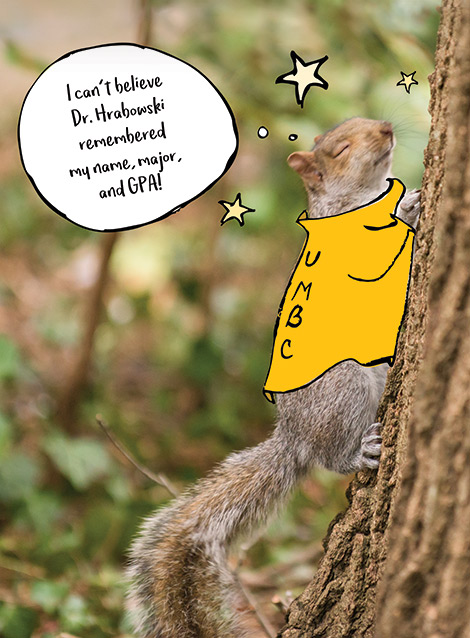
There’s something irresistible about our fair university’s unofficial mascot, the UMBC squirrel. Maybe it’s because we appreciate an animal with smarts enough to make a feast of our leftovers. Or perhaps it’s because it’s impossible not to wonder what the little jokers are thinking as they scamper by. Which is why a springtime social media caption contest tempted so many Retrieverland imaginations. Congratulations to winner Jill Marie Timmons ’94, English, for her classic take on the student experience. See more squirrels and such on Instagram at @UMBCLife. You’d be nuts to miss out.

At Play – Spring 2017

Making a Case

Just six years after its founding, the UMBC Mock Trial team is already taking the nation by storm. Having outperformed hundreds of other college and university teams since September, the team made a historic trip to the American Mock Trial Association’s National Championship Tournament in Los Angeles, California, in April, competing against a select group of only 48 teams from across the United States.

UMBC received team and individual honors in L.A., including an honorable mention for the Spirit of AMTA award, for best display collegiality and fair play, and two All-American awards—the highest individual honor in collegiate mock trial. Senior Brandon James, English, won UMBC’s first All-American attorney award, and sophomore Alex Ezigbo won the first All-American witness award.

The year has been a heady one for the team, spending weekends on the road to compete in – and win – invitational tournaments up and down the east coast. After finishing the Baltimore Regional Championship with a record of 5–3, both the A and B Teams advanced to the Opening Round Championship Series, held March 25–26, where the A Team secured one of only six bids to the national competition, and the B Team narrowly missed capturing a second.

Graduating seniors Dylan Rogers Elliott, history; Zuhair Riaz, political science; Kayla Smith, interdisciplinary studies; and James have earned a collective 14 individual mock trial awards, reflecting hundreds of hours spent writing and memorizing materials, in addition to the intense collaboration and team planning required to overcome more established teams.

“From my perspective, this is especially rewarding because of how this program has grown and evolved,” reflects coach Ben Garmoe ’13, political science. “I was on UMBC’s first-ever Mock Trial team, just six years ago,” he says. “It’s hard to believe sometimes how quickly things have grown since then.”

Reflecting on the historic trip, Elliott said, “As a senior, I can graduate happy knowing that I played a role, however small, in the team’s growth.”

While mock trial teams tend to attract students majoring in the humanities and social sciences, UMBC Mock Trial includes students from all three colleges, including a biochemistry major. Team members get experience honing their speaking, writing, and presentation skills, applicable to any career path. For some, like Smith, the team has also inspired future graduate school and career plans.

“Mock Trial has prepared me for a lifetime of experiences,” Smith says. “After my first round in a real courtroom, I thought to myself, ‘I wish I could do mock trial professionally,’ and I realized that was just called being an attorney. I’m now headed to law school in New York, and I wouldn’t have taken this path without Mock Trial.”

She’ll be following in the footsteps of UMBC Mock Trial alumni who have attended prestigious law programs at Georgetown University, UCLA, William & Mary, the University of Maryland, and the University of Baltimore.

As news of UMBC Mock Trial’s win at regionals spread during the height of the basketball postseason, the campus found itself cheering yet another UMBC team’s remarkable victory.

Some might be surprised at the rapid rise of such a young team, but coach Ben Garmoe isn’t. “I told them at the beginning of this season that Nationals was possible,” he says. “They went out and did the work to make it happen.”

— Dinah Winnick

Read more at UMBC News

Odom Honored for Coaching
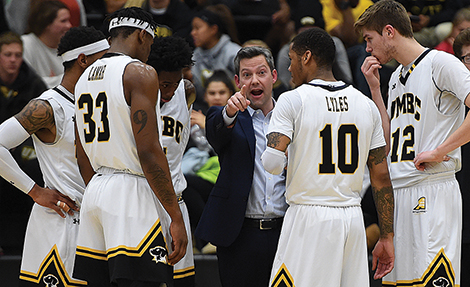
Odom Honored for coaching

UMBC men’s basketball coach Ryan Odom has been named 2017 recipient of the Joe B. Hall Award, CollegeInsider.com’s honor recognizing the top first-year Division I coach in the United States. Odom led the team to a record of 21-13, and its first winning season since 2007-08, when the Retrievers went to the NCAA Tournament. UMBC finished the year as the third most-improved team nationwide, and the team’s 21 wins represent the second most wins in a single year in the Division I history of UMBC men’s basketball.

“I would like to thank the committee for this prestigious award,” Odom said. “It is a testament to the work that our players and staff put in all year. I’m humbled by this recognition and I’m extremely blessed to coach such great young men.”

Prior to this season UMBC had never a won a post-season tournament game. Odom’s team posted three wins in the CIT and became the first America East team to win three games in a post-season tournament. UMBC also smashed single-season marks for points and three-point field goals.

“Ryan is an excellent coach, but a better person,” said UMBC Director of Athletics Tim Hall. “He has laid the foundation this year for sustained success. This award is confirmation that he is the right leader for Retriever men’s basketball.”

The award is named in the honor of Joe B. Hall who was given the task of following the legendary Adolph Rupp. In his first season at the University of Kentucky, Hall finished 20-8, won the SEC and advanced to the NCAA Regional Finals.

“Ryan Odom brought a new attitude and a new style to UMBC,” said CollegeInsider.com’s Angela Lento. “He changed the culture and won more games this season than the program had won in the previous three seasons combined.”

— Steve Levy ’85
Image: Gail Burton

Read more at UMBCRetrievers.com.

Fine Dining
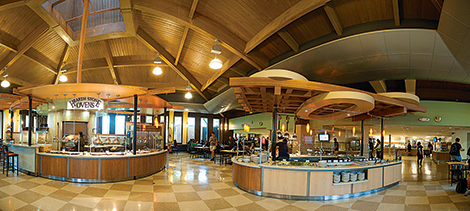
Dining Hall

Complaining about campus dining is a time-honored college tradition, and even with options as varied as Chick-Fil-A, Indian cuisine, and kosher dining, UMBC is no exception – until recently. A new satisfaction survey by campus caterer Chartwells of more than 200 universities coast to coast lists UMBC fifth overall among students and faculty.

“I actually do find it surprising that it made it that high,” says Karlo Begazo, a junior English major.

Even though the high ratings may surprise some students, the dining program takes them seriously. According to Tom DeLuca, resident district manager of Chartwells, UMBC’s dining is always looking to improve. “We make changes year on year based on our surveys,” he says, such as switching chicken vendors because of student concerns.

Dining options can also factor into prospective students’ choice of schools.

“It is reassuring to know how highly our students think of the quality of dining services on campus,” said Dale Bittinger M.P.P. ’16, Assistant Vice Provost for Undergraduate Admissions, Orientation, and School Partnerships. “This is an important factor, among many others, that prospective students consider when conducting their college search.”

It’s a far cry from UMBC’s earliest days. In the early 1970s, alumnus James Milani ’73, political science, director of administrative affairs in the College of Engineering and Information Technology, recalls a sandwich vending machine containing pre-packaged subs; his favorite was the Italian, which he heated in a microwave oven. The cafeteria also sold sandwiches, pizza, burgers, fries, and more.

One of Milani’s other favorites was a cinnamon bread available in the dining hall once a week. But the cinnamon bread “came to a sad conclusion when we all started to gain weight,” he recalls.

UMBC’s dining has indeed come a long way from vending machine lunches with a push toward better quality and health. The dining hall’s food theme nights have also contributed to these positive changes. By partnering with different student groups, the dining hall hosts various theme nights each year, one of the most popular being Indian food night. The success of the Indian dinner theme sparked the idea to open Masala, which serves Indian cuisine, in The Commons.

“We have come a long way from a sandwich vending machine and commuter cafeteria to the many options that exist today,” notes Milani.

— Allison Cruz ’18

What do Retrievers eat? Find out here.

Retriever Round-Up

UMBC’s winter sports teams all found success in different ways. Here are some highlights.

Men’s Basketball
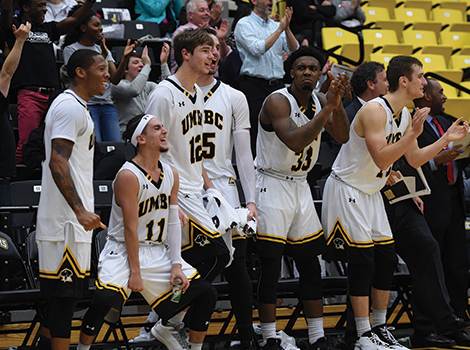
Men's Basketball
New coach Ryan Odom turned the team around in his first year, installing a fast-paced offense that took UMBC from a 7-25 team last season to a 21-13 squad that reached the College Insider Tournament semifinals and racked up the second most victories in UMBC’s 30-year Division I history.

“It was an amazing year; it was a lot of fun,” Odom said. “It was a great ride. I’m really proud of each and every one of them. It was truly an unselfish basketball club… and there’s a lot of room for growth.”

UMBC started fast, passing last year’s victory total by mid-December and going on to finish fifth in the America East with a 9-7 conference record. Odom’s new offensive style helped UMBC average 81.1 points per game, ranking them among the top 30 Division I schools in the nation.

The Retrievers lost to New Hampshire in the first round of the America East tournament before earning a CIT bid, where UMBC scored home victories over Fairfield, St. Francis, and Liberty before falling to Texas A&M University-Corpus Christi, 79-61, in the semifinal round.

Swimming and Diving
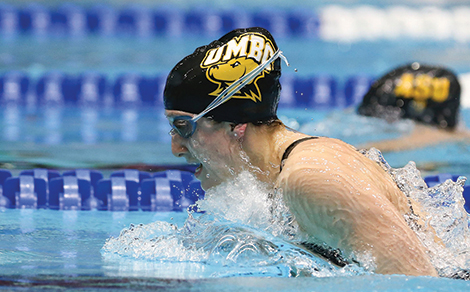
Swimming

Both men’s and women’s teams won their third straight team championships. The men captured the Coastal Collegiate Sports Association title while the women won the America East crown.

Coach Chad Cradock ’97 and his staff earned Coaching Staff of the Year honors from their conference while Lauren Day ’17 won the Elite 17 Award for the top GPA at the meet.

Senior Emily Escobedo ’17 truly had a memorable season, making the America East All-Academic team and winning her fourth America East Swimmer of the Year award plus the Dave Alexander Coaches Award, given to the person with most points scored in the meet. However, Escobedo’s biggest moments came later, when she qualified for the NCAA Championships for the fourth time. There, she took third in the 200 breaststroke, setting a new school record and earning All-American status. She also set a new UMBC records in the 100 breaststroke and 200 Individual Medley, in which she finished ninth and twelfth, respectively.

Women’s Basketball
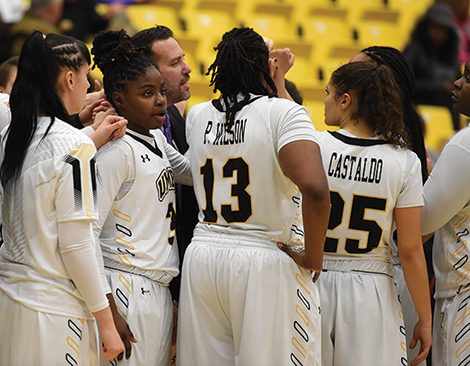
Women's Basketball

Coach Phil Stern’s team battled numerous injuries but still finished with a 15-16 record, with the Retrievers earning a second consecutive postseason bid. UMBC lost to Brown in the first round of the Women’s Basketball Invitational (WBI) tournament.

“This season was up and down due to the injuries suffered by 13 different players,” Stern said. “Once we were healthy in mid-January, we played the way I knew we could and won 10 of 11. Earning our second straight post-season bid is something to build on for next year.”

The Retrievers finished 10-6 in the America East and earned the No. 3 seed heading into the conference tournament but sixth-seeded Hartford upset UMBC in the first round. After that, the Retrievers fell to Brown (81-75) in the WBI’s opening round.

Senior Taylor McCarley ’17 led the team in scoring and earned first-team All-America East honors and also made the conference’s All-Defensive team. She ended her career ranked fourth all-time in scoring (1,449 points). Junior guard Laura Castaldo ’18 was a third-team All-America East pick while senior forward Pandora Wilson ’17 made the All-Academic team.

Indoor Track and Field

The UMBC men finished fourth, and the women ended up seventh at the America East championship meet.

For the men, the 4×400 meter relay team set a new school record with its victory in the championship meet. Jamal Cody ’19, Erick Soetje ’17, James Oakley ’18, and Darrius Oxley ’17 combined to win in a time of 3 minutes, 14.88 seconds. Cody set a UMBC record in the 400 meters at that championship meet. His time of 48.69 seconds was good enough for a third-place finish in that event. Soetje broke the school mark in the 500 meters at the IC4A championships, finishing second in 1:03.10 to earn a spot on the America East All-Academic team.

For the women, Tori Johnson ’20 was picked as the America East Most Outstanding Female Rookie.

— Jeff Seidel ’85

Grand Master
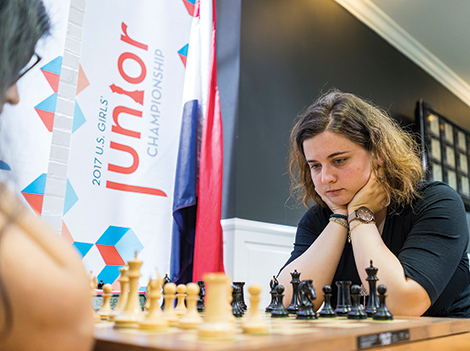
There can be only one – national women’s chess champ, that is. In April, Sabina Fiosor ’12, modern languages and linguistics, bested former UMBC player (and reigning national champ) Nazi Paikidze to be crowned U.S. Women’s Champion International master. Fellow alumnus Alexander Onischuk ’07, MLL, came in second for the men the same day. Photo courtesy of the Chess Club and Scholastic Center of Saint Louis, Lennart Ootes.

Present to the Future
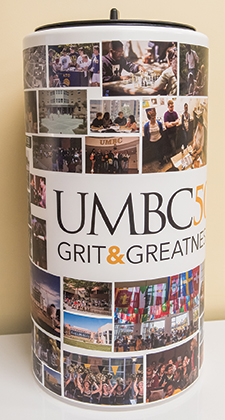
Time CapsuleFifty years from now, what will UMBC look like? Will students float around campus on Jetsons-esque jet packs? Will we all plug into teaching modules to download lessons straight into our brains, a la Asimov?

While we may not be able to predict the future, students in 2066 will be able to understand UMBC’s past thanks to a time capsule filled with artifacts from the 50th anniversary year, including a letter written by UMBC’s first graduate, Robin Mayne ’69, to the students of UMBC’s freshman class of 2016; an Election Night Extravaganza t-shirt; copies of the Retriever Weekly, including a copy of the April Fool’s Day “Deceiver” issue, and more.

“We’re hoping that in 2066, members of the UMBC community will be able to open the time capsule and learn a little about what it’s like to be a Retriever in 2016,” said Craig Berger, coordinator of student life for campus and civic engagement, who hopes to make the capsule’s burial a part of fall’s Homecoming.

Berger has been working with UMBC Special Collections to figure out the best ways of keeping items in the capsule safe while also investigating digital options to accompany the project.

While the capsule is more for fun than academic purposes, archivist Lindsey Loeper ’04 agrees that it “can generate a lot of excitement and interest about the history of the university, which is a great thing.”

— Jenny O’Grady

Alumni Awards 2017: Sylvia Trent-Adams, Ph.D. ’06, Public Policy

In the weeks leading up to the Alumni Awards Ceremony, we’ll be profiling each honoree in more detail here on our blog. Today, meet Rear Admiral Sylvia Trent-Adams, Ph.D. ’06, public policy, the current Deputy Surgeon General of the United States and our Outstanding Alumna in the Social and Behavioral Sciences.

S.Trent-Adams

Sylvia Trent-Adams, Ph.D. ’06, public policy, currently serves as the Deputy Surgeon General of the Unites States. She is a Rear Admiral (RADM) in the U.S. Public Health Service (USPHS) Commissioned Corps. In her role as Deputy Surgeon General she advises and supports the Surgeon General regarding operations of the USPHS Commissioned Corps and in communicating the best available scientific information to advance the health of the nation. She served as Acting Surgeon General from April 2017 through September 2017.

RADM Trent-Adams has held various positions in the Department of Health & Human Services, working to improve access to care for poor and underserved communities. As a clinician and administrator, she has had direct impact on building systems of care to improve public health for marginalized populations globally. She states, “The greatest success of my career has been the opportunity to assist in building programs both domestically and internationally, to serve the underserved.”

RADM Trent-Adams career spans 30 years of public service. She has served on commissions for the United Nations and the World Health Organization, worked to develop HIV/AIDS treatment plans in the U.S. and Sub-Saharan Africa, and presented her research on HIV, healthcare delivery, public health, nursing and emergency preparedness worldwide. Prior to joining the USPHS, RADM Trent-Adams was a nurse officer in the U.S. Army.

Trent-Adams holds a bachelor’s in nursing from Hampton University and a master’s in nursing and health policy from the University of Maryland at Baltimore. She was inspired to pursue her doctorate at UMBC by its “outstanding academic programs” and “the caliber of the policy faculty,” including Dr. Nancy Miller, Dr. Marvin Mandell, Dr. Kevin Eckert, Dr. Chris Hewitt, and Dr. Cheryl Miller. She often returns to campus to speak to classes and participate in panel discussions, and maintains a mentoring relationship with several undergraduate and graduate students.

As for life outside of work, she says, “I am blessed with a husband who is supportive of my career…[and] we have two amazing daughters who keep life interesting! My extended family keeps me grounded by accepting me for who I am, and constantly remind me that I am still a country girl from Virginia.”


Alumni Awards 2017: Dennis Williams II ’14, American Studies

In the weeks leading up to the Alumni Awards Ceremony, we’ll be profiling each honoree in more detail here on our blog. Today, meet Dennis Williams II ’14, American studies, head of content marketing at Skillshare and this year’s Outstanding Alumnus in the Humanities.

Near the end of his time at UMBC, Dennis Williams II ’14, American studies, had already begun to break into online media, writing professionally for Funny or Die and the Huffington Post. And in the few short years since he graduated, he’s made a name for himself in the tech industry, heading up a global content marketing team at the startup Augment, receiving an Oculus fellowship, and, most significantly, being named one of LinkedIn’s 2016 Top Voices in marketing. Williams, now head of content marketing at the online learning platform Skillshare, says the community and support he had at UMBC helped him to build his thriving career. “There were many months that I was sleeping out of my car during my time at UMBC, or pressing financially to secure all of the classes that I needed,” he writes. “It was more convenient for me to drop out, but the fortitude that I had then has essentially defined my career moving forward.” He credits fellow Alumni Award winner Dr. Kimberly Moffitt for being “a relentless support system, pushing me to persevere in class and in life,” and Dr. Ken Baron for setting him up for success as a transfer student: “He hadn’t known me beforehand, but treated me as if he had known me for the last 10 years.” In addition to his work in writing and marketing strategy, Williams is also a filmmaker: his short Note to Self, which he wrote and directed, has won three awards and was recently selected for the HollyShorts Film Festival.

Join us for the Alumni Awards Ceremony on Thursday, October 5!